Qualifications · Solar
NABCEP PV Technical Sales
Assumes you know: NABCEP PV Associate
The PV Technical Sales certification, PVTS, is NABCEP’s Board Certification for the people who sell solar: the proof that a salesperson’s proposals are technically sound, honestly priced, and real. Its signature requirement has no equivalent in any other NABCEP credential: the sales credits behind an application must show that at least half of the submitted proposals were actually sold and installed. Talk does not certify; installed systems do.
*Learn the Trades is a free study resource. We are not a licensing body, an authorized training provider, or an exam administrator. Reading this page does not award any card, license, or certification. Always verify requirements with the issuing authority linked in the sources.*Why it matters on the job
Solar sales has a reputation problem, and everyone in the industry knows it: overpromised production, fantasy payback math, contracts signed on doorsteps by reps who could not read a load calculation. PVTS exists as the counter-signal. For a customer or employer, it marks a salesperson whose numbers are held to a technical standard; for the salesperson, it is the one credential path in solar built for a career that runs on proposals rather than tools.
How the requirements work
PVTS follows NABCEP’s board pattern, verified training plus documented experience plus a proctored exam, with the experience defined in sales terms:
- Sales credits by category. The handbook defines categories of qualifying sales work, the site assessments, system proposals, and financial analyses that make up real technical selling, and applications are built from documented work across them.
- The sold-and-installed test. At least half of the proposals submitted as evidence must have been sold and installed. A stack of unsold quotes, however polished, cannot carry an application past this line.
- The exam and the cycle. The proctored board exam gates the certification, which then runs on NABCEP’s 3-year cycle with 30 hours of continuing education to recertify.
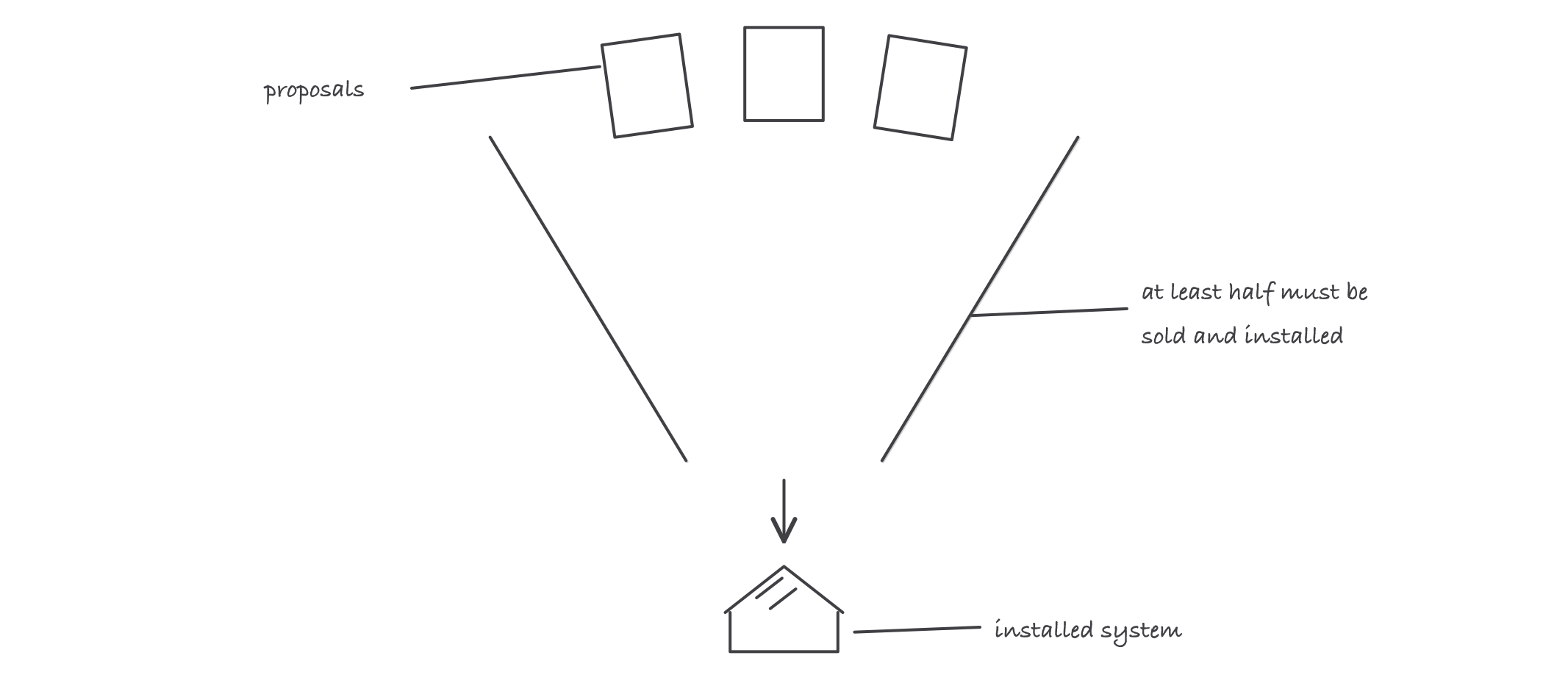
The filter that defines PVTS: proposals only count when at least half became installed systems
Worked example: auditing a sales portfolio
A residential sales consultant reviews two years of work: 60 full proposals delivered to customers, of which 24 were sold and installed. Test the ratio: 24 ÷ 60 = 0.40, or 40 percent. Submitting all 60 fails the sold-and-installed test, which requires at least half. But the requirement governs the proposals she submits, not her lifetime close rate: submitting 40 proposals that include those 24 installed systems gives 24 ÷ 40 = 0.60, and 60 percent clears the bar. The exercise also shows what the rule is really doing: it forces the portfolio toward verified, installed work, where every claimed system can be checked.
Where it bites
- Counting proposals like production. The evidence is not “how much did you quote” but “how much of what you quoted got built.” Track installs against your own proposals from day one; your employer’s CRM may not do it for you.
- Verification reaches the install. Sold-and-installed means documentation connects your proposal to a completed system. A commission statement is not a paper trail to an installed array.
- Selling past the technical line. The certification’s whole premise is technically defensible proposals. Production estimates and savings math that would not survive the design lessons in this curriculum are the thing PVTS exists to filter out.
- Letting the cycle lapse. Three years passes quickly in a commission career; the 30 recertification hours are easiest as a habit, hardest as a scramble.
Exam relevance
The PVTS exam tests the technical substance behind selling: system sizing and production estimating from the design group, financial and economic analysis, and enough code and interconnection knowledge to promise only what can be built. If you can defend every number on your own proposals, you are studying for it already.