Business · Solar
Becoming a Solar Contractor
Assumes you know: Solar Licensing by State
Becoming a solar contractor means moving from doing the work to owning the work: holding the state license that lets you contract directly with customers, pull permits in your own name, and build a company around your trade. It is the top rung of the solar career ladder, and the step where the requirements stop being about your hands and start being about your business.
Why it matters on the job
Every installer eventually notices the same thing: the person who signed the contract earns differently from the people on the roof. The Bureau of Labor Statistics counted about 28,600 solar PV installer jobs in 2024, with 42 percent projected growth from 2024 to 2034 and roughly 4,100 openings a year; the median installer wage was $51,860 as of May 2024. That growth creates room not only for installers but for the contractors who employ them, and a fast-growing trade with a licensing gate rewards the people who get through the gate early.
What the license path looks like
The exact rules depend on which licensing model your state uses (covered in Solar Licensing by State), but the contractor step has a consistent shape:
- Qualify with experience. States require documented trade experience before you may sit contractor exams. Your years as an installer and lead installer are the raw material; document them as you go.
- Pass the exams. Contractor licensing typically tests two things separately: the trade itself and business-and-law topics such as contracts, liens, and payroll obligations. The trade exam you can study for like any code exam; the business exam is new territory for most tradespeople.
- Stand up the business. Bonding, insurance, and registration requirements are set by each state board. They exist because a contractor license is permission to take customer money for future work.
- Keep it current. Renewal cycles and continuing requirements are the board’s terms, forever.
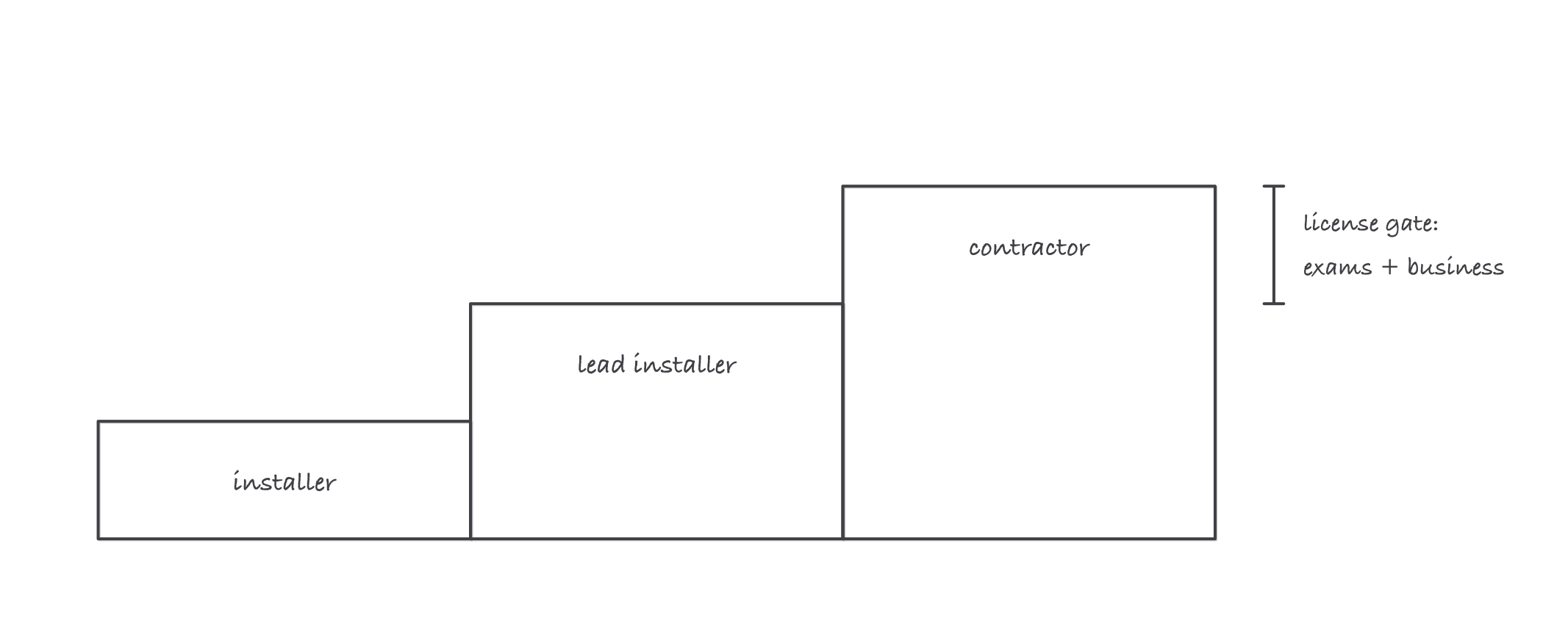
The last step up is a legal gate: exams, experience, and a business behind them
The scope-limit trade-off
A solar-only license buys focus and costs breadth. California’s C-46 Solar classification states it plainly: the contractor installs, modifies, maintains, and repairs thermal and photovoltaic solar systems, and may not perform work in other trades except where required to complete the solar installation. Cross that line (a service-panel upgrade that is not part of a solar job, unrelated electrical work) and you are contracting outside your license.
Florida shows the mirror image: its statute defines a solar contractor category, and also lets contractors certified in other categories perform solar work within their existing scope. In a state like that, your competition includes electrical and other contractors who added solar to what they already do. Where the boundaries sit in your state decides whether a solar-only license is a niche advantage or a constraint worth avoiding.
Worked example: reading a scope decision
A California lead installer is choosing a classification to test for. Her work is rooftop PV plus the occasional standalone battery retrofit and panel upgrade. Under a C-46, the PV work is squarely in scope, but non-solar electrical jobs are not; the C-10 electrical classification covers broader electrical work, and the C-46/C-10 boundary around storage is an active policy question at the CSLB. Her decision rule: list the jobs she actually wants to sell over the next five years, then pick the classification whose scope covers that list. The license is a business plan expressed as law.
Where it bites
- Experience that was never documented. Boards want verifiable records, and reconstructing years of work at application time is painful. Keep your own file from day one.
- The business exam surprises trade-strong candidates. Contracts, liens, and employment law fail more good installers than the trade content does.
- Scope creep into other trades. The narrow license makes it easy to drift out of bounds one change order at a time. Every job either fits the scope or needs a different license on the permit.
- Storage rules are moving. Battery work sits on a shifting boundary between solar and electrical scopes. What was permissible last cycle may not be next cycle; verify with the board.
Exam relevance
Contractor exams are state-specific, but the pattern holds everywhere: a trade exam built on the code and design content in this curriculum, plus a business-and-law exam that has no equivalent in installer life. Treat the business exam as its own subject, not an afterthought.