Qualifications · Masonry and Concrete
ACI Certifications
Part of Concrete Work to ACI Certification · step 15 of 22 · next: ACI Field Testing Technician Grade I: The Exam
In learning paths: Concrete Work to ACI Certification
Assumes you know: Finishing Flatwork
American Concrete Institute certifications are the credentials that project specifications name by name. When a set of documents says the slump test shall be performed by an ACI Certified Concrete Field Testing Technician Grade I, that sentence decides who is allowed to hold the cone, and no amount of experience substitutes for the card. That is the whole reason this ladder matters to a working concrete hand.
*Learn the Trades is a free study resource. We are not a licensing body, an authorized training provider, or an exam administrator. Reading this page does not award any card, license, or certification. Always verify requirements with the issuing authority linked in the sources.*Why it matters on the job
Public agencies, departments of transportation and most commercial specifications require certified technicians for acceptance testing, because the numbers those tests produce decide whether a placement is accepted, rejected or cored. Certification is also the cheapest career leverage in concrete: the field testing exams have no experience prerequisite, so a second-year hand can hold a credential that puts them on the testing side of a job.
The four programs to know
- Concrete Field Testing Technician, Grade I. Fresh concrete on the job: sampling, slump, temperature, air content, density and casting cylinders. The one specifications ask for most often, and the usual first certification.
- Concrete Flatwork. The finishing ladder, in three levels, aimed at the people who actually place and finish slabs rather than test them.
- Concrete Strength Testing Technician. Hardened concrete in the lab: breaking cylinders and beams, and the capping methods that make those breaks valid.
- Aggregate Testing Technician, Level 1. The stone and sand before they are concrete: sampling, reducing samples and gradation.
Field testing and flatwork have their own lessons next; the two lab programs share one after that.
The pattern all four share
Once you have seen one ACI program you can predict the others:
- A written exam plus a performance exam. The written exam checks whether you know the standard; the performance exam checks whether you can execute it in front of an examiner. Passing one is not passing the program.
- The exams are built directly on ASTM and AASHTO test methods. You are not being tested on concrete in general: you are being tested on named procedures, clause by clause.
- Usually no experience prerequisite. Field testing, strength testing and aggregate testing are open to anyone who registers and can perform the methods.
- Time-limited certification. Field testing, flatwork and strength testing certifications run for five years; check the program’s own policy for the term on any other program before you assume it.
- Recertification means the exams again. For field testing you sit both exams a second time. Flatwork offers a continuing education plus work hours alternative to re-sitting the performance exam.
The naming trap
The programs do not share a level vocabulary, and the words are not interchangeable:
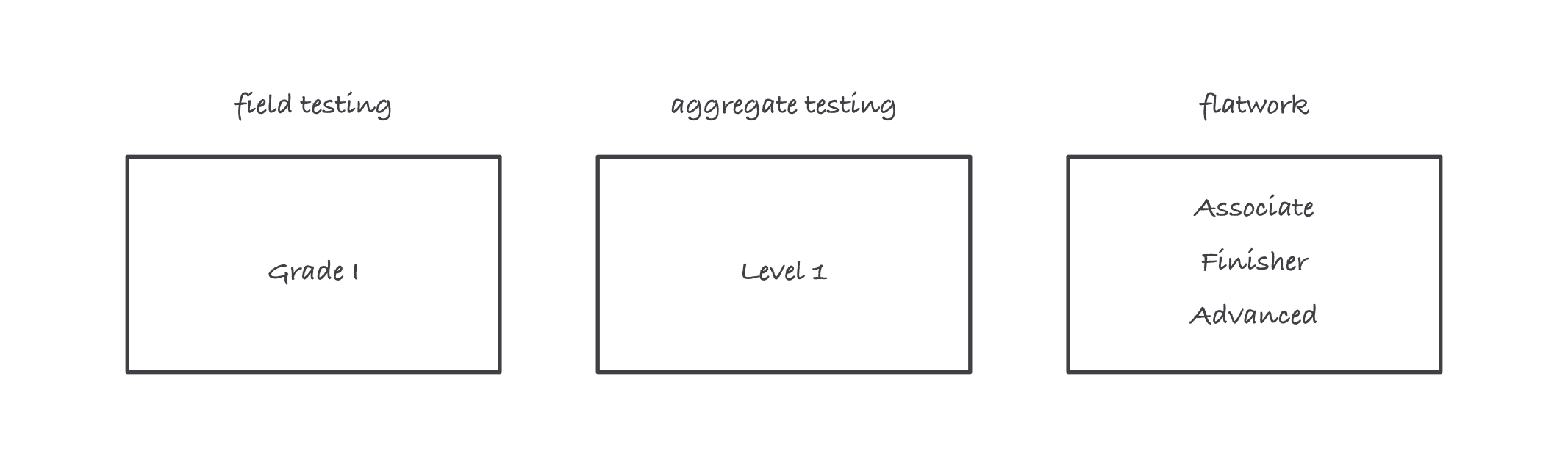
Three programs, three different words for a level: Grade, Level and named tiers are program-specific and never synonyms
Field testing counts in Grades, and Grade I is the entry level. Aggregate and laboratory testing count in Levels (Level 1, Level 2). Flatwork uses named tiers (Associate, Finisher, Advanced Finisher). A resume line reading “ACI Level 1 certified” tells a hiring foreman nothing, because there is no such thing on its own: name the program, then the level.
Which one first
Start from the work you do, not the ladder’s shape:
- You place and finish slabs. The flatwork ladder describes your job, and the Finisher level is built around proving hours you are already accumulating.
- You want to move toward testing, inspection or QC. Field Testing Grade I first, every time. It is the specified credential. It has no prerequisite, and the lab certifications build on the same standards habits.
- You work in a testing laboratory. Strength testing and aggregate testing are the lab pair, and they are usually held alongside field testing rather than instead of it.
Where it bites
- Certified and qualified are different words. Certification proves you can execute the method to the standard. It does not license you to design a mix, accept a placement or overrule an engineer, and the exam will not teach you the judgment that experience does.
- The certification belongs to you, not your employer. It travels between jobs, which is the point, but so does the expiry date. Diary it five years out on the day you pass.
- “ACI certified” on its own is not a claim. Specifications name a program and a grade or level. Write yours out in full on any resume or prequalification form.
- The written exam is the smaller half. People with years on the tools fail performance exams for procedural reasons (wrong rod count, wrong strike-off, wrong timing) because on-site habits drift from the written method. The exam scores the method, not the result.
Verified requirements
| Where | Expires | Renewal | Continuing education |
|---|---|---|---|
| United States (federal) | Yes | 5 years | Confirm with issuer |
| United States (federal) | Yes | 5 years | Recertification: pass the performance exam again, OR 10 hours of approved continuing education plus 1,500 additional hours of verified finishing work within the previous 5 years |
| United States (federal) | Yes | 5 years | Confirm with issuer |
| United States (federal) | Confirm with issuer | Confirm with issuer | Confirm with issuer |
Information comes from issuing-authority sources. Confirm current rules, fees and eligibility with the authority before acting.