Learn · Low Voltage and Telecom
Navigating NFPA 72: Finding Answers Fast
Part of Fire Alarm Technician, NICET Track · step 5 of 11 · next: Fire Alarm Inspection, Testing and Maintenance
In learning paths: Fire Alarm Technician, NICET Track
Assumes you know: NFPA 72 Basics
NFPA 72, the National Fire Alarm and Signaling Code, is organized so that a person who knows its structure can find any requirement in under a minute, and a person who does not can lose ten. Fire alarm exams are open-book against the clock, and field disputes get settled by whoever can put a finger on the governing chapter first. Navigation is a skill, and it is learnable in an afternoon.
*Learn the Trades is a free study resource. We are not a licensing body, an authorized training provider, or an exam administrator. Reading this page does not award any card, license, or certification. Always verify requirements with the issuing authority linked in the sources.*Why it matters on the job
You will never memorize NFPA 72, and no one expects you to. What separates a Level II candidate who finishes the exam from one who runs out of clock, and a tech who wins the argument with an inspector from one who concedes it, is knowing which chapter owns which question. The code’s structure is the index in your head; everything else is looking it up.
The shape of the book
The 2025 edition groups its chapters by function:
- Front matter chapters: administration, referenced publications, and definitions (Chapter 3). Definitions are a destination, not a formality: exam questions turn on defined terms.
- Fundamentals (Chapter 10): the baseline requirements that apply across systems, the general rules a specific chapter modifies.
- Hardware and pathways: circuits and pathways (Chapter 12, home of the pathway class designations), initiating devices (Chapter 17), and notification appliances (Chapter 18).
- Systems: protected premises fire alarm systems (Chapter 23), emergency communications systems (Chapter 24), supervising station alarm systems (Chapter 26), and single- and multiple-station alarms and household systems (Chapter 29).
- Inspection, testing and maintenance (Chapter 14): everything recurring, with the frequency tables.
- Annexes: explanatory material, not enforceable requirements. Annex A expands numbered sections; an “A.” reference explains, it does not bind.
Note the numbering gaps: NFPA 72 reserves chapter numbers, so the sequence has holes by design. A missing chapter number is not a missing chapter in your copy.
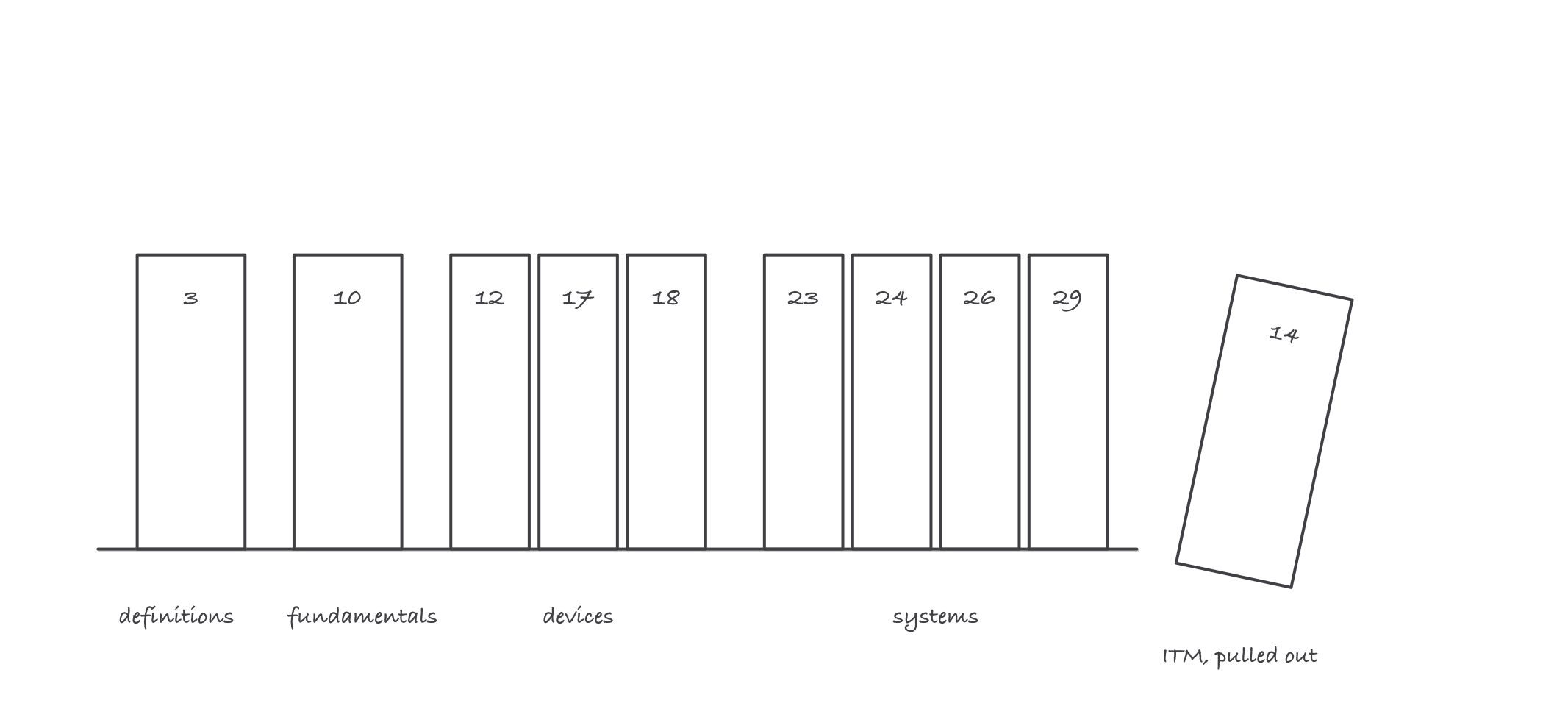
Learn the shelf, not the pages: five groups hold the whole code
The lookup method
For any question, run the same three steps:
- Classify the question: system, component, or activity. “What does a household smoke alarm need?” is a system question (Chapter 29). “How must this heat detector be spaced?” is a component question (Chapter 17). “How often is this tested?” is an activity question (Chapter 14).
- Go to the owning chapter first, fundamentals second. The specific chapter states or modifies the rule; Chapter 10 backstops what the specific chapter leaves general.
- Check the definition and the annex. If a term is doing heavy lifting, confirm it in Chapter 3; if the requirement seems ambiguous, see whether Annex A explains the intent.
Worked lookup, exam style: “On which circuit class may a notification appliance circuit operate with a single open?” Classify: that is a pathway question, so Chapter 12 owns the class designations, and the system chapter, 23, governs their application to the circuit in question. Two chapters, one answer, no page-flipping through detector spacing on the way.
Tabbing for the exam
Tab the book by the groups above, not by every section you ever highlighted: definitions, fundamentals, 12, 14, 17, 18, 23, and the system chapters your exam level emphasizes. A dozen tabs you know beats fifty you have to read. Then drill: take practice questions and log which chapter answered each one until classification is reflex.
Where it bites
- Editions matter. Chapter organization has been stable in recent editions, but jurisdictions adopt specific editions, and the one your AHJ enforces may not be the newest. Confirm the adopted edition before quoting section numbers at anyone.
- Annex material is not code. Citing Annex A as a requirement is a classic exam trap and a faster way to lose an argument with an inspector.
- The signaling half is in scope. Emergency communications systems are part of the code, and NICET content reaches into them; do not treat the book as fire alarm only.
Exam relevance
Open-book NICET exams give you roughly a minute and a half per question; the navigation method above is how that budget gets met. Examiners reward candidates who classify first and read second, because that is exactly the skill the job needs.