Learn · Low Voltage and Telecom
Pathways, Spaces and Firestopping
Assumes you know: Structured Cabling Overview
Pathways are the routes cable travels (conduit, cable tray, J-hooks, sleeves); spaces are the rooms it starts and ends in (entrance facility, equipment room, telecom rooms). The jacket on the cable must match the airspace the pathway crosses, and every hole a pathway makes in a fire-rated wall or floor must be sealed back to its rating. Those two rules, jacket ratings and firestopping, are where cabling work meets the building’s fire safety.
Why it matters on the job
Pulling cable is most of an installer’s day, and inspectors do not check your terminations: they check your pathways. Wrong jacket in a plenum, an unsealed penetration through a rated floor, or a tray stuffed past its fill are the violations that stop a job. They are also the mistakes that turn a cable installer into the reason smoke spread between floors.
Ratings: what jacket goes where
Communications cable jackets are listed by where they may burn:
- CMP (plenum) for air-handling spaces: the ducts and open ceiling or floor cavities that move building air. Plenum jacket produces less smoke and resists flame spread.
- CMR (riser) for vertical runs between floors, typically in shafts or riser sleeves.
- CM (general purpose) for ordinary spaces on one floor.
The hierarchy substitutes downward: CMP can go anywhere CMR or CM can, CMR can substitute for CM, never the reverse.
The trap is in the names. Plenum is about airspace, not altitude: a first-floor ceiling that returns air to the HVAC system is a plenum and demands CMP. Riser is about floor-to-floor penetration, not “being upstairs”.
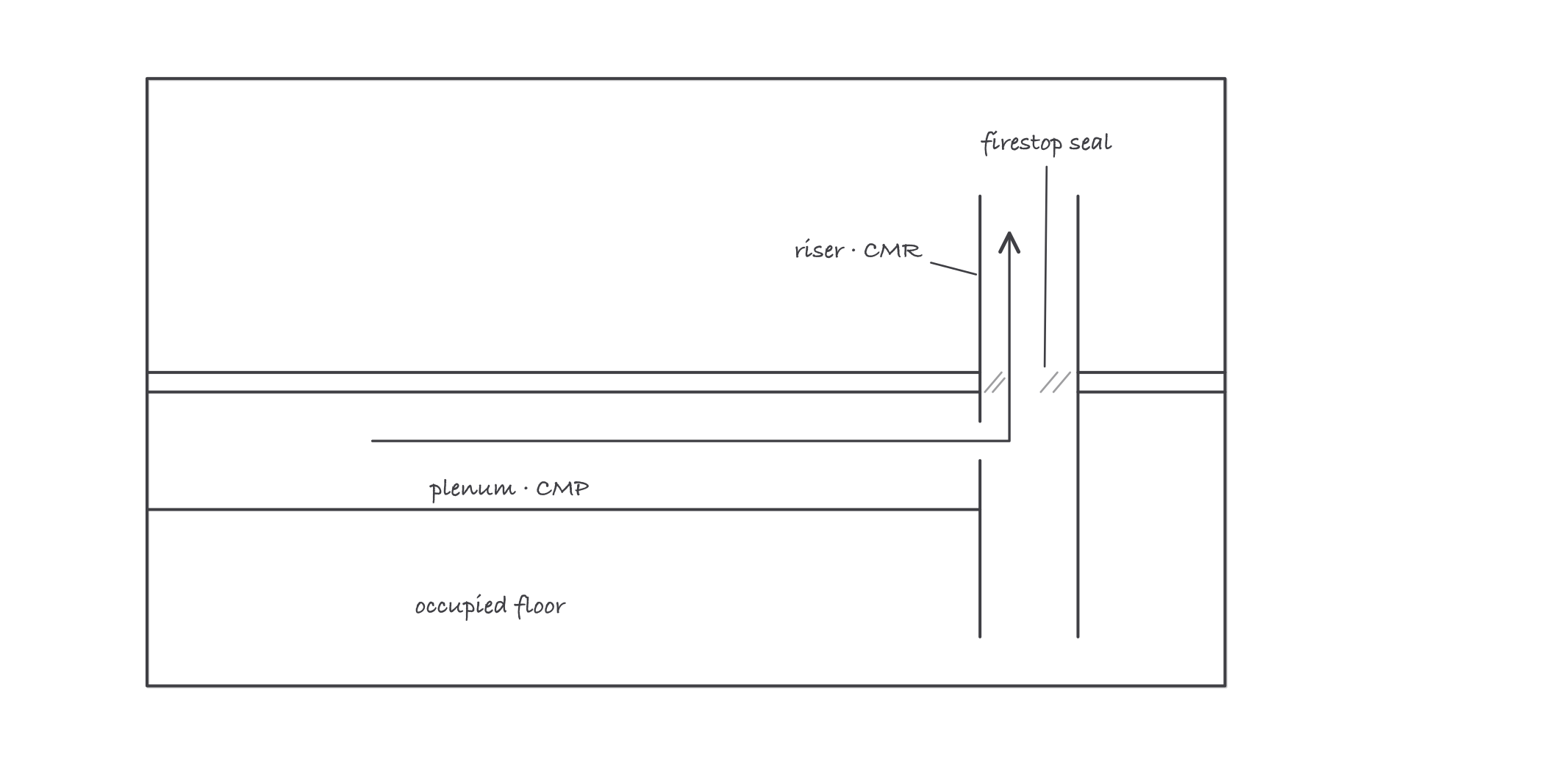
The airspace decides the jacket: plenum cavities take CMP, floor-to-floor shafts take CMR, and every rated penetration gets sealed
Firestopping
Fire-rated walls and floors exist to contain fire and smoke for a rated time. Every sleeve, conduit, or cable bundle that penetrates one defeats that containment until the penetration is sealed with a listed firestop system: the tested combination of sealant, putty, pillows, or devices matched to that wall type, that penetrant, and that annular space. You install to the listed system’s details, photograph it, and label it. Generic caulk or spray foam is not firestopping, whatever color it is.
Worked example
A run of 36 cables goes from the second-floor TR to offices on the first floor. The route: 8 m across the second-floor ceiling (which returns air, so it is a plenum), down a riser sleeve through the rated floor, then 40 m along the first-floor corridor on J-hooks in a non-plenum ceiling.
- Jacket: the route crosses a plenum, and one pull uses one cable. CMP satisfies the plenum segment and substitutes for CMR in the sleeve and CM in the corridor, so the whole run is CMP.
- Supports: J-hooks at 1.5 m intervals over the 40 m corridor: 40 ÷ 1.5 = 26.7, so 27 hooks, plus one within 300 mm of the turn at each end per the layout drawings.
- Firestop: the riser sleeve penetrates a rated floor, so the annular space and the sleeve get sealed per the listed system for that assembly, and the seal gets re-done any time cables are added.
Where it bites
- “Riser cable for upstairs” is the classic wrong model. Plenum and riser describe airspaces and penetrations, not floor levels.
- Firestop is a listed system, not a product. The same tube of sealant is compliant in one assembly and worthless in another. The listing details govern.
- Abandoned cable is a real obligation. Cable that is no longer terminated and not tagged for future use is generally required to be removed where accessible. Budget the demo, not only the pull.
- Fill limits are for pulling and heat, not neatness. An overstuffed pathway damages cable on the pull and traps heat in service.