Learn · Low Voltage and Telecom
Access Control Systems
Assumes you know: Structured Cabling Overview
An access control system decides who gets through which door, and when, and it writes down every attempt. At each controlled door, a reader takes a credential (card, fob, PIN, or phone), a controller checks it against its database, and an electric lock releases if the answer is yes, while a door position switch and a request-to-exit device watch the door itself. Multiply that by every controlled opening, tie the controllers to a server or cloud host, and you have the system.
Why it matters on the job
Access control is steady, growing low-voltage work that combines cabling skill with door hardware, networking, and life safety. It is also the security discipline where a wiring mistake can lock a person in a building, which is why the egress rules below are not optional knowledge. Installers who understand the whole door, not only the reader, are the ones trusted to commission systems.
The parts of one door
- Reader: takes the credential and passes it to the controller. Modern readers are moving to encrypted credential formats; the trade lesson is that reader and credential must speak the same format.
- Controller: the decision-maker, usually in a secured closet, holding the database of who may open what and when. Doors keep working from the controller’s local database even when the head-end server is unreachable.
- Electric lock: an electric strike releases the latch’s keeper; a magnetic lock (maglock) holds the door with an electromagnet. The choice drives the life-safety design.
- Door position switch (DPS): reports open or closed, which is how the system knows about a propped or forced door.
- Request to exit (REX): a motion sensor or bar that tells the controller “someone is leaving”, so the exit does not log as a forced door, and, with maglocks, actually releases the lock.
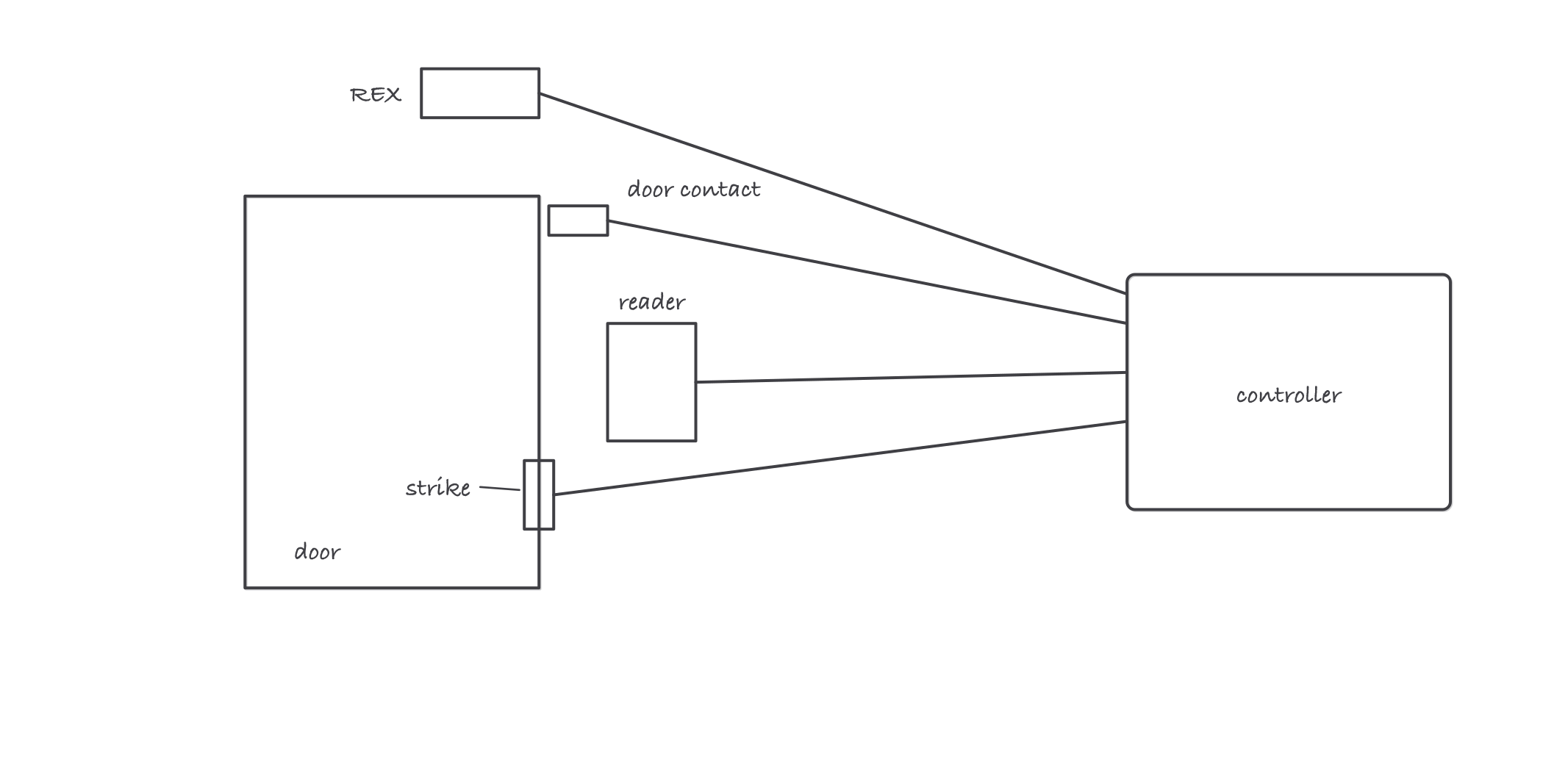
Everything at the opening reports to the controller: reader in, lock power out, DPS and REX watching the door
Fail-safe, fail-secure, and egress
- Fail-secure hardware stays locked when power fails: the standard choice for strikes on perimeter doors, because the mechanical latch still lets people leave.
- Fail-safe hardware unlocks when power fails: maglocks are inherently fail-safe, and fire-rated stairwell doors often require fail-safe locking for reentry.
The immovable rule above all hardware choices: people must always be able to leave freely. Egress is life safety, governed by the building and fire codes, and a maglock installation lives or dies by its release provisions (REX plus the required egress hardware, and unlock on fire alarm where required). Wiring that traps an occupant is the one mistake this trade does not forgive.
Worked example: sizing a door power supply
A 4-door system runs on a 12 V DC power supply rated 2.0 A, with battery backup. Each door carries a strike drawing 0.25 A and a reader drawing 0.12 A.
- Per door: 0.25 + 0.12 = 0.37 A
- All doors: 4 × 0.37 = 1.48 A
- Loading: 1.48 ÷ 2.0 = 74% of the supply’s rating. Workable, but note there is little room to add a fifth door.
- Battery standby, for a 4-hour requirement from the design brief: 1.48 A × 4 h = 5.92 Ah, so the next standard size up, a 7 Ah battery, backs the supply.
Strikes that only energize momentarily draw less over time, but you size for the worst case: every strike held open at once.
Where it bites
- Fail-safe and fail-secure get swapped in speech and in orders. Confirm which one the opening needs before hardware hits the frame, and think through what the door does during a power failure and a fire alarm.
- The REX is not a courtesy. Without it, every legitimate exit logs as a forced door, and on a maglock the REX chain is what makes the door legal at all.
- This work is often licensed as security work, not electrical work. In Texas, for example, access control installers fall under the Department of Public Safety’s private security program, with company affiliation and fingerprint background checks, separate from the electrical licensing board. Check your state’s security or alarm board before assuming an electrical license covers it.
- The door is a system. A perfect reader install with a misaligned strike is a door that does not work. Walk the whole opening: frame, hinge, latch, closer, then electronics.