Qualifications · Low Voltage and Telecom
NICET Fire Alarm Levels I-II: Exams and Work History
Part of Fire Alarm Technician, NICET Track · step 9 of 11 · next: NICET Fire Alarm Levels III-IV: Recommendations and the Major Project
In learning paths: Fire Alarm Technician, NICET Track
Assumes you know: NICET Fire Alarm Certification (Levels I-IV)
NICET Fire Alarm Levels I and II are the working technician’s rungs of the ladder: the levels employers expect field staff to hold, and the ones most people earn while still building their first years of experience. Each is an exam plus a documented work history, and the pairing is deliberate: the exam proves knowledge, the work history proves you have applied it.
*Learn the Trades is a free study resource. We are not a licensing body, an authorized training provider, or an exam administrator. Reading this page does not award any card, license, or certification. Always verify requirements with the issuing authority linked in the sources.*Why it matters on the job
Level I and Level II are the levels that appear in field-staff requirements: specs and employers commonly expect installers and service techs at these levels. They are also the cheapest and fastest credentials in the program, which makes them the natural first target once you have real fire alarm hours behind you.
The two exams
| Level | Questions | Time | Fee |
|---|---|---|---|
| I | 85 | 110 min | $235 |
| II | 110 | 155 min | $325 |
Fees took effect August 1, 2026. The pacing math is worth doing before exam day. Level I gives you 110 minutes for 85 questions: 110 / 85 = 1.29 minutes per question, call it 78 seconds. Level II gives you 155 minutes for 110 questions: 155 / 110 = 1.41 minutes per question, about 85 seconds. Neither exam leaves room to hunt through NFPA 72 from scratch on every question; you have to already know where answers live.
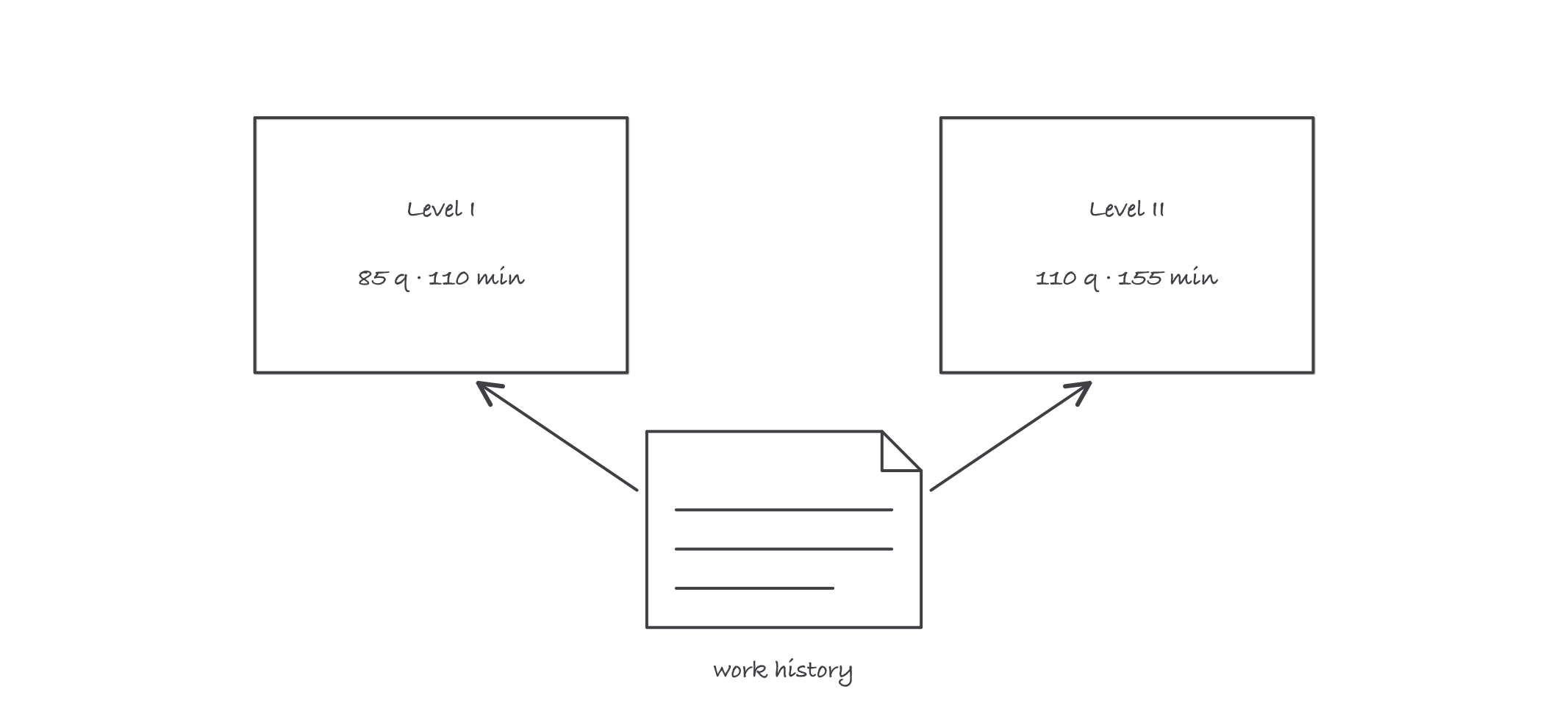
The exam is the visible half; the documented work history underneath it is required at both levels
The work history document
Both levels require a documented, verifiable work history alongside the exam. In practice that means project dates, the kind of fire alarm work performed, and verification from people in a position to know, typically supervisors. Start the document now, whatever level you are targeting:
- Log projects as you finish them: site, dates, your role, the systems and tasks involved.
- Capture verifier contact details while you still work with them. The supervisor who can vouch for your 2024 hours may be unreachable by 2027.
- Keep it factual and specific. “Installed and tested initiating devices on a 4-story office retrofit, March-June” beats a job title every time.
Reaching Level II: the worked numbers
Suppose you are starting from zero certifications. Exam fees alone: $235 for Level I plus $325 for Level II is $560 across the two levels, before any study materials or employer reimbursement. Testing time: 110 + 155 = 265 minutes of examination, about 4.4 hours total, spread over two sittings. The gating item is rarely the money or the seat time; it is having a work history strong enough to document, which you cannot buy or cram.
Where it bites
- The exam is only half the application. Candidates who pass the exam but cannot document their work history do not hold the certification. Nothing about the exam result changes that.
- Recertification starts immediately. Both levels sit on the program’s three-year cycle with continuing professional development to log. Build the habit at Level I.
- Level II is not “Level I but harder” in content alone. It assumes broader responsibility across installation and service work, and the work history you submit has to show it.
Exam relevance
These exams are the reason the life-safety lessons in this trade exist in the shape they do: fire alarm fundamentals, initiating and notification devices, circuit classes and supervision, and NFPA 72 itself. Study the code by structure, not by page: the navigation lesson shows how to find answers inside a minute, which is roughly the budget these exams give you.