Learn · Low Voltage and Telecom
Structured Cabling Overview
Structured cabling is the standardized copper and fiber wiring that carries a building’s networks: data, phones, Wi-Fi access points, cameras, access control, and a growing share of building systems. “Structured” is the operative word. Instead of running a separate wire for every gadget, you install one standardized infrastructure of outlets, horizontal cable, and telecom rooms, and every system plugs into it.
Why it matters on the job
This is the bread-and-butter work of the low-voltage trade. Installers pull, terminate, and label thousands of cable runs; technicians test and certify them. Because the infrastructure is standardized, a run you install today must work for equipment nobody has invented yet, which is why the standards, not the gear on site, decide how you install.
The standard model
Every structured cabling system is a star. Each work area outlet (the jack at the desk or the ceiling box feeding a camera) gets its own dedicated cable running back to a telecom room (TR) on the same floor. In the TR, runs land on patch panels, and patch cords connect them to network switches.
Telecom rooms connect to each other and to the main equipment room through backbone cabling, usually fiber, sometimes copper. Backbone handles room-to-room; horizontal cabling handles TR-to-outlet. The two are designed, installed, and tested differently, so keep the vocabulary straight from day one.
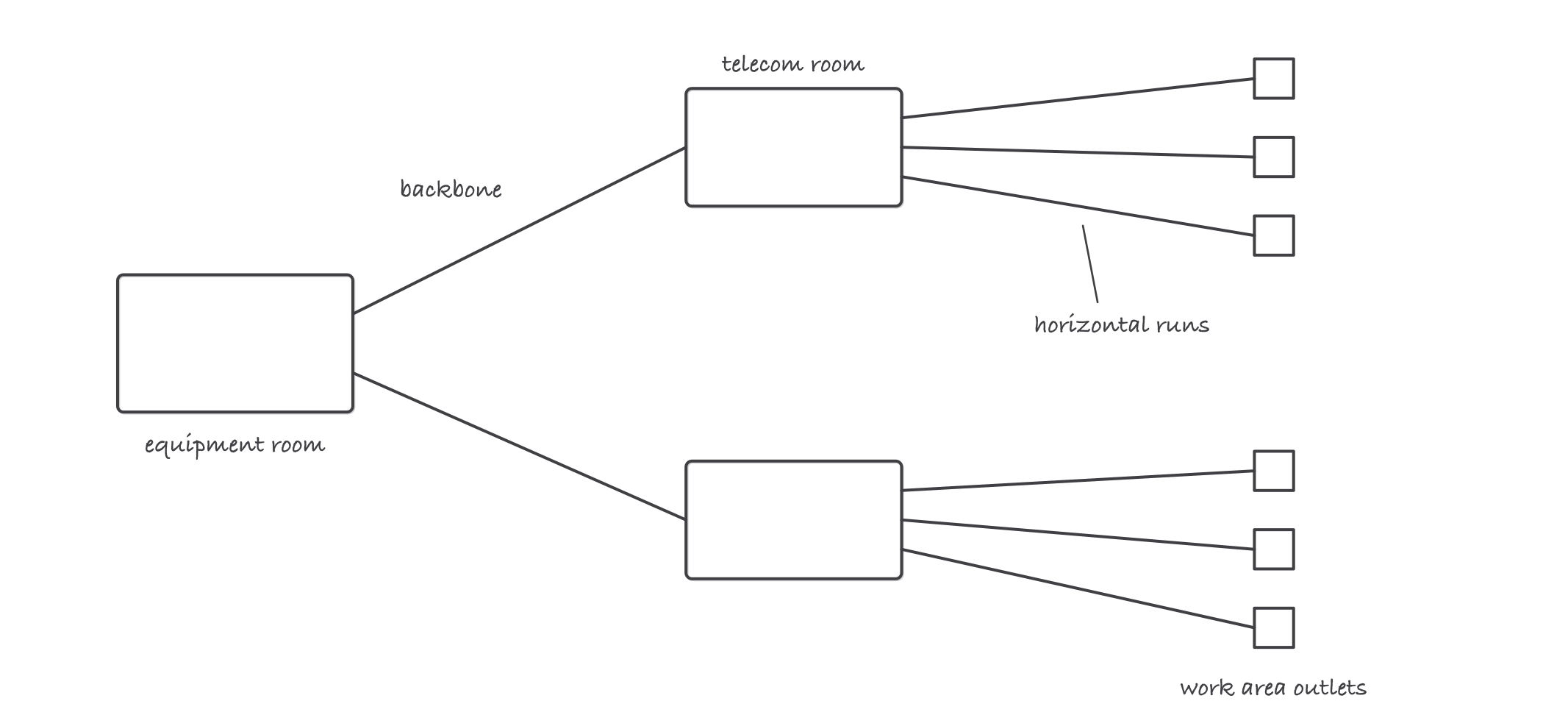
Every outlet homes to its telecom room; telecom rooms home to the equipment room
The controlling number in horizontal design is the channel: the whole path from switch to device, patch cords included, is limited to 100 m. The fixed cabling in the wall (the permanent link) gets 90 m of that, which leaves 10 m for the patch cords at both ends.
Worked example
An office floor has 24 rooms, and the design calls for 2 drops per room.
- Drop count: 24 × 2 = 48 runs, so one 48-port patch panel (or two 24-port panels) in the TR.
- Cable estimate: the average run scales at 45 m, plus 5 m per run for service loops and termination slack, so 50 m per run.
- Total cable: 48 × 50 = 2,400 m. Cable ships in 305 m boxes: 2,400 ÷ 305 = 7.87, so order 8 boxes.
Every one of those 48 runs gets tested and labeled individually. The labeling scheme is not decoration: it is how the next technician finds anything.
The trade
BLS tracks this work under telecommunications technicians, with a median wage of $64,310 (May 2024). Employment is projected to decline about 3% from 2024 to 2034, yet roughly 23,200 openings appear each year because retiring and transferring workers must be replaced. The realistic pitch is steady replacement demand, not a growth boom.
Where it bites
- “Low voltage” has no single legal definition. California’s C-7 classification caps at 91 V; Oregon’s limited energy licenses cap at 100 volt-amperes, a power limit, not a voltage; Washington defines its 06 specialty by circuit type. Never say “low voltage means under X volts” without naming the state.
- The standard outlives the equipment. Install to the standard’s distances and practices even when today’s device “works fine” on a sloppy run. The next device may not.
- Horizontal and backbone are different disciplines. Distance limits, media choices, and test methods all differ. Answers that are right for one are wrong for the other.
Exam relevance
The BICSI installer ladder starts here. Installer 1 (INST1) is an entry-level certificate with no experience prerequisite, and BICSI describes it as non-renewable; the INSTC, INSTF, and Technician credentials above it recertify on 3-year cycles. Their exams lean on exactly this material: the star model, the 100 m channel, the split between horizontal and backbone, and the names of the spaces.