Learn · Low Voltage and Telecom
Copper: Categories, Termination, Testing
Assumes you know: Structured Cabling Overview
Category cable is 4 twisted pairs of copper in one jacket, and the category number (Cat5e, Cat6, Cat6A) is a performance promise: how much bandwidth the pairs can carry, over what distance, with how much resistance to interference. The twisting is the whole trick. Each pair is twisted at a different rate so the pairs reject outside noise and leak less signal into each other.
Why it matters on the job
You will terminate more 8-pin jacks and patch panels than any other connector in your career. Termination quality is invisible to the eye and decisive on the tester: a run that looks fine can fail certification because of 2 cm of sloppy untwist. Knowing what each category actually promises also keeps you from installing the wrong cable, which is the most expensive mistake in the trade because the fix is a re-pull.
What the categories promise
- Cat5e supports 1 Gb/s Ethernet to the full 100 m channel. Still common in existing buildings.
- Cat6 supports 1 Gb/s to 100 m with more headroom. It does not make a building “10 Gig ready”: 10GBASE-T on Cat6 works only over sharply limited distances.
- Cat6A supports 10 Gb/s to the full 100 m channel. When the spec says 10 Gig, this is the copper that delivers it.
Higher categories are backward compatible, and the channel rule from the overview lesson still governs: 90 m of permanent link, 10 m of patch cords, 100 m total.
Termination
Jacks and panels wire to one of two pinout maps, T568A or T568B. Both work; mixing them on one run gives you crossed pairs. Pick the scheme the site already uses and stay consistent.
The physical rules matter more than the map. Keep each pair twisted to within 13 mm of the termination point, do not strip more jacket than the termination needs, respect the cable’s bend radius, and never exceed the pulling tension the manufacturer rates. Every one of those abuses shows up later as a failed or marginal test.
Worked example
A design calls for 10 Gb/s to a lab bench 82 m from the telecom room.
- Media: 10 Gb/s at 82 m rules out Cat6, so the run is Cat6A.
- Permanent link: 82 m ≤ 90 m, within limits.
- Patch cords: 3 m at the panel + 4 m at the bench = 7 m.
- Channel: 82 + 7 = 89 m ≤ 100 m. The design passes on paper; certification testing proves it in copper.
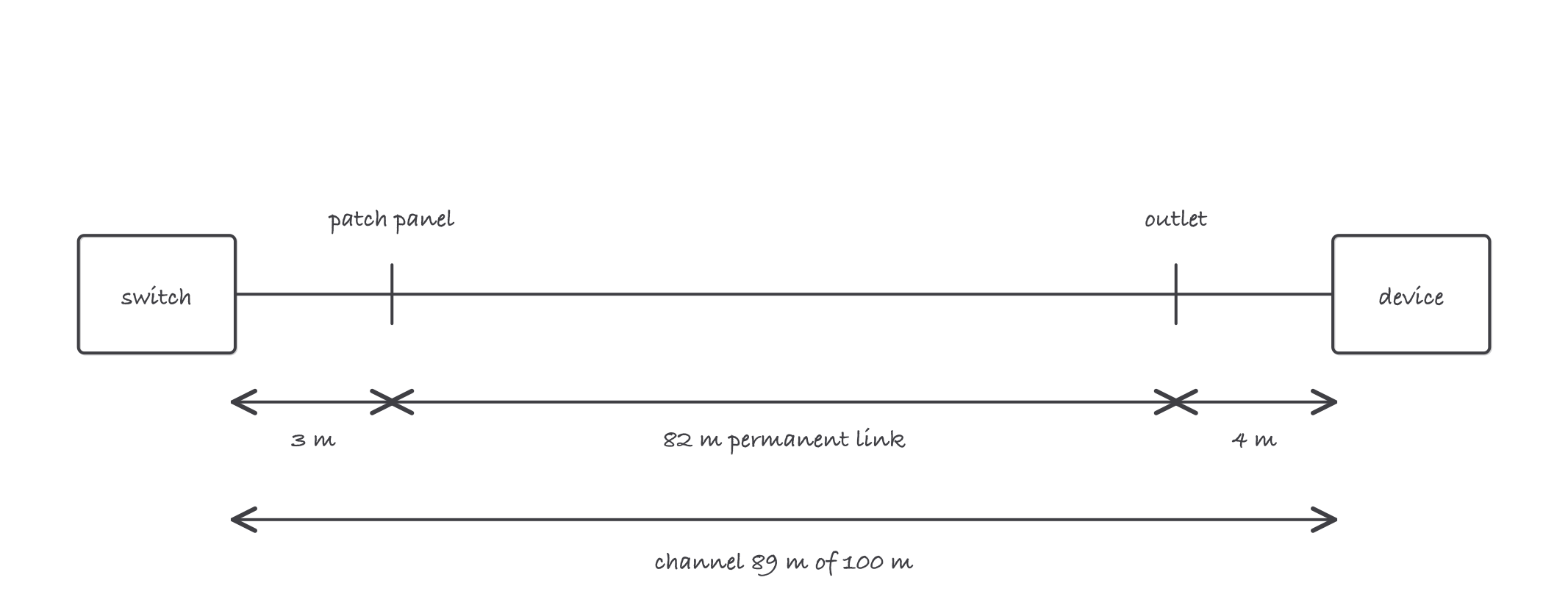
The permanent link gets 90 m; cords get the last 10 m; the channel never exceeds 100 m
Where it bites
- Three unrelated “class/category” systems collide in this trade. Cat5e/6/6A are copper performance categories. NEC Class 2 and Class 3 are power-limited circuit types. NFPA 72 Class A/B/N/X are fire alarm pathway designations. Merging them is the classic rookie confusion.
- Vendor copy blurs Cat6 and 10 Gig constantly. Our rule stands: full-distance 10GBASE-T means Cat6A.
- Damage is invisible. Kinks, crushed jacket under a tight zip tie, and over-tension during the pull all pass a visual check and fail the tester.
Exam relevance
The BICSI INSTC (Installer 2, Copper) credential tests exactly this scope: category performance, pinouts, termination discipline, and the distance rules. Expect questions that hinge on which category supports which speed at which distance, and on the 90 m/10 m split of the 100 m channel.