Learn · Low Voltage and Telecom
Video Surveillance Systems
Assumes you know: Structured Cabling Overview
An IP video surveillance system is a network application: cameras are network devices that stream compressed video, a recorder (NVR or server-based VMS) stores and indexes the streams, and the cabling between them is the same structured cabling you learned in the cabling group, usually delivering power to the cameras over the data cable itself (PoE). Design a surveillance system well and you have really designed three budgets: coverage, power, and storage.
Why it matters on the job
Camera work rides directly on cabling skill: every camera is a horizontal run, a termination, and a certification test, plus mounting, aiming, and commissioning. The technicians who can also carry the PoE arithmetic and the storage math are the ones who design small systems instead of only pulling cable for them.
Coverage: cameras and lenses
A camera’s usefulness is pixels on target. Resolution spread across a wide scene identifies nothing; the same resolution narrowed onto a doorway reads faces. Fixed cameras watch one scene; varifocal lenses let you tune the view at install; PTZ (pan-tilt-zoom) cameras patrol but only see where they point. The design habit that matters: define what each camera must accomplish (observe a lot, or identify at a choke point) before choosing the camera, and confirm it on the monitor at commissioning, at night too.
Power: PoE budgets
PoE switches power cameras through the data cable, and two limits apply at once:
- Per port: the camera’s demand must fit what the port type delivers. In this example system, standard ports deliver up to 15.4 W at the source and higher-power ports up to 30 W.
- Total: every switch has a power budget shared across all ports, and it is almost always less than every port maxed at once.
Worked example: one switch, twenty cameras
A 24-port PoE switch with a 370 W total budget serves 16 fixed cameras at 6.5 W each and 4 PTZ cameras at 25.5 W each.
- Fixed: 16 × 6.5 = 104.0 W
- PTZ: 4 × 25.5 = 102.0 W
- Total: 104.0 + 102.0 = 206.0 W ≤ 370 W. The budget fits with headroom.
- Per-port check: 25.5 W exceeds 15.4 W, so the 4 PTZ cameras must land on the higher-power 30 W ports. The total budget passing does not waive the per-port limit.
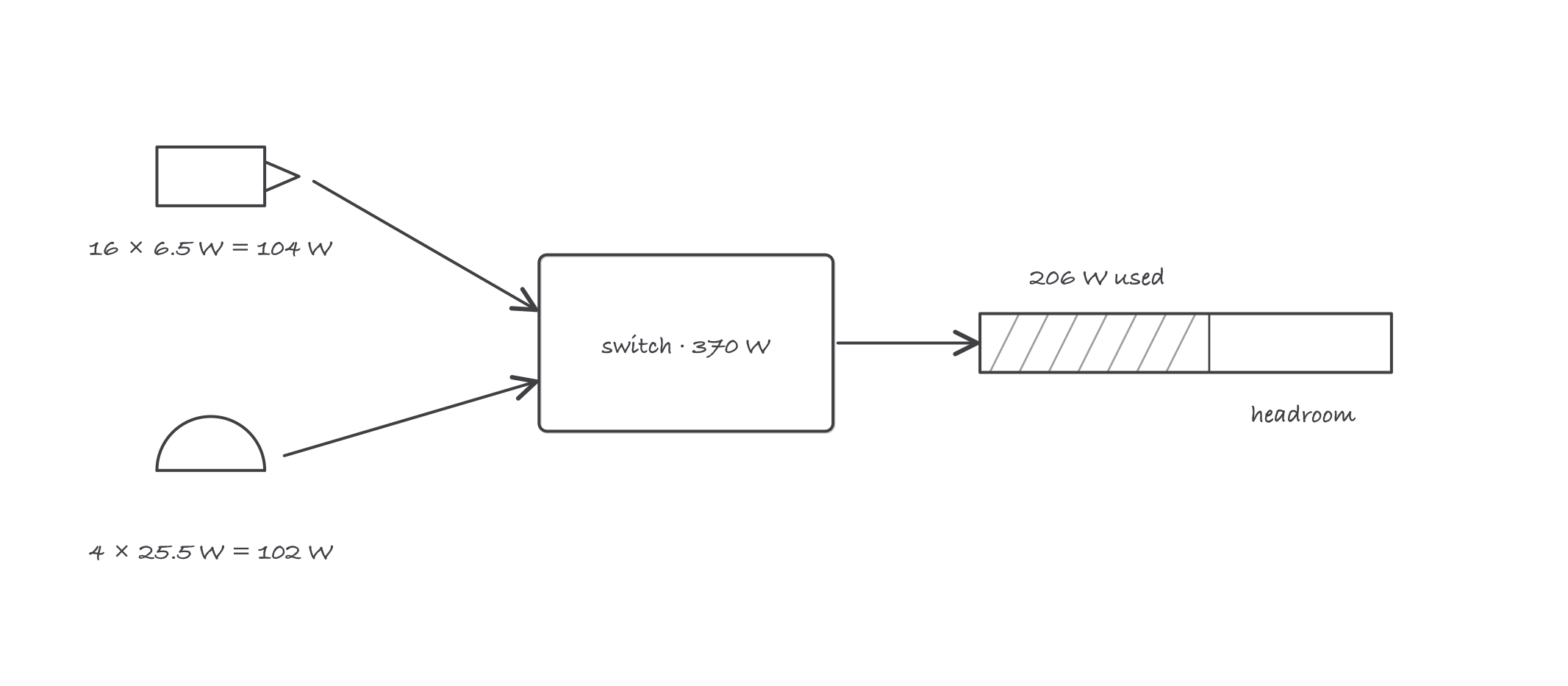
Two limits at once: the whole switch shares 370 W, and each camera must also fit its own port’s class
Storage rides the same style of arithmetic. The same 20 cameras streaming 4 Mb/s each produce 20 × 4 = 80 Mb/s, which is 10 MB/s. A day is 86,400 s: 10 × 86,400 = 864,000 MB, or 864 GB per day. A 30-day retention requirement means 30 × 864 = 25,920 GB, roughly 26 TB before overhead. Bitrate assumptions drive everything: double the bitrate and the storage doubles.
Where it bites
- The 100 m channel limit still applies. A camera is a network device on a horizontal run. The parking lot pole 160 m out needs fiber with a media converter or PoE extender in the design, not hope.
- IR at night raises power draw. A camera specified from its daytime figure can brown out when the infrared illuminators switch on. Budget the listed maximum.
- Recording people has legal boundaries. Audio recording in particular is regulated differently from video in many places, and camera views into private areas cause real trouble. Camera aim is a design decision the client signs off, in writing.
- Storage math is honest; marketing is not. Retention promises made without the bitrate arithmetic fail in week two. Run the numbers in front of the client.