Learn · Low Voltage and Telecom
Power-Limited Circuits and Cable Ratings
Part of Fire Alarm Technician, NICET Track · step 7 of 11 · next: NICET Fire Alarm Certification (Levels I-IV)
In learning paths: Fire Alarm Technician, NICET Track
Assumes you know: Structured Cabling Overview
Power-limited circuits are why low-voltage cable can run in bundles through a ceiling without conduit: the power source is limited by design so the circuit cannot deliver enough energy to start a fire or, in the strictest class, to injure a person. The National Electrical Code trades that guaranteed limitation for relaxed wiring rules, and the cable jacket’s listing decides where the cable may physically run.
Why it matters on the job
Every structured cabling, security and control installation leans on this bargain. Understand it and you know why your Cat6 needs no breaker-sized conductors, why the plenum spool costs more, and why an inspector can make you rip out a run whose terminations were flawless. The jacket listing, not the signal on the cable, is what passes or fails the rough-in.
Class 2 and Class 3: the circuit side
The NEC defines power-limited circuit classes, covered in Chapter 7 (Article 725 in recent editions):
- Class 2 circuits are limited such that they are considered safe from both fire initiation and electric shock. Thermostat wiring, most security devices, PoE data circuits: the everyday low-voltage world is largely Class 2.
- Class 3 circuits carry more energy: still fire-safe by limitation, but enough that shock is a consideration, so slightly stricter rules apply.
The limitation lives in the listed power source (a transformer, power supply or listed equipment output designed so a fault cannot push the circuit past its class limits). That is the deal: because the source physically cannot deliver dangerous energy, the code does not demand power-circuit wiring methods downstream of it.
NEC Class 2/3 (circuit power limits), copper cable categories like Cat6 (transmission performance), and NFPA 72 Class A/B/N/X (fire alarm pathway survivability) are three unrelated classification systems. Merging them is the fastest way to talk nonsense fluently.
Jacket listings: the cable side
Where a cable may run is set by its fire-related listing, printed on the jacket. For communications cable the ladder is:
- CMP (plenum): listed for spaces handling environmental air, ducts and plenums, because it is built to limit flame spread and smoke.
- CMR (riser): listed for vertical runs between floors, built to resist carrying fire floor to floor.
- CM (general purpose): everything less demanding.
Substitution runs strictly downward: a higher listing may stand in for a lower one, CMP anywhere CMR or CM is required, CMR where CM is required, never the reverse.
The classic wrong model is “plenum cable for the ceiling, riser cable for upstairs”. Plenum is about airspace, not floor level: a ceiling void used for return air is a plenum on any floor, and a hallway ceiling that is not air-handling may need no plenum cable at all. Riser is about vertical shafts penetrating floors. Ask “what does this space do”, not “where is it”.
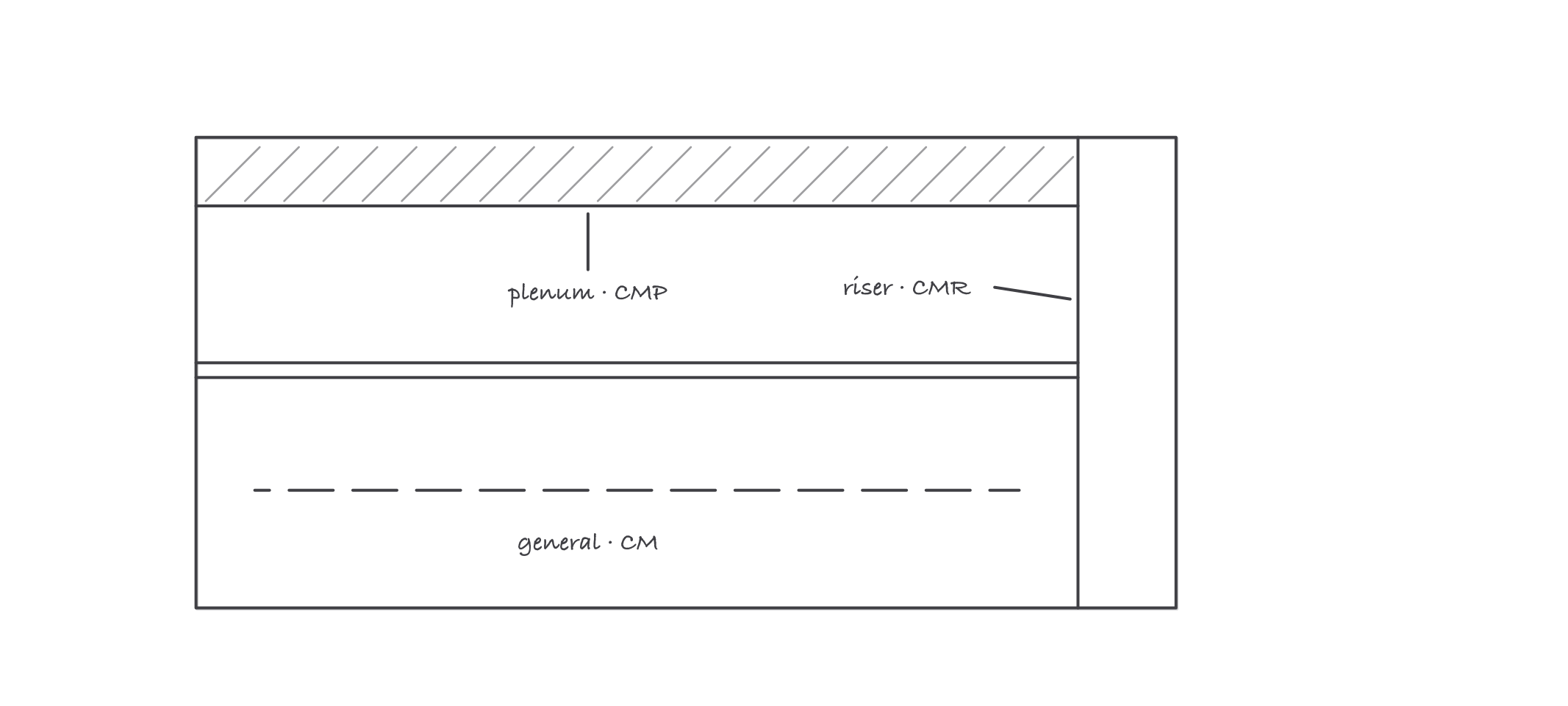
The space’s function, air handling, floor-to-floor shaft, or neither, picks the jacket
Worked example: one pull, three spaces
You are pulling a camera drop from a first-floor equipment room to a third-floor exterior wall. The route: across the first-floor ceiling void, which the mechanical drawings show as a return-air plenum, up a riser shaft to the third floor, then across a non-plenum ceiling to the camera.
Work the listing per segment: the plenum segment demands CMP; the shaft demands at least CMR; the last segment needs only CM. You cannot change jackets mid-pull, so the whole run must satisfy the strictest segment. Substitution runs downward, so one CMP pull covers all three spaces: CMP satisfies the plenum requirement outright, and stands in for CMR in the shaft and CM in the ceiling. The buying decision follows: for this route you order plenum cable for the full length, and the premium over CM is the cost of the mechanical engineer’s return-air design, not of your cabling design.
Where it bites
- The drawings, not the ceiling tiles, tell you what is a plenum. Air handling is a mechanical design fact; verify it before you order cable, because the jacket is unfixable after the pull.
- Power limitation comes from the listed source, not the low voltage. A circuit fed from an unlisted supply is not a Class 2 circuit no matter what voltage it runs at; the class is a property of the source and its listing.
- Separation rules still apply. Power-limited conductors keep their relaxed rules partly by staying separated from electric light and power conductors; mixing them in raceways and boxes is restricted. When your run has to share space with power wiring, that is a code question to answer, not a judgment call.
- Edition drift. Article numbering and class details evolve between NEC editions; your jurisdiction’s adopted edition governs. Verify against the code your inspector carries.
Exam relevance
Limited-energy licensing exams and cabling certifications both probe this material: the meaning of Class 2 versus Class 3, the CMP/CMR/CM hierarchy and substitution direction, and the plenum-is-airspace distinction. If an exam question pairs a space with a jacket listing, decide what the space does before you look at the answer options.