Learn · Low Voltage and Telecom
Intrusion Detection
Assumes you know: Access Control Systems
An intrusion detection system (a burglar alarm) is a panel that watches sensors grouped into zones, and raises local and monitored alarms when a zone opens while the system is armed. The sensor set is small and standard: magnetic contacts on doors and windows, passive infrared (PIR) motion detectors for interiors, glassbreak detectors for window lines, and a keypad for arming. The craft is in the zoning, the supervision, and the entry logic, and the business is wrapped in state licensing that often lives outside the electrical board entirely.
*Learn the Trades is a free study resource. We are not a licensing body, an authorized training provider, or an exam administrator. Reading this page does not award any card, license, or certification. Always verify requirements with the issuing authority linked in the sources.*Why it matters on the job
Alarm work is high-volume, service-heavy low-voltage work: many small systems, recurring monitoring revenue, and constant service calls. A technician who zones a system so an alarm names a place, and who wires supervision so cut wires announce themselves, builds systems that dispatch correctly. One who does not builds false-alarm machines, and false alarms carry fines and lost police response in many jurisdictions.
Sensors and where they belong
- Magnetic contacts: a magnet on the door, a switch on the frame. Opening the door separates them. The perimeter workhorse.
- PIR motion detectors: sense a moving heat signature. Interior coverage, mounted to face across the likely path rather than head-on toward it, and kept away from heat sources that false them.
- Glassbreak detectors: listen for the frequency signature of breaking glass, covering a window line a contact cannot.
- Shock/vibration sensors: feel an attack on the surface itself, used on high-risk openings.
Perimeter sensors catch entry; interior sensors catch presence. A sound design layers both, so defeating one layer still trips the next.
Zones: making the alarm mean something
A zone is the panel’s unit of location. Put the whole building on two zones and “Zone 1” tells the monitoring center nothing worth dispatching on; give each opening or area its own zone and the operator can say exactly what opened and in what order. Zone types carry behavior too: an entry/exit zone grants delay time to disarm, an interior follower stays quiet during that delay, and a 24-hour zone (panic, tamper) is armed no matter what the keypad says.
Supervision uses the same end-of-line resistor logic as fire alarm circuits: a resistor at the last device lets the panel distinguish normal, open, and shorted loop, so a cut wire is a trouble, not a silence.
Worked example: zoning a small office
An 8-zone panel protects an office with 2 doors, 6 windows in two rooms, and 2 open work areas.
- Front door contact: zone 1, entry/exit with delay (staff disarm at the keypad inside).
- Rear door contact: zone 2, instant (nobody legitimately enters there first).
- Windows, room A (3 contacts in series on one supervised loop): zone 3, instant.
- Windows, room B (3 contacts in series): zone 4, instant.
- PIR, work area 1: zone 5, interior follower.
- PIR, work area 2: zone 6, interior follower.
- Glassbreak covering the storefront line: zone 7, instant.
- Zone 8: spare for the next request, because there is always a next request.
Seven zones used, and every alarm names a place: “zone 4” sends a responder to room B’s windows, not on a lap of the building.
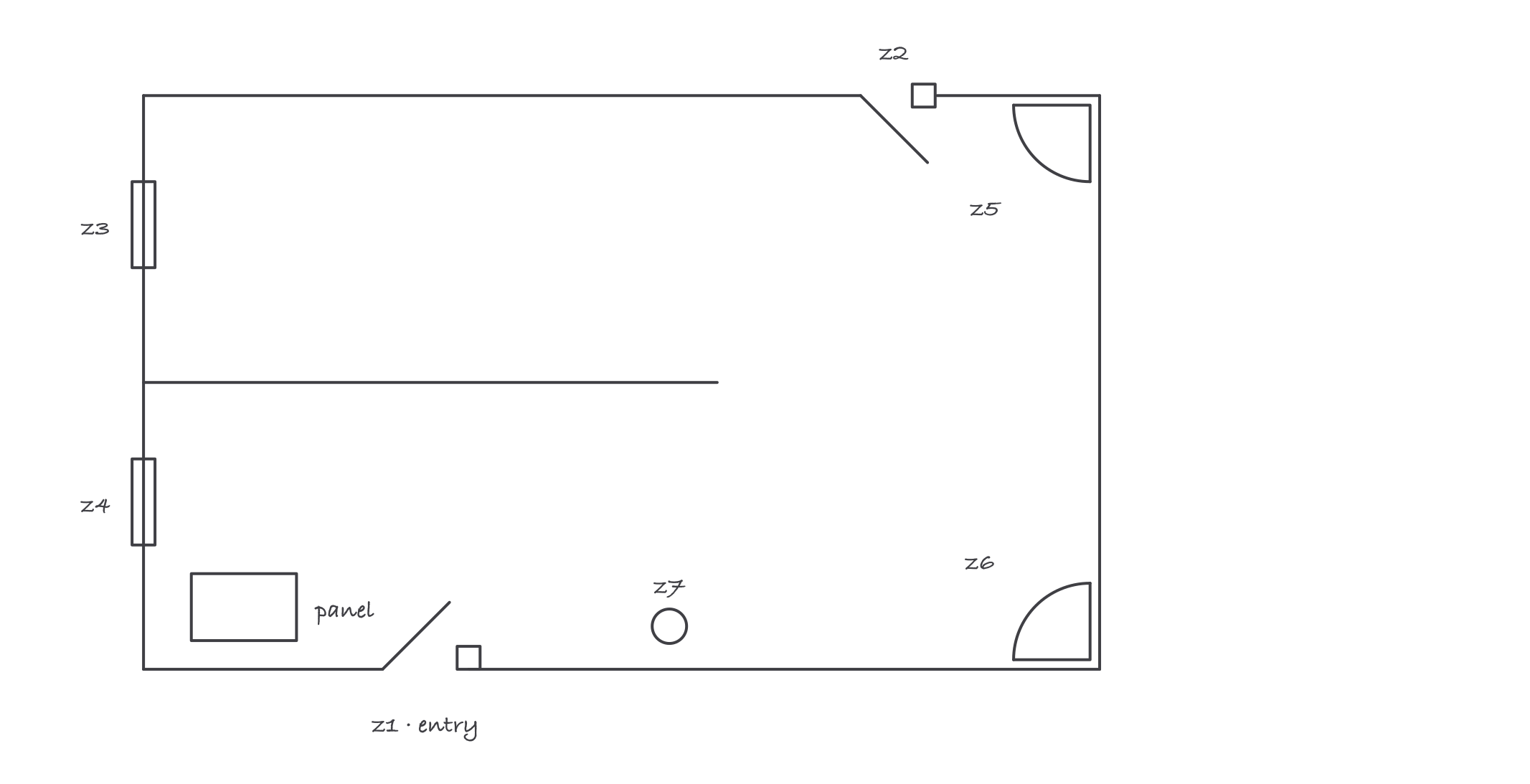
One zone per answerable question: which opening, which room, which area
Licensing: check the security board, not only the electrical board
Where it bites
- False alarms are the product failing. Many cities require alarm permits and fine repeat false alarms, and chronic offenders lose priority response. Sensor placement, zone logic, and user training are the fixes, in that order.
- A siren is not monitoring. Local-only systems make noise; monitored systems get response. The communicator (cellular or IP today, phone line historically) and its supervision are part of the install.
- Series contacts trade cost for information. Looping 3 windows on one zone saves wire and spends location detail. Decide deliberately, and never loop unlike things (a door and a motion) onto one zone.
- PIRs false on heat, not on ghosts. Sun through glass, heaters cycling, and pets account for most motion falses. Placement is the cure.
Exam relevance
States that license this work through limited-energy or alarm-specific credentials test the practical core: sensor application, supervised loop behavior with end-of-line resistors, zone types (entry/exit, follower, 24-hour), and the licensing structure itself. Exam formats and requirements vary by state, so let your state board’s candidate bulletin, not a national summary, define what you study for the legal portion.
Verified requirements
| Where | Expires | Renewal | Continuing education |
|---|---|---|---|
| Washington | Yes | Confirm with issuer | Confirm with issuer |
| Oregon | Yes | 3 years | Confirm with issuer |
| California | Yes | Confirm with issuer | Confirm with issuer |
| Texas | Yes | Confirm with issuer | Confirm with issuer |
| Florida | Yes | Confirm with issuer | Confirm with issuer |
Information comes from issuing-authority sources. Confirm current rules, fees and eligibility with the authority before acting.