Qualifications · Ironworking
Welding Endorsements for Ironworkers
Part of Ironworker, Steel and Rebar · step 23 of 25 · next: Running Work: Foreman and Beyond
In learning paths: Ironworker, Steel and Rebar
Most structural connections in the field are bolted, and 1926.756 is written around bolts for that reason. The ones that are welded are welded to a procedure, by a welder who has demonstrated they can produce a sound weld in that position and configuration. Welding is the endorsement that widens what an ironworker can be sent to do, and the AWS Certified Welder program is the portable version of that demonstration.
*Learn the Trades is a free study resource. We are not a licensing body, an authorized training provider, or an exam administrator. Reading this page does not award any card, license, or certification. Always verify requirements with the issuing authority linked in the sources.*Why it matters on the job
A welding endorsement changes which calls you can take. Joist attachments, moment connections, embed plates, stair and rail work, repair and retrofit work: all of it needs someone who can weld to a procedure and prove it. In a small trade with cyclical work, being the hand who can both connect and weld is the difference between being dispatched and waiting.
Two different things called a welding test
An employer or contractor qualification test is the one most ironworkers take first. The employer tests you to the welding procedure specification for that project, in the positions and processes the work requires, and the resulting qualification belongs to that employer and that procedure. Change employers or change procedures and you test again. It is fast and usually free to the welder. It does not travel.
The AWS Certified Welder program is the portable version. You test at an AWS Accredited Test Facility to an AWS Standard Welding Procedure Specification, or to another industry-recognized specification, or to a company or non-code procedure. The result is recorded in a national registry, which is what makes it verifiable by an employer who has never met you.
The program covers a wide range of work, including structural steel, sheet metal, petroleum pipelines, pressure vessels and chemical refinery construction. What you hold is specific: a process, a position, a material and a thickness range, not a general license to weld anything.
The continuity requirement
This is the part that catches people, and it is the one operational duty the program puts on the welder.
The certification is kept active by filing a maintenance form every six months. File it and the certification stays active with no expiry date attached. Miss it and the certification goes inactive, and getting back to active means retesting rather than paying a late fee.
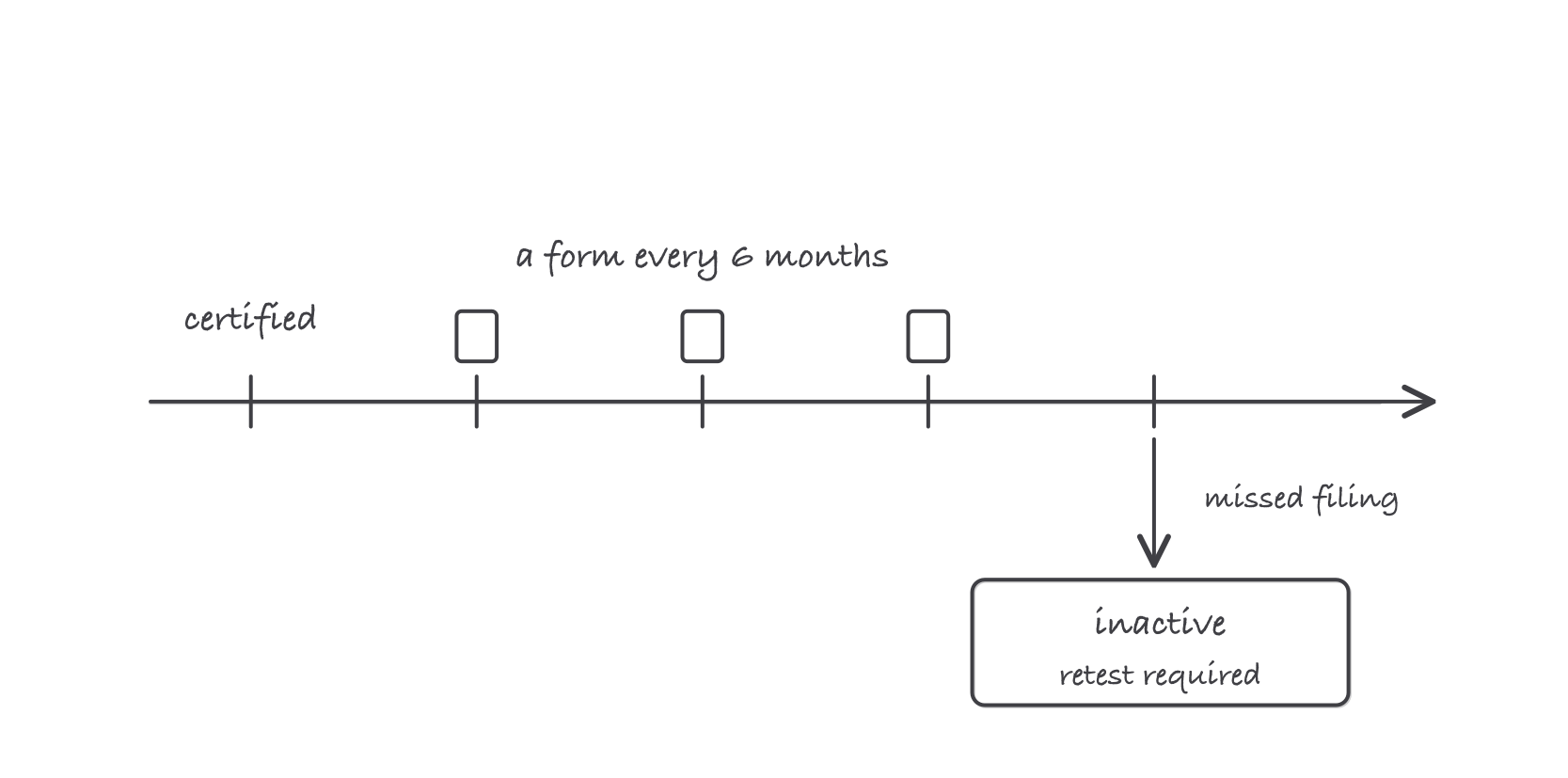
The certification has no expiry date and no renewal cycle; it has a filing you either keep making or you do not
Worked example
Take a welder who tests and is certified on 15 January 2026. Map the obligation across five years.
The maintenance form falls due every six months, so the filing dates are 15 July 2026, 15 January 2027, 15 July 2027, and so on.
Filings in five years: 5 years × 2 per year = 10 filings.
Now compare two histories.
- Welder A files all 10. At the five-year mark the certification is still active, on the strength of the original test and ten pieces of paper. Nothing was ever retaken.
- Welder B files the first two, then changes address and misses the filing due 15 July 2027. The certification goes inactive at that point, 18 months after testing. Restoring it means going back to an Accredited Test Facility and welding the test again.
Welder B lost the certification without ever welding a bad weld. Put the six-month filing in a calendar on the day you pass, not the first time you need the paperwork.
The inspection side
The Certified Welding Inspector is the credential on the other side of the weld: the person who checks it. Ironworkers meet a CWI on any structural job with welded connections, and moving to CWI is a recognized route out of the tools later in a career. It is a different qualification with its own examination and its own requirements, and it is worth knowing about early even if it is a decade away.
For the code itself, AWS has authored more than 350 standards covering welding practice and procedure, including D1.1, the structural welding code for steel. Field welding on a building is done to the project’s welding procedures, which are written against a code like D1.1 rather than invented on site.
Exam relevance
The AWS Certified Welder test has no written component to study for, which is the point of calling it performance-based. What it tests is whether you can lay a sound weld to the specified procedure, in the specified position, and have it pass the specified examination. Preparation is bench time in the position you intend to test in, on the material thickness you intend to be qualified for, using the same process and consumables the procedure calls out. Practicing flat and testing overhead is how people fail.
Where it bites
- A qualification is process, position and material specific. Passing in one position does not qualify you in another. Read what your paperwork actually covers before you accept a call that assumes more.
- Employer qualifications are not portable and AWS certification is. Both are legitimate; they answer different questions. Knowing which one you hold matters when you change employers.
- Rebar is not general structural steel. Welding reinforcing bar is governed by its own procedure requirements and is not a field decision. That applies on the rebar side of the trade specifically.
- Continuity lapses quietly. There is no warning, no grace and no renewal notice built into the structure of the program. The filing is yours to remember.
Verified requirements
| Where | Expires | Renewal | Continuing education |
|---|---|---|---|
| United States (federal) | No | Confirm with issuer | Confirm with issuer |
Information comes from issuing-authority sources. Confirm current rules, fees and eligibility with the authority before acting.