Business · Ironworking
Getting Into an Ironworker Apprenticeship
Part of Ironworker, Steel and Rebar · step 25 of 25
In learning paths: Ironworker, Steel and Rebar
An ironworker apprenticeship is a paid job with school attached. You are hired, you work on the tools from the first week, and the classroom hours and the field hours both count toward completion. Nothing about it resembles paying tuition and hoping for a job at the end.
*Learn the Trades is a free study resource. We are not a licensing body, an authorized training provider, or an exam administrator. Reading this page does not award any card, license, or certification. Always verify requirements with the issuing authority linked in the sources.*Why it matters on the job
The apprenticeship is the whole entry route into this trade. There is no exam you can study your way into, no certificate that substitutes for it, and no reliable way to accumulate the hours informally. Getting in is the hard part, and staying in is a matter of showing up, which is why programs screen for reliability at least as hard as for aptitude.
How the hours stack up
The US Department of Labor’s national guideline standards of apprenticeship for iron workers set the shape of a program:
- A minimum of 204 hours of related classroom instruction for each year of the apprenticeship.
- A maximum of 2,000 on-the-job training hours per year.
Local programs build their own term length on top of that, and the International recommends that locals consider the four-year shape. Because both figures are per year, the term length does all the arithmetic.
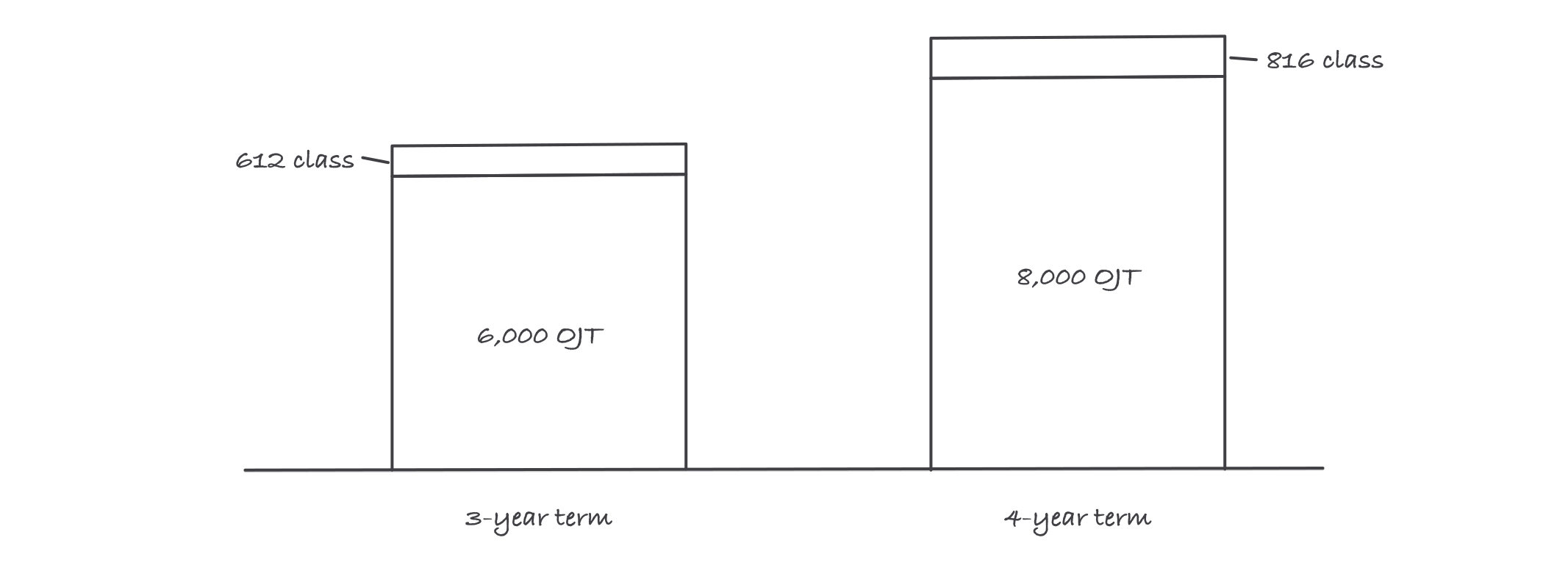
Both figures are annual, so the term length sets the totals
Worked example: three years against four
A three-year term.
- Classroom: 3 × 204 = 612 hours.
- On the job: 3 × 2,000 = 6,000 hours.
- Total: 612 + 6,000 = 6,612 hours.
A four-year term.
- Classroom: 4 × 204 = 816 hours.
- On the job: 4 × 2,000 = 8,000 hours.
- Total: 816 + 8,000 = 8,816 hours.
Now the ratio, which is the part worth carrying. Classroom as a share of the three-year total is 612 / 6,612 = 0.0926, so 9.3 percent. For the four-year term, 816 / 8,816 = 0.0926, so 9.3 percent again. The share never moves, because both inputs scale with the same number of years. This trade teaches roughly nine parts field to one part classroom no matter how long the term runs.
Put the classroom figure on a calendar and it stops sounding heavy: 204 / 52 = 3.9 hours a week averaged across a year, which most programs deliver as evening classes or as blocks of full days rather than a few hours every week.
Treat these as the national guideline figures, not as your program’s numbers. Registered programs vary by local and by state registration agency, and the sponsor publishes the term length, the schedule and the wage progression that actually apply to you.
What programs ask for
Entry requirements are set by each registered program, whether that is a local joint apprenticeship committee or a nonunion sponsor, and they are published by the sponsor rather than by any national body. Expect the application to cover minimum age, education, documentation and physical ability to perform the work, and expect the specifics to differ between two locals in the same state. Get the list from the program you intend to apply to, in writing, before you assemble anything.
What is consistent across programs is what gets you selected and kept: attendance, a clean drug screen, reliable transportation to a job that moves, comfort at height for structural work, and the physical durability to do it again tomorrow. Applications often run on a cycle with a limited intake, so missing the window costs you a year.
What the trade looks like on the other side
BLS counts 85,100 ironworkers in the US in 2024 across the two occupations, structural and reinforcing. The projection is 4 percent growth from 2024 to 2034, with about 7,000 openings a year. Against 85,100 workers, 7,000 / 85,100 = 0.082, so roughly 8 percent of the trade’s positions open annually, and most of that comes from workers leaving the occupation rather than from new positions being created.
Practically, that means the intake is steady rather than booming, and it also means the work is cyclical and geographic. Ironworkers follow the steel, and the willingness to travel is part of the job description in most of the country.
Where it bites
- “Licensed ironworker” is not a thing. No state licenses the trade and no state examines it, so any offer built around getting you licensed as an ironworker is describing something that does not exist.
- Completion is recorded, not awarded by a school. The registration agency records the completion of a registered program. A private course is training, and training is not the apprenticeship.
- Hour requirements are per year, and terms differ. Reading “6,000 hours” somewhere does not tell you what your local requires. The term length is the variable.
- Reinforcing and structural are separate paths from early on. Decide which one interests you before you apply, because programs and locals specialize.
- Getting in is a campaign, not an application. Intake cycles, waiting lists and interviews mean the useful preparation starts months before the window opens.
Verified requirements
| Where | Expires | Renewal | Continuing education |
|---|---|---|---|
| United States (federal) | Confirm with issuer | Confirm with issuer | Confirm with issuer |
Information comes from issuing-authority sources. Confirm current rules, fees and eligibility with the authority before acting.