Qualifications · Industrial Maintenance
The CMRT Certification
Part of Maintenance Tech to CMRP · step 26 of 30 · next: Vibration Analyst Certification and ISO 18436
In learning paths: Maintenance Tech to CMRP
Assumes you know: Preventive Maintenance
The Certified Maintenance and Reliability Technician is SMRP’s credential for the person doing the work. It covers four hands-on domains, runs on the same administrative machinery as the CMRP, and is aimed squarely at the technician on the floor rather than at the planner or the manager.
*Learn the Trades is a free study resource. We are not a licensing body, an authorized training provider, or an exam administrator. Reading this page does not award any card, license, or certification. Always verify requirements with the issuing authority linked in the sources.*Who it is for
The CMRT is written for maintenance technicians, millwrights, industrial machinery mechanics and the multi-craft maintenance workforce. The content is what you do with your hands and your instruments, which makes it the natural certification for someone who intends to stay technical rather than move into planning or management.
Its counterpart is not a higher rung. The CMRP covers the management and engineering of the maintenance function, and a plant needs both kinds of person. Reading the CMRT as a junior CMRP leads technicians to skip it and go for a credential aimed at a job they do not hold and may not want.
Four domains, and one of them you already know
The CMRT is organized around four domains. SMRP’s CMRT page is the authority on their names and content, and it is worth reading the current wording there rather than a summary, because domain names get paraphrased into inaccuracy quickly.
One naming detail is worth carrying with you: SMRP spells its maintenance domain “Preventative and Predictive Maintenance”. Our lessons use the more common US spelling, preventive, and the two words mean the same thing. Quote SMRP’s spelling when you are quoting SMRP.
That domain maps directly onto two lessons you have already worked through. Preventive maintenance is interval-triggered work; predictive maintenance is condition-triggered work; knowing which one a given task is, and why, is exactly the kind of distinction a domain-based exam tests.
The mechanics are shared with the CMRP
Nearly everything administrative about the two credentials is the same, which makes them easy to learn together.
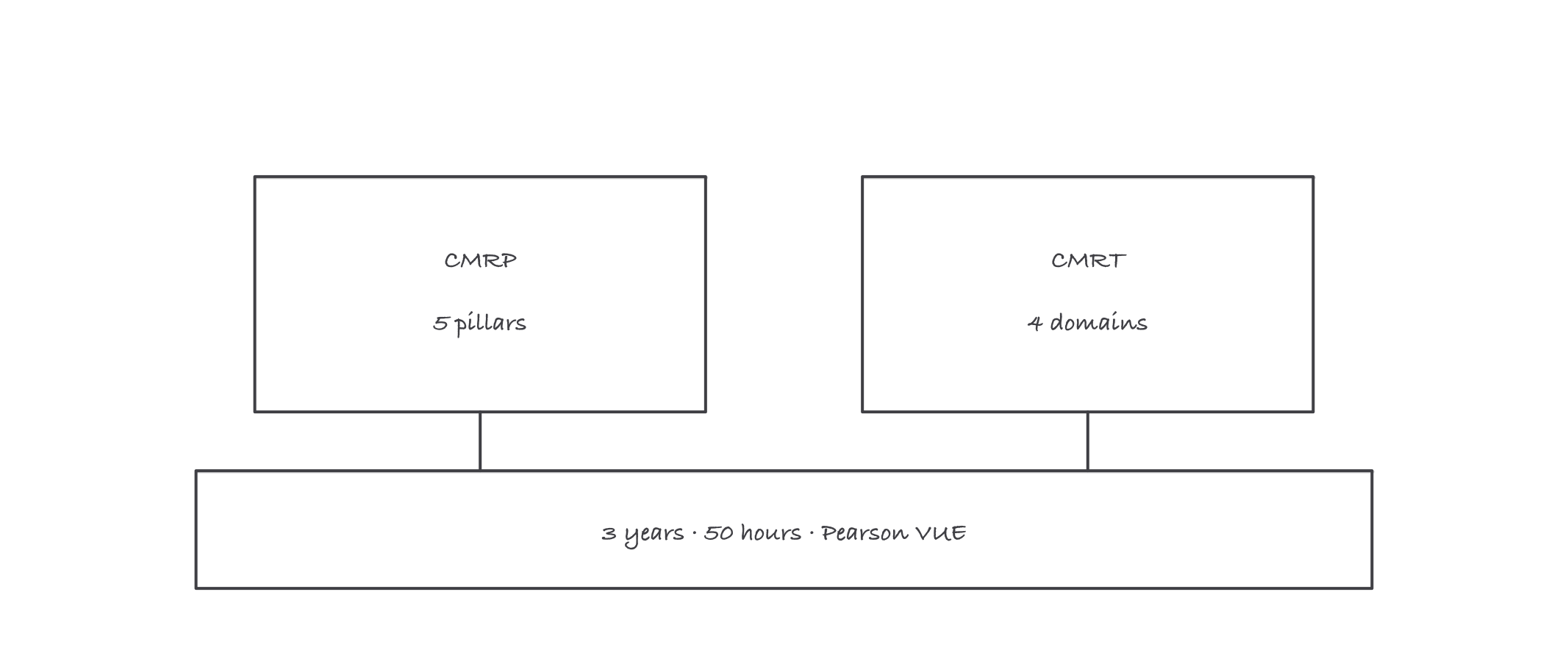
Different content, different audience, identical machinery underneath
- Delivery: Pearson VUE test centers, under Pearson VUE’s identification rules. The name on your registration has to match your government-issued ID exactly.
- Application window: once your application is approved, you have six months to take the exam. Let it lapse and you apply again rather than reschedule.
- Cycle: three years.
- Recertification: 50 course hours per cycle, drawn from two or more of SMRP’s activity categories.
- Lapse: a 90-day window after expiry in which recertification is still possible, after which the route back is re-examination.
One thing this page deliberately does not tell you is the number of questions and the time limit. SMRP publishes those figures for the CMRP and does not publish them for the CMRT, so any source quoting a CMRT question count is quoting something other than the issuer. Ask SMRP or read your exam confirmation.
Fees are the same story for a different reason: they change. SMRP’s application page carries the current figures, and it is linked in this page’s sources.
Preparing for it
The exam is domain-based and practical, so preparation is about coverage rather than depth in your favorite area. A technician who has spent five years on hydraulics will have one domain nearly free and will need real work on the others.
- Audit yourself against the four domains as SMRP words them, honestly, and put your study time into the weakest.
- Study the vocabulary, not only the practice. Plenty of technicians do the right thing daily and cannot name it the way an exam does. Preventive against predictive, availability against reliability, authorized against affected: the distinctions in these lessons are exactly that kind of vocabulary.
- Work from the issuer’s structure. Free study guides reconstruct the domains from memory and drift. The current domain list on SMRP’s page is the map.
Where it bites
- Open eligibility invites underestimation. No prerequisite means no gate; it does not mean no exam. Technicians who walk in on experience alone tend to be caught by the domains furthest from their daily work.
- This is a certification, not a license. It does not authorize anything, no state requires it, and no employer is obliged to recognize it. Its value is as evidence to employers who do.
- The recertification requirement is the same trap as the CMRP’s. Fifty hours across three years from two or more categories is a habit rather than a task, and the 90-day post-expiry window is a short one.
- Do not let a vendor’s course description stand in for SMRP’s domain list. Training is useful but none of it is required, and the exam is written against SMRP’s structure rather than against any curriculum.
Exam relevance
The reliability lessons in this trade are the closest match: preventive maintenance, predictive maintenance, root cause failure analysis and the metrics lesson. The mechanical subject (bearings, alignment, lubrication, pumps and seals) and the safety subject both feed a hands-on technician exam too, because the CMRT is testing the work rather than the theory around it.
Verified requirements
| Where | Expires | Renewal | Continuing education |
|---|---|---|---|
| United States (federal) | Yes | 3 years | 50 course hours per 3-year cycle, drawn from two or more of the recertification activity categories; recertification application due within 90 days of the expiration date or the exam must be retaken |
Information comes from issuing-authority sources. Confirm current rules, fees and eligibility with the authority before acting.