Business · Linework
The Lineworker Apprenticeship
Part of Groundman to Journeyman Lineworker · step 19 of 23 · next: Journeyman Lineworker: What It Takes
In learning paths: Groundman to Journeyman Lineworker
A line apprenticeship is a paid, multi-year training agreement: you work on crews under journeymen, bank on-the-job hours, complete related classroom and home study, and step up through wage increases until the program confers journeyman status. Electrical power-line installer and repairer is a registered apprenticeable occupation with the US Department of Labor, and BLS describes the typical apprenticeship as running 3 to 4 years.
Why it matters on the job
The apprenticeship is not one path among several; for outside line work it is effectively the path. Employers and unions treat completion of a recognized program as the definition of a journeyman lineworker, and the hours you log are the currency the whole career runs on.
The shape of a program
Sponsors. Programs are run by joint apprenticeship and training committees (JATCs, run by IBEW locals and signatory contractors), by individual utilities, and by line contractors. The California-Nevada JATC’s outside line program is a representative example of the union shape: home study, classroom instruction and 7,000 hours of on-the-job training, with eligibility for journeyman status on completion.
On-the-job hours. The core of the program is supervised crew time, rotated across the work: framing and setting poles, stringing conductor, transformers, underground, energized methods as you advance. Hours are documented and audited; they are the proof the credential rests on.
Related instruction. Classroom and home-study coursework runs alongside the field hours: electrical theory, code and standards, rigging, safety regulation. Programs test this material and can hold or drop apprentices who fall behind.
Steps and raises. Apprentices are paid on a step scale, starting at a percentage of journeyman wage and rising as hour and coursework milestones are met. Each step is a gate: progress reviews decide whether you advance.
Mobility. Outside line work follows the work. The California-Nevada JATC notice tells applicants plainly that apprentices travel away from home at their own expense. Storm rolls, remote jobs and per-diem living are part of the deal from year one.
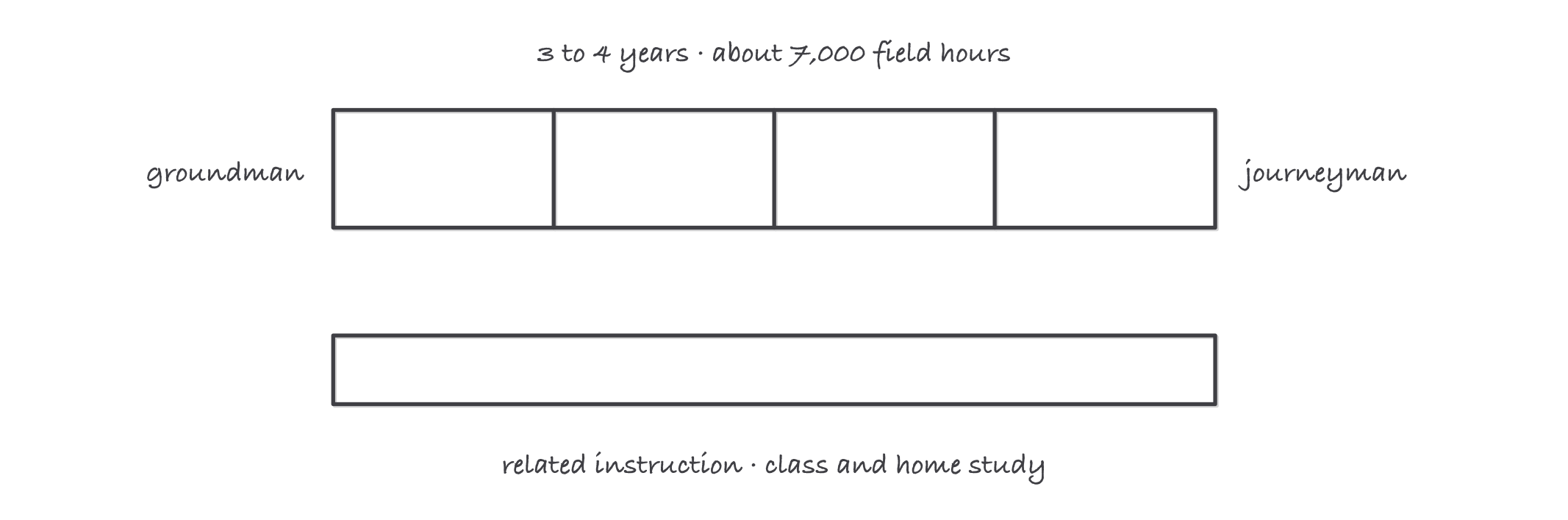
The apprenticeship shape: field hours on top, study underneath, wage steps at the milestones
A concrete exemplar
The California-Nevada JATC outside line apprenticeship (covering IBEW jurisdiction in those two states) asks applicants to be at least 18, hold a high school diploma or GED, and hold a valid unrestricted commercial driver’s license. Selection runs through an aptitude test and interview, and the program opens with a five-day orientation and climbing class before crew placement. From there: 7,000 documented on-the-job hours plus home study and classroom work, and eligibility for journeyman status on completion. Other JATCs and utility programs vary in numbers and sequence; the architecture is the same.
Where it bites
- Groundman time is often the real first step. Many hands work as a groundman (the entry crew classification) before or while seeking an apprenticeship slot. It is how you learn the material, the vocabulary and whether you want the life, and programs notice it.
- Hours belong to the program, not to you. Undocumented work does not count. Keep your own records from day one and reconcile them with the program’s.
- Dropping out is expensive. Progress gates are real: failed climbing school, stalled coursework or poor evaluations can end an agreement. Treat the classroom half as seriously as the pole half.
Exam relevance
There is no single national exam for journeyman lineworker status; the apprenticeship itself is the assessment, through step evaluations, coursework tests and documented hours. The exception is Alaska’s state certificate, covered in the journeyman status lesson.
Verified requirements
| Where | Expires | Renewal | Continuing education |
|---|---|---|---|
| United States (federal) | No | Confirm with issuer | Confirm with issuer |
| Alaska | Yes | 2 years | Confirm with issuer |
Information comes from issuing-authority sources. Confirm current rules, fees and eligibility with the authority before acting.