Business · Linework
Utility, Contractor or Co-op: Career Paths
Part of Groundman to Journeyman Lineworker · step 21 of 23 · next: Why Lineworkers Need a CDL
In learning paths: Groundman to Journeyman Lineworker
Three kinds of employers hire lineworkers: investor-owned utilities, line contractors, and rural electric cooperatives (plus their close cousin, municipal utilities). The work is recognizably the same trade at all three; the life around the work (travel, schedule, pay structure, career shape) differs enough that choosing among them is one of the biggest decisions a journeyman makes.
Why it matters on the job
BLS puts the median wage for electrical power-line installers and repairers at $92,560 (May 2024 data), but medians hide the spread that employer type creates: storm work, overtime, per diem and travel can move real annual income dramatically, in exchange for time away from home. Knowing the trade-offs early lets you steer your apprenticeship and your first journeyman years deliberately.
The three shapes
Investor-owned utility (IOU). The large regulated companies that own and operate the system in most metro areas. Utility crews maintain and operate their own territory: switching, maintenance, service work, storm response on home ground. The shape: stable location, bid lines and seniority, deep familiarity with one system, pension-style benefits common under utility union contracts. Storm mutual assistance sends utility crews traveling occasionally, but home base is home.
Line contractor. Construction companies that build and rebuild lines for utilities under contract. The employers behind OSHA’s ET&D partnership include major national contractors (Quanta’s operating companies, MYR Group companies, Pike, among others), and contractor work is where big construction happens: new transmission, rebuilds, storm restoration at scale. The shape: the work moves and you move with it, per diem and overtime stack on top of scale, and the union hall (for signatory contractors) is the hiring mechanism. Feast and travel go together.
Cooperative and municipal. Member-owned co-ops and city-owned utilities serve rural territory and small cities. Crews are small and versatile: the same journeyman may switch, build, troubleshoot and handle the public in one shift, across long rural miles. The shape: community roots, broad scope, smaller crews with wide responsibility, and system knowledge that runs person-deep rather than department-deep.
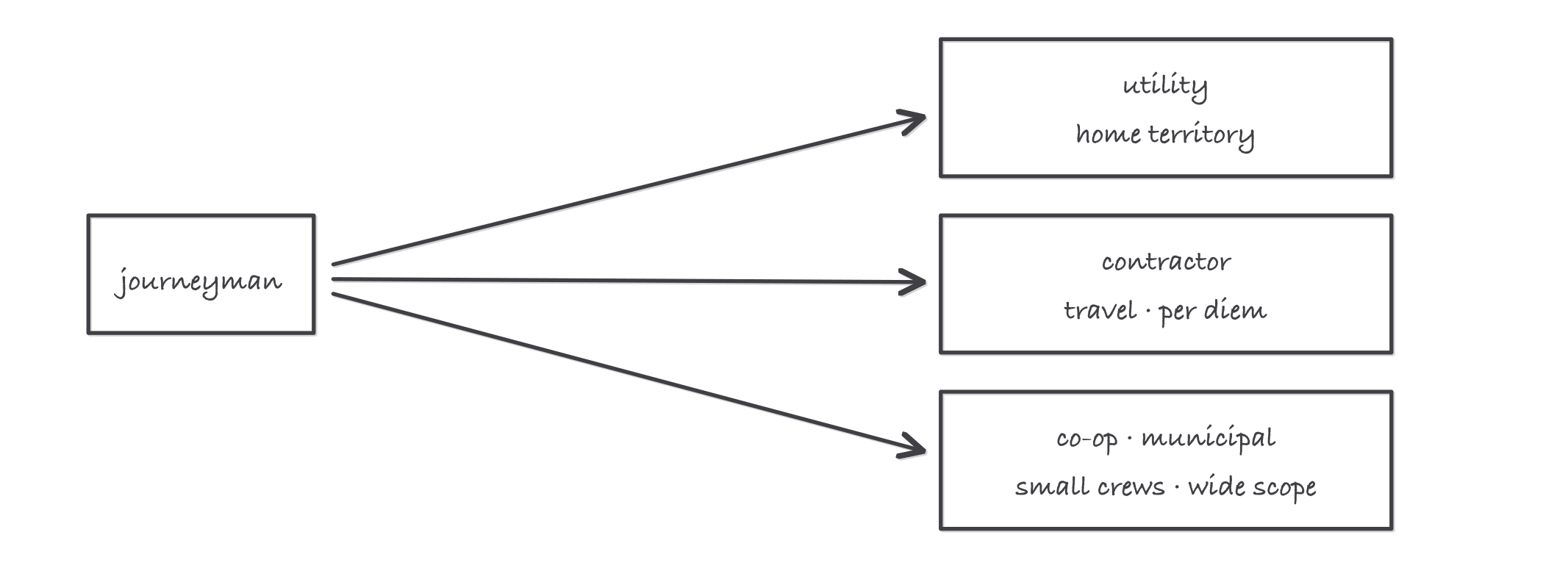
Same trade, three lives: territory and stability, travel and volume, or community and breadth
A concrete comparison
Picture the same storm from all three seats. The co-op journeyman is out the door at midnight because the system is his county and everyone in it knows his truck. The IOU crew works its own feeders on a planned restoration sequence, then may roll to a neighboring utility under mutual assistance. The contractor hand gets the call, drives four hundred miles, and works the rebuild on per diem until the system is whole, then moves to the next job. None of these is the easy version; they are different bargains between money, home and variety.
Where it bites
- Career ladders differ. Utilities and co-ops promote into troubleshooter, crew foreman, operations and supervision roles inside one organization. Contractor careers build through the hall and the road: general foreman, superintendent, or eventually the stability of a utility job taken with journeyman credentials in hand.
- Benefits math is not wage math. Compare pension or annuity structures, health coverage and overtime rules, not hourly rates alone. Two offers at the same scale can differ by a third in real value.
- You are not locked in. Journeyman status conferred through a recognized apprenticeship travels across employer types. Many careers deliberately sequence them: contractor years for money and miles early, utility or co-op years for home life later.