Learn · Diesel Mechanics
Fuel Systems: Common Rail and Injectors
Part of ASE T-Series Prep · step 2 of 20 · next: Air Induction and Turbocharging
In learning paths: ASE T-Series Prep
Assumes you know: Diesel Engine Fundamentals
A common-rail fuel system stores diesel at extreme pressure in a shared pipe (the rail) and lets computer-controlled injectors spray it into the cylinders in precisely timed bursts. Pressure generation and injection timing are separated, which is the whole idea: the rail holds pressure ready at all times, and the computer decides when, how often, and how much to inject.
Why it matters on the job
Fuel systems are where diesel work gets expensive. A set of injectors can cost more than a used car, rail pressures are high enough to injure through gloves, and a few grams of dirt can destroy components machined to tolerances tighter than anything else on the truck. Techs who understand the low-pressure side, the high-pressure side, and the return path diagnose fuel complaints in an hour that others chase for days.
Three circuits, one system
The low-pressure side feeds everything. A lift pump (electric or gear-driven) pulls fuel from the tank through a primary filter and water separator, then pushes it through a finer secondary filter to the high-pressure pump. Diesel fuel doubles as a lubricant and coolant for the injection components, so restriction here starves more than combustion: a clogged filter or air leak on the suction side shows up as low power, derates, or hard starting long before the truck quits.
The high-pressure pump and rail store the muscle. The pump raises fuel to rail pressures that run into the tens of thousands of psi on modern engines, commonly in the 25,000 to 35,000 psi range at full demand. The rail is a thick-walled accumulator feeding every injector equally. A pressure sensor reports rail pressure to the engine computer, and a regulator or metering valve holds it on target. Actual versus commanded rail pressure is a valuable data point on a scan tool.
The return circuit carries the excess home. Injectors and the regulator bleed off fuel to control pressure and cool the components, and that warm fuel flows back to the tank. Measuring return flow is a standard test: an injector returning too much fuel is leaking internally and stealing rail pressure from the others.
Injectors: solenoid-fast, computer-timed
Each injector is a hydraulic valve switched electrically. When the computer energizes it, needle lift lets rail pressure atomize fuel through orifices smaller than a human hair. Because the electronics are fast, one combustion event is built from several shots: a small pilot injection quiets the burn, the main injection makes the power, and post injections can add heat for the aftertreatment system.
Worked example: how fast is an injection event
Injection events are measured in thousandths of a second. See what that means in crank rotation at working speed.
At 1,800 rpm the crankshaft turns 1,800 ÷ 60 = 30 revolutions per second. Each revolution is 360°, so the crank sweeps 30 × 360 = 10,800° per second.
A 1 millisecond main injection therefore lasts 0.001 s × 10,800°/s = 10.8° of crank rotation.
A pilot shot a fraction of that size, placed a few degrees earlier, is what softens the sharp diesel knock. Timing errors you could never see with your eyes are enormous at this scale, which is why worn injectors change the sound, smoke, and power of an engine.
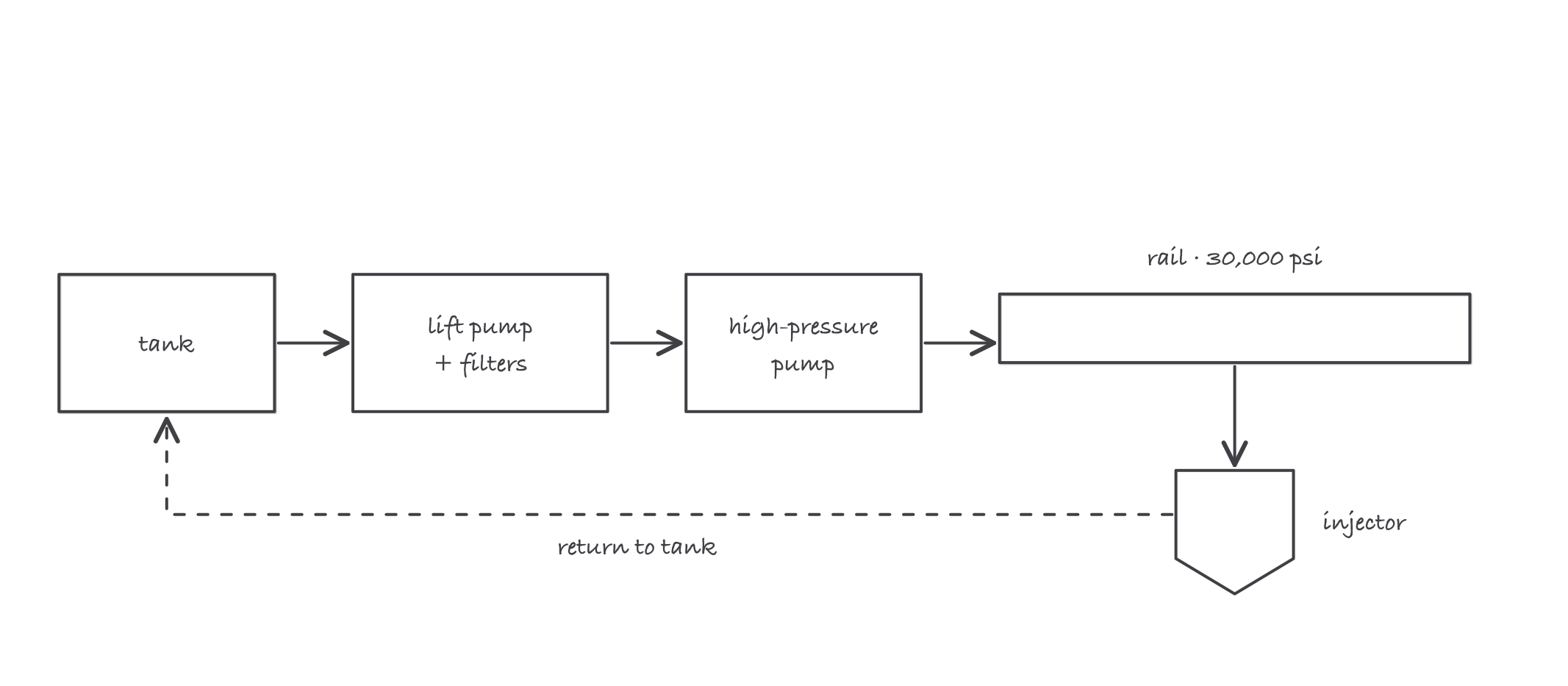
Low pressure feeds, the rail stores, the injector times: three circuits in one system
Where it bites
- Cleanliness is a specification, not a virtue. Injection components live or die on 2 to 5 micron clearances. Cap every opened line, never reuse a contaminated filter, and treat the fuel island’s dirty nozzle as the enemy.
- Never crack a high-pressure line to test for fuel. Fluid at rail pressure can inject through skin, an injury that looks minor and becomes a surgical emergency. Depressurize per the service procedure and use the scan tool instead.
- Air on the suction side mimics failing parts. A pinhole above the fuel level in a suction line makes low-power and no-start complaints that come and go, and no part replacement will fix it.
- A leaking injector hides in the return path. Rail pressure that sags under load with a healthy pump often means one injector is returning far more than its siblings. Measure return flow before condemning the pump.