Learn · Diesel Mechanics
Diesel Engine Fundamentals
Part of ASE T-Series Prep · step 1 of 20 · next: Fuel Systems: Common Rail and Injectors
In learning paths: ASE T-Series Prep
A diesel engine lights its fuel with heat alone. There is no spark plug: the piston squeezes air until it is hot enough to ignite fuel on contact, and the injector decides exactly when that happens. Every diagnostic habit you build in this trade traces back to that one difference.
Why it matters on the job
Compression ignition explains almost everything that makes a diesel a diesel: why there is no ignition system to fail, why cranking speed and cylinder sealing decide whether a cold engine starts, why fuel must arrive at precise pressure and timing, and why these engines run for hundreds of thousands of miles under loads that would destroy a gasoline engine. When you understand what the engine needs (clean air, compression heat, timed fuel), every failure you will ever chase sorts into one of those three buckets.
Compression ignition
A gasoline engine mixes fuel and air first, compresses the mixture moderately, and fires it with a spark. A diesel compresses air only, and much harder. Diesel compression ratios commonly run from about 15:1 to 18:1, against roughly 9:1 to 12:1 for gasoline. Squeezing air that hard heats it past the self-ignition temperature of diesel fuel: well over 1,000 °F near the top of the stroke.
Fuel is injected directly into that hot air moments before the piston reaches top dead center, and it ignites as it sprays. That makes combustion timing the same thing as injection timing: the engine computer (or the injection pump, on older engines) controls when the burn starts by controlling when the fuel arrives.
Because the cylinder holds only air until the injector fires, a diesel needs no throttle plate to meter a mixture. Power is set by how much fuel is injected, not by choking the airflow. At idle the engine still breathes a nearly full charge of air and burns a small shot of fuel, one reason a diesel sips so little at idle.
The four-stroke cycle, diesel style
The cycle is the familiar four strokes with one habit changed: nothing but air goes in the intake.
- Intake: the piston travels down and draws in air only, packed harder by the turbocharger on nearly every modern truck engine.
- Compression: the piston squeezes that air to a fraction of its volume, heating it past ignition temperature.
- Power: fuel injects near top dead center, ignites in the hot air, and the expanding burn drives the piston down.
- Exhaust: spent gas leaves through the turbine side of the turbo and into the aftertreatment system.
Built heavy for a reason
Compression ignition produces high peak cylinder pressures, and the hardware shows it: heavy blocks, large bearing surfaces, stout cranks and rods, and long piston strokes. The long stroke and the fuel-metered combustion give the diesel its signature: strong torque at low engine speed. Most heavy-truck diesels are governed well below 3,000 rpm and do their best work far lower. You shift, spec, and diagnose around that torque character for your whole career.
Worked example: compression ratio
Compression ratio compares the cylinder volume with the piston at the bottom of its stroke to the volume left when the piston reaches the top.
Suppose one cylinder sweeps 2.0 L as the piston rises, and 0.125 L of clearance volume remains above the piston at the top.
Compression ratio = (swept volume + clearance volume) ÷ clearance volume = (2.0 + 0.125) ÷ 0.125 = 2.125 ÷ 0.125 = 17:1.
Seventeen volumes of air packed into one is what makes the heat. If the cylinder cannot hold that squeeze (worn rings, a leaking valve, or cranking too slowly to outrun leakage), it cannot reach ignition temperature, and hard cold starting is the first symptom you will see.
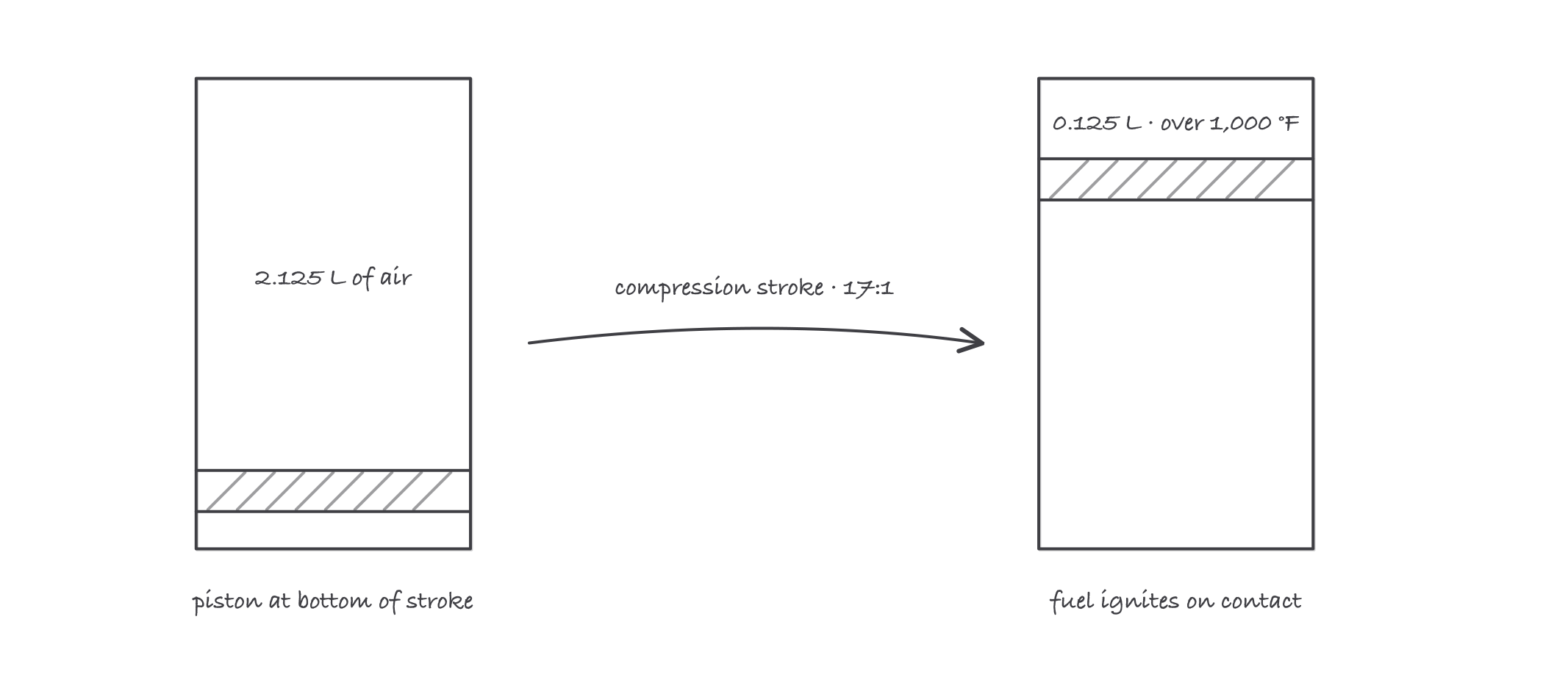
Seventeen volumes squeezed into one: the compression stroke is the ignition system
Where it bites
- “No spark” cuts both ways. There is no ignition system to fail, so a diesel no-start is a cranking-speed, compression, or fuel-delivery problem. Techs raised on gasoline engines waste hours looking for the missing spark equivalent.
- Combustion timing is fuel timing. Knock, smoke, and power complaints that would be ignition problems on a gas engine are injection problems here.
- Diesels are throttled by fuel, not air. A blocked air path still costs power and makes smoke, but idle quality and power delivery are fuel-quantity decisions made by the injection system.
- Cold-morning white smoke is usually unburned fuel, a sign the cylinder is not making enough compression heat, not a sign the engine is running “rich.”