Learn · Diesel Mechanics
Truck HVAC and MVAC Service
Part of ASE T-Series Prep · step 12 of 20 · next: Truck Shop Safety: Rim Wheels and Stored Energy
In learning paths: ASE T-Series Prep
Assumes you know: Truck Electrical and Electronic Systems
Cab air conditioning moves heat; it does not make cold. A refrigerant loop absorbs heat inside the cab and rejects it to the outside air, driven by a compressor. Heating is the easy half: hot engine coolant through a heater core, with a blower and blend doors deciding what reaches your face. Master the loop and every truck AC complaint becomes a question you know how to ask.
*Learn the Trades is a free study resource. We are not a licensing body, an authorized training provider, or an exam administrator. Reading this page does not award any card, license, or certification. Always verify requirements with the issuing authority linked in the sources.*Why it matters on the job
A driver in a 100 °F cab is a driver who stops working, so AC tickets get priority all summer. HVAC work also pays twice: it is its own repair category, and it exercises the electrical diagnosis skills from Truck Electrical and Electronic Systems, because compressor clutches, blower circuits, pressure switches and climate control heads fail electrically as often as the loop fails mechanically.
The refrigerant loop
Four stations, one circle:
- Compressor: takes low-pressure refrigerant vapor and squeezes it to high pressure, which also makes it hot. It divides the loop into a high side and a low side.
- Condenser: the coil in front of the radiator. Outside air removes heat from the hot vapor until it condenses to liquid.
- Expansion device: a restriction that drops the liquid’s pressure sharply. Cold, low-pressure refrigerant leaves it.
- Evaporator: the coil in the cab. Cabin air gives up heat to boil the cold refrigerant, the air comes off the coil cool and dry, and the vapor returns to the compressor.
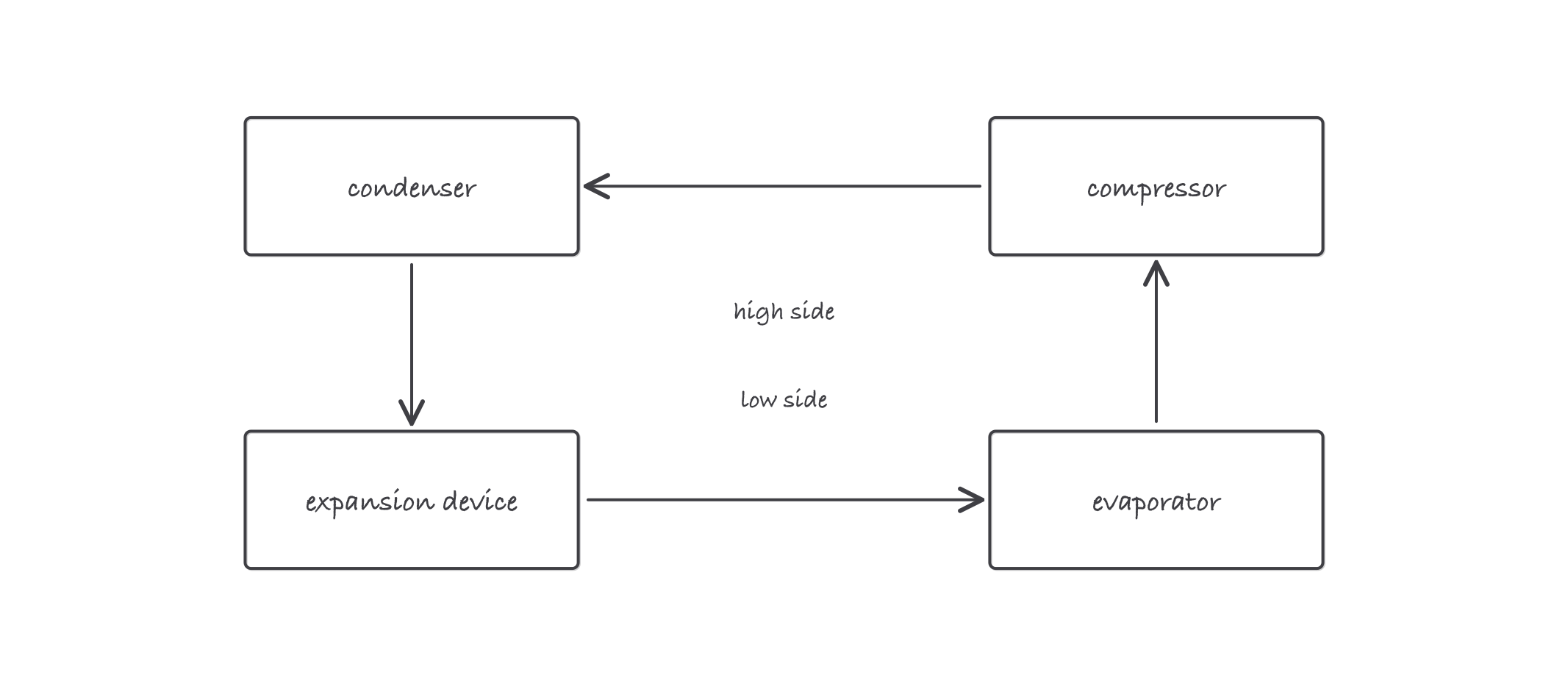
One circle, four stations: heat picked up in the cab is thrown away in front of the radiator
The loop only works because pressure controls boiling point. High pressure lets refrigerant condense at engine-bay temperatures; low pressure lets it boil at cab temperatures. Every gauge reading you will ever take is a window into that relationship.
A worked diagnosis
A day cab arrives with weak cooling. You connect the gauge set. Both sides read low and cooling is poor: the classic undercharge pattern. Now you are hunting the leak, not topping off and hoping. Different truck, different story: head pressure climbs abnormally high on the high side. Now you suspect heat rejection, so you check the condenser face for bugs, mud and blocked airflow before condemning any part. The gauges do not name the failed component; they tell you which question to ask next.
Recovery rules
Refrigerant never gets vented. When a circuit has to be opened, the refrigerant is recovered with dedicated equipment, and EPA’s MVAC rules govern the machines and the handling. Recovery is not a courtesy; it is the law that created the certification below.
Where it bites
- The reefer is not the cab. A refrigerated trailer’s unit is not MVAC; Section 608 rules govern that work, and a 609 card does not cover it.
- An “AC failure” is often electrical. A clutch that never engages, a blower on one speed, a pressure switch holding the system off: check the circuit before the loop.
- Heat is the product being moved, not made. Techs who chase “more cold” replace parts; techs who trace where heat enters and leaves fix trucks.
Exam relevance
This is T7 territory: the ASE Heating, Ventilation and Air Conditioning test runs 40 scored questions plus 10 unscored research questions, and it leans on exactly this loop, its controls and its service rules. In practice T7 pairs with Section 609 certification, because the test proves you understand the system and the 609 credential lets you open it for pay.
Verified requirements
| Where | Expires | Renewal | Continuing education |
|---|---|---|---|
| United States (federal) | No | Confirm with issuer | Confirm with issuer |
Information comes from issuing-authority sources. Confirm current rules, fees and eligibility with the authority before acting.