Learn · Diesel Mechanics
Air Induction and Turbocharging
Part of ASE T-Series Prep · step 3 of 20 · next: Aftertreatment: DPF, SCR, DEF
In learning paths: ASE T-Series Prep
Assumes you know: Diesel Engine Fundamentals
A turbocharger uses energy in the exhaust stream to pack more air into the cylinders. A turbine wheel in the exhaust spins a compressor wheel in the intake on a common shaft, and the compressed charge passes through a charge air cooler before entering the engine. More air means more fuel can burn, and more fuel burned means more power from the same displacement.
Why it matters on the job
Power is limited by air. Every low-power complaint, black-smoke complaint, and derate you diagnose starts with the same question: is the engine getting the air the computer thinks it is getting? The air path (filter, compressor, charge air cooler, intake plumbing, exhaust turbine) is long, pressurized, and full of clamps and boots that live in vibration and heat. It fails often, and it fails cheap, so rule it out before touching expensive fuel components.
How the turbo works
Exhaust gas leaving the cylinders still carries heat and pressure. Routed through the turbine housing, it spins the turbine wheel, commonly at speeds over 100,000 rpm. The shaft carries that spin to the compressor wheel, which draws air through the filter and squeezes it into the intake system. The pressure it adds above atmospheric is boost.
The bearings between the wheels float on engine oil. That single fact drives two shop rules: oil supply problems kill turbos fast, and a failing turbo often announces itself with oil in the intake or exhaust side of the housing.
Variable geometry turbos (VGT) add movable vanes in the turbine housing. Closing the vanes speeds the exhaust across the turbine for quick boost at low rpm; opening them protects the engine at high flow. The engine computer positions the vanes constantly, and the same mechanism supplies most engine-brake and regen-temperature control. Sticking vanes from soot buildup are a common turbo complaint on modern trucks.
Hot air is thin air
Compressing air heats it, and hot air is less dense, which throws away part of what the turbo gained. The charge air cooler (CAC), the wide core in front of the radiator, cools the compressed charge and restores density. Cooler charge also lowers combustion temperatures, which the emissions system depends on. A leaking CAC or a boot that blows off under load wastes boost the turbo already made: the engine computer sees the missing pressure and pulls fuel, and the driver reports low power.
Worked example: what boost is worth
Density tracks absolute pressure and absolute temperature. Compare the cylinder charge against the outside air on an 80 °F day (that is 80 + 460 = 540 °R absolute).
Atmospheric pressure is about 14.7 psi. With the gauge reading 20 psi of boost, absolute intake pressure is 14.7 + 20 = 34.7 psi.
Pressure ratio: 34.7 ÷ 14.7 = 2.361.
After the charge air cooler brings the charge down to 120 °F (120 + 460 = 580 °R), the temperature ratio is 540 ÷ 580 = 0.9310.
Density gain = 2.361 × 0.9310 = 2.198, about 2.2 times the air of the naturally aspirated charge. Without the cooler, at a compressor-outlet temperature near 400 °F (860 °R), the factor would be 2.361 × (540 ÷ 860) = 2.361 × 0.6279 = 1.482. The cooler turns a 1.5× engine into a 2.2× engine with no moving parts.
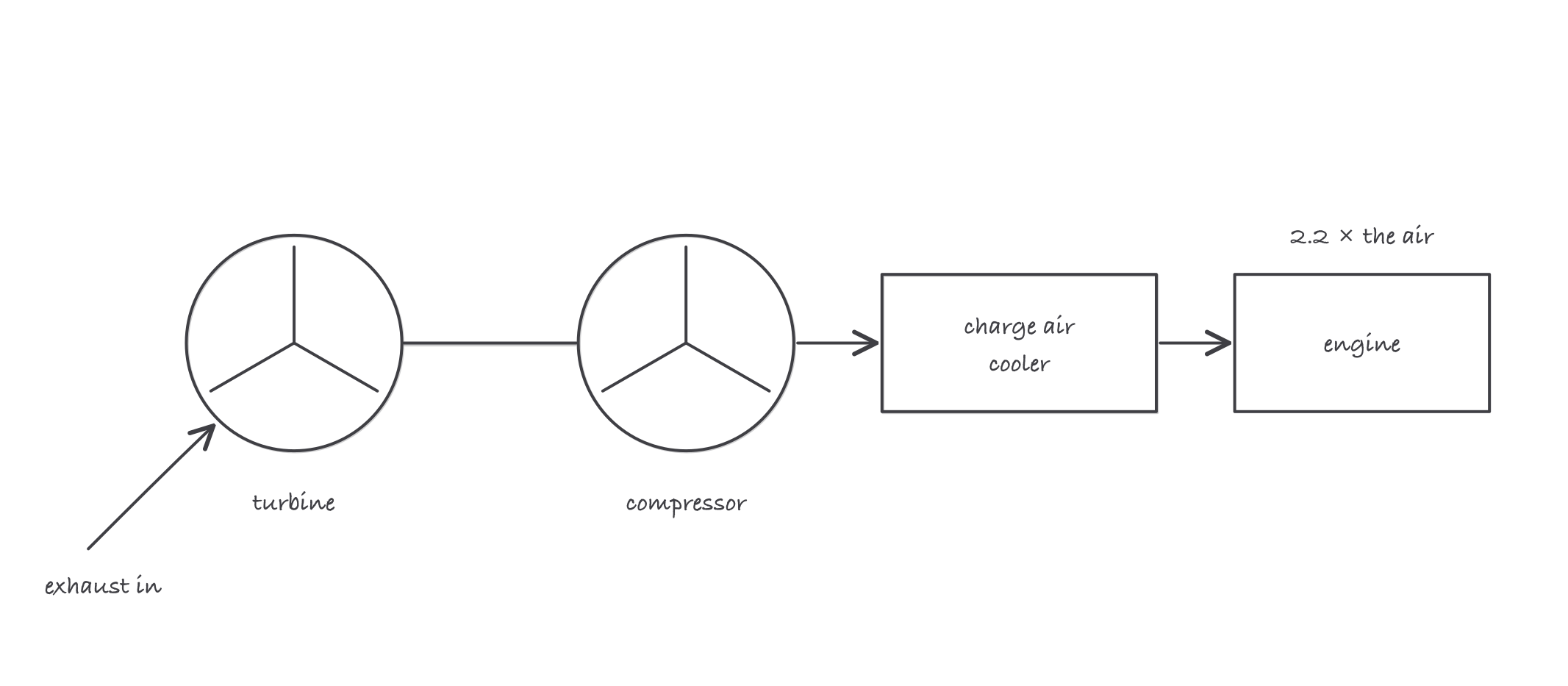
The turbine spends exhaust energy, the compressor packs the air, the cooler makes it dense
Where it bites
- Boost leaks mimic big failures. A split boot or cracked CAC tank costs a few dollars and produces the same low-power complaint as a worn turbo or failing injectors. Pressure-test the charge side before condemning hardware.
- Oil in the intake pipe is not automatically a dead turbo. Crankcase ventilation deposits an oil film over time. Look for wheel contact marks, shaft play beyond spec, and oil dripping from the housing drain area before you condemn it.
- A restricted air filter shows up at full load only. The engine idles fine, then smokes and starves at peak flow. Check the filter minder, not your idle impressions.
- VGT vanes stick sooty. Slow spool, overboost codes, or weak engine brake on a high-idle-time truck points at the vane mechanism before the wheels or bearings.