Learn · Diesel Mechanics
Air Brake Systems
Part of ASE T-Series Prep · step 6 of 20 · next: Drivetrains: Clutches, Transmissions, Differentials
In learning paths: ASE T-Series Prep
Air brakes stop a heavy truck with compressed air doing the work your leg does in a car. A compressor charges storage tanks, the brake pedal meters air to chambers at each wheel, and the chambers convert pressure into the mechanical force that applies the brakes. The design has one beautiful inversion at its heart: the parking brakes are applied by springs and held OFF by air, so losing air applies them.
Why it matters on the job
Air brake work is constant, regulated, and unforgiving. Brakes are a leading cause of out-of-service violations at roadside inspections, and brake defects on a truck you signed off follow you. The system is also refreshingly logical: air is made, stored, metered, and spent, and every symptom maps onto one of those four stages.
Making and storing air
An engine-driven compressor builds pressure, managed by a governor that cuts the compressor in and out to hold system pressure in its working band (roughly the low 100s of psi; the exact cut-in and cut-out points are a spec you verify, not guess). Air first enters a supply (wet) tank, where moisture condenses, then feeds primary and secondary tanks.
Those two tanks serve two independent service circuits, typically one for the rear axles and one for the front. This dual-circuit design is the first layer of failure protection: a burst line in one circuit still leaves the other circuit braking. An air dryer between compressor and wet tank removes water and oil, and its cartridge is routine PM: water in the tanks is the enemy of every valve downstream.
A low-air warning (light and buzzer) alerts the driver when pressure falls to the warning threshold, well above the pressure where spring brakes start to drag.
Metering and spending air
Press the treadle valve (the pedal) and metered air flows to the brake chambers. In each chamber, air pushes a diaphragm, the diaphragm pushes a pushrod, the pushrod rotates a slack adjuster, which turns a camshaft ending in an S-cam that spreads the shoes against the drum. Release the pedal and quick-release valves dump the air.
Trailer brakes get their air through two gladhand-coupled lines: the supply (emergency) line charges the trailer and holds its spring brakes off, and the service line signals braking.
Springs hold, air releases
Rear service chambers are usually spring brake chambers: two chambers stacked. The service side applies the brakes when you press the pedal. The spring side contains a large coil spring, compressed and held off by tank pressure. Pull the dash valve (or lose enough air) and the spring applies the brake mechanically. That is why the parking brake needs no air to hold, why a truck with drained tanks cannot be moved, and why the exam answer is always: air holds the spring brake off; losing air applies it.
Never disassemble a spring brake chamber outside its service procedure: the caged spring stores enough energy to kill.
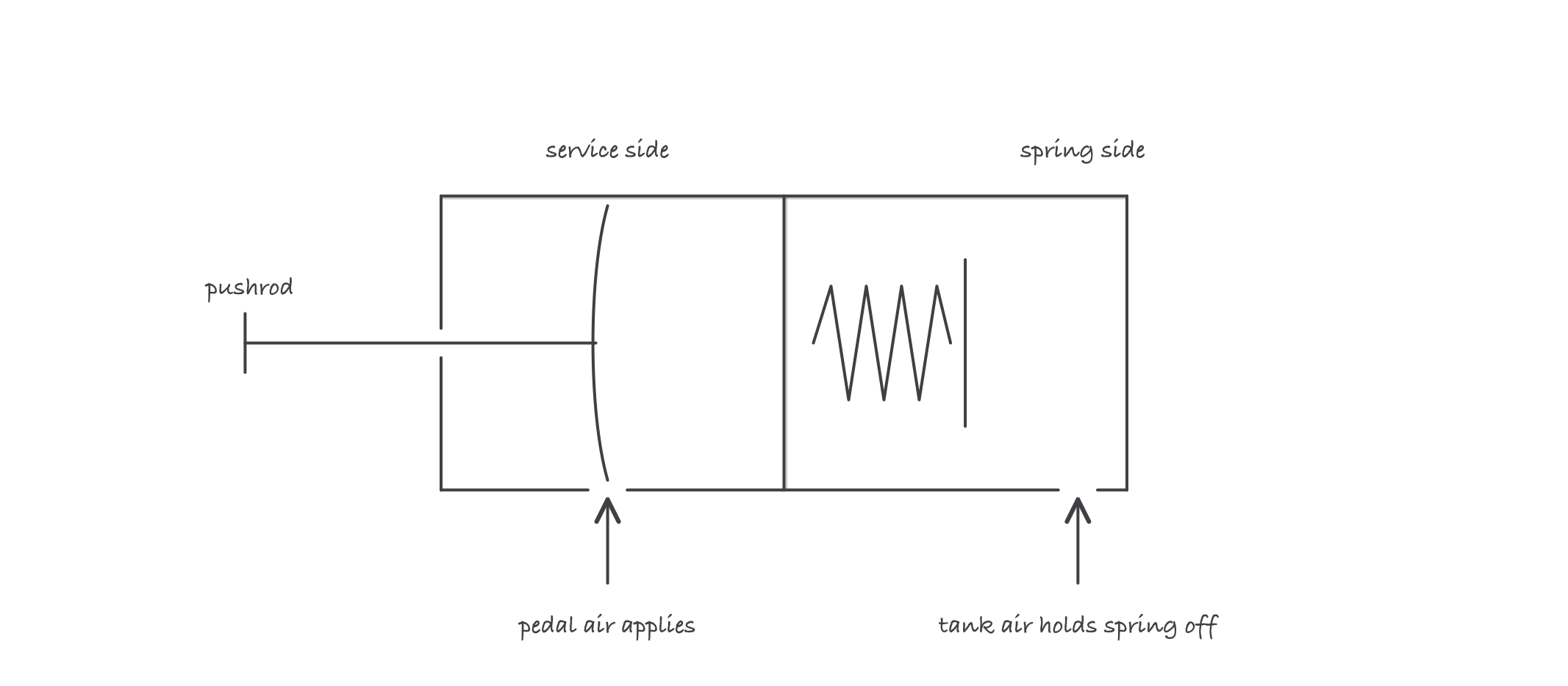
Two chambers in one: pedal air applies the service brake, tank air holds the parking spring off
Worked example: chamber force
Brake chambers are sized by effective diaphragm area in square inches: a Type 30 chamber has about 30 in² of effective area. Force is pressure times area.
At 100 psi of application pressure: 100 psi × 30 in² = 3,000 lb of pushrod force.
That force works through the slack adjuster arm as a lever. With a 5.5 in slack adjuster arm: 3,000 lb × 5.5 in = 16,500 lb·in of torque turning the S-cam.
Now the reason stroke matters: the diaphragm only delivers full force through its designed stroke. As lining wears and stroke lengthens, the chamber runs out of travel and force collapses exactly when the driver needs it. That is why measuring pushrod stroke against the spec table is the heart of every brake inspection, and why automatic slack adjusters that have quit adjusting are found, not assumed.
Where it bites
- “Air applies the parking brake” is backwards. Air releases it. This distractor appears on CDL knowledge tests and technician exams alike because the service brakes work the opposite way.
- Out-of-adjustment brakes feel fine around the yard. Long-stroke problems appear under hard application at temperature. Measure stroke; never trust a yard test.
- An automatic slack adjuster out of adjustment is a broken part. Manually adjusting it and releasing the truck hides a defect that will walk back out of adjustment. Find why it stopped adjusting.
- Water in the tanks means the dryer is overdue, and every valve in the system is corroding on schedule. Drain checks are diagnostic, not ceremonial.
- One dragging brake cooks itself. A slow-releasing valve or kinked hose shows up as one hot drum and a pull. Temperature-gun the wheel ends after a road test.