Learn · Diesel Mechanics
Aftertreatment: DPF, SCR, DEF
Part of ASE T-Series Prep · step 4 of 20 · next: Engine Diagnosis
In learning paths: ASE T-Series Prep
Assumes you know: Air Induction and Turbocharging
Aftertreatment is the chemistry set bolted between the turbo and the tailpipe. Three devices in series clean the exhaust: a diesel oxidation catalyst (DOC) burns off unburned fuel and carbon monoxide, a diesel particulate filter (DPF) traps soot, and a selective catalytic reduction (SCR) catalyst converts oxides of nitrogen (NOx) into nitrogen and water using diesel exhaust fluid (DEF). Modern trucks will not stay in service unless all three work, because the engine computer enforces them with derates.
Why it matters on the job
Aftertreatment work is a huge share of a modern shop’s engine bays. The systems are sensitive to everything upstream: a lazy injector, a boost leak, or a coolant seep changes what reaches the catalysts, and the aftertreatment throws the first visible symptom. Techs who treat a soot-loaded DPF as the disease replace filters forever. Techs who treat it as a signal find the engine problem that loaded it.
The exhaust path, device by device
DOC first. The oxidation catalyst has no moving parts. Exhaust passes over a coated honeycomb that oxidizes hydrocarbons and carbon monoxide. It also does a second job: when the system needs heat downstream, fuel dosed into the exhaust burns across the DOC and raises the temperature entering the DPF.
DPF second. The particulate filter is a ceramic honeycomb with alternately plugged channels, so exhaust must pass through the porous walls, leaving soot behind. Pressure sensors before and after the filter watch the restriction grow. Soot is stored fuel: burned off at high temperature it becomes carbon dioxide and leaves. What remains after many burn cycles is ash (mostly from engine oil additives), which never burns off and is why filters eventually come out for cleaning or replacement.
SCR third, with DEF. Ahead of the SCR catalyst, a doser sprays DEF, a solution of urea in purified water, into the hot exhaust. Heat decomposes the urea into ammonia, and on the catalyst the ammonia reacts with NOx to form nitrogen and water vapor. DEF lives in its own tank and its own plumbing. It never touches the fuel system.
Regen is three different things
Burning stored soot out of the DPF is regeneration, and the word covers three distinct events. Say which one you mean.
- Passive regen happens on its own when a working truck runs hot enough that soot oxidizes continuously. No commanded action, and the driver never knows.
- Active regen is commanded by the engine computer while driving: fuel dosed across the DOC raises DPF inlet temperature to burn accumulated soot. Normal, automatic, and more frequent on low-load duty cycles.
- Forced (parked) regen is commanded with a scan tool, truck stationary, when soot load has passed what active regen can handle. It is a service procedure with real heat at the tailpipe, done deliberately.
A truck that idles all day never gets hot enough for passive regen, so it leans on active and forced regens. Duty cycle is the first question in every DPF conversation.
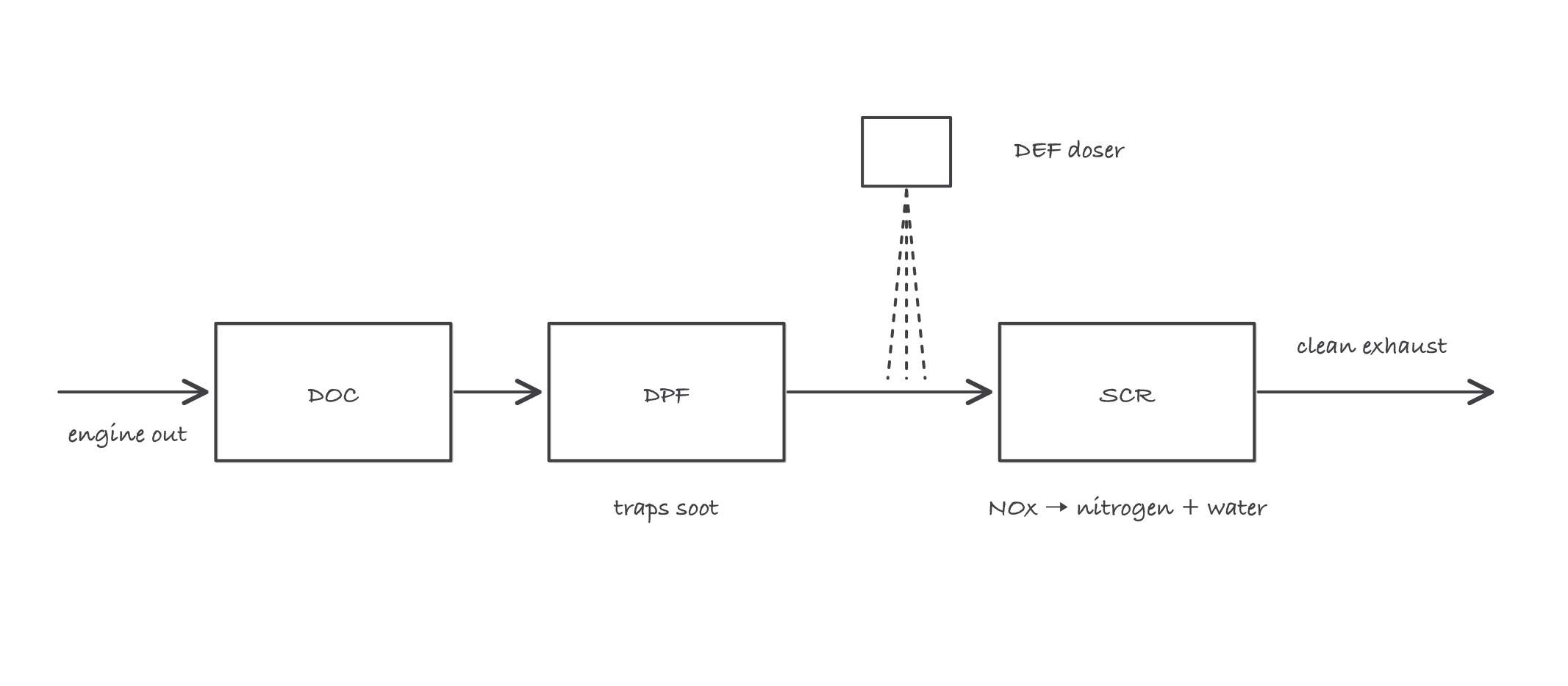
Three devices in series: the DOC makes heat available, the DPF traps soot, the SCR turns NOx into nitrogen and water
Worked example: DEF consumption
DEF use scales with fuel use, because NOx production scales with fuel burned. Suppose a linehaul tractor averages a DEF dosing rate of 3 percent of fuel consumption, and burns 80 gallons of diesel in a day’s run.
DEF used = 80 × 0.03 = 2.4 gallons per day.
With a 10 gallon DEF tank, that is 10 ÷ 2.4 = 4.17 days of running between fills. If the same truck suddenly consumes DEF at double the rate with no change in route, that is a diagnostic clue (dosing system fault or rising engine-out NOx), not a nuisance. Consumption that collapses to near zero is a bigger one: a doser that has quit will soon put the truck in derate.
Where it bites
- DEF is not a fuel additive. Poured into the diesel tank it damages the fuel system, and diesel in the DEF tank ruins the dosing system. The fills are different sizes for a reason; label confusion still happens weekly.
- DEF quality matters. It is roughly one-third urea by weight, and it freezes, ages in heat, and picks up contamination easily. Crystals around fittings and cheap unsealed containers are the classic causes of doser and injector faults.
- Ash is not soot. No number of regens will clear ash loading. A filter that regens clean but reloads its baseline restriction is telling you it is full of ash.
- The DPF is a symptom collector. Excess soot means excess engine-out smoke: injectors, air path, or duty cycle. Find out why the filter loaded before you hand the truck back.
- Face-melted filters point upstream. A DPF with melted or cracked substrate took an uncontrolled burn, usually from oil or fuel carryover. Replacing it without finding the source buys the customer a second failure.