Learn · Diesel Mechanics
Steering and Suspension
Part of ASE T-Series Prep · step 8 of 20 · next: Truck Electrical and Electronic Systems
In learning paths: ASE T-Series Prep
Steering and suspension are the systems that keep 40 tons pointed where the driver aims it and the tires flat on the road while it gets there. Steering on a heavy truck is a chain of leverage: wheel, column, steering gear, pitman arm, drag link, steering arm, knuckles, with a tie rod linking the two front wheels so they steer together. Suspension carries the load: leaf springs or air bags, with shocks controlling the motion.
Why it matters on the job
These systems wear in ounces and fail in inches. A loose drag link end is a handling complaint this month and a steering loss next year, which is why steering components sit high on every inspection checklist. And tires are one of a fleet’s largest running costs: alignment errors measured in fractions of an inch scrub thousands of miles off a set of steer tires. The tech who reads tire wear patterns diagnoses geometry with a flashlight.
The steering chain
The driver’s input enters a steering gear (recirculating ball on most heavy trucks), which multiplies torque and swings the pitman arm. The pitman arm pushes the drag link fore-and-aft to the steering arm on the left knuckle, and the tie rod carries the motion across the axle to the right knuckle. Hydraulic power assist, driven by an engine-mounted pump, does most of the muscular work; lose the engine and you still steer, heavily, which is the design intent.
Wear checks are made with the wheels loaded and an assistant rocking the wheel: watch each joint for lash. Kingpins (the pivots the knuckles steer on) are checked by jacking the axle and levering the wheel; play beyond spec means line boring or knuckle work, not a part swap.
Alignment: three angles, one that eats tires
- Caster tilts the kingpin axis fore-and-aft. Positive caster makes the truck self-center and track straight. Wrong or unequal caster causes wander and pulls, not rapid tire wear.
- Camber tilts the tire in or out at the top, wearing one shoulder when it is off. On solid front axles it is set by the axle itself, so bad camber usually means a bent component, not an adjustment.
- Toe is the difference in track width between the front and rear of the tires: pointing in slightly at the front is toe-in. Toe is the tire-killer: a small error scrubs the tread sideways with every foot of travel, feathering the tread face fast. It is also the one angle routinely adjustable, by rotating the tie rod’s threaded ends.
Worked example: measuring toe
Toe is measured as the difference between the distance across the tires at axle height behind the axle and ahead of it, marked on the tread centerline.
Scribe a line on each tire, roll the truck forward half a turn, and measure: across the front of the tires 79 15/16 in, across the rear of the marks 80 1/16 in.
Toe = rear − front = 80 1/16 − 79 15/16 = 2/16 = 1/8 in toe-in.
If the spec calls for 1/16 in ± 1/32, this axle carries double the specified toe-in. Correct it at the tie rod: lengthening or shortening the rod changes the front measurement directly. Recheck after tightening the clamps, because clamp torque can walk the adjustment.
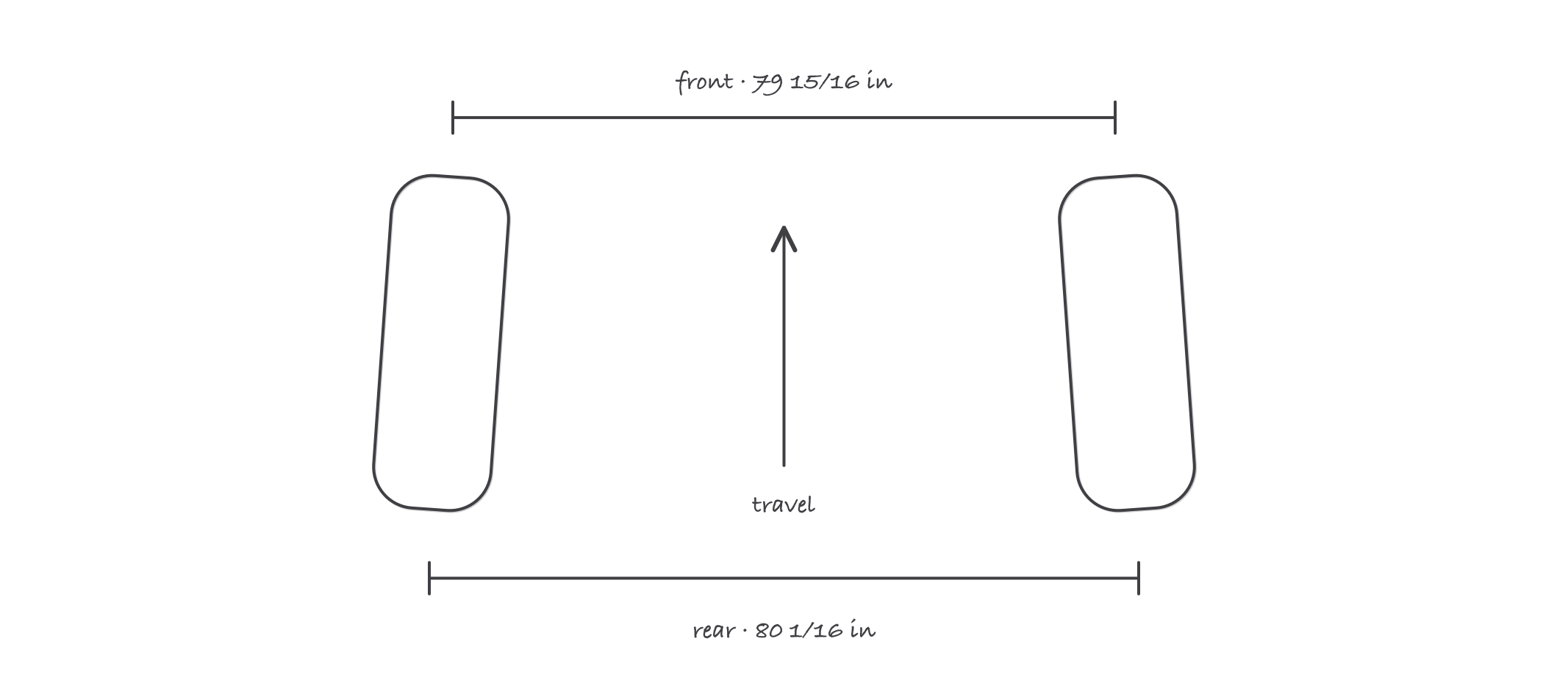
Toe-in seen from above: the fronts of the tires sit closer together than the rears
Suspension: steel or air
Leaf springs stack steel leaves that flex to carry load and locate the axle. They are simple and hard to kill; broken or shifted leaves, worn shackle bushings, and loose U-bolts are the standard defects, all visual finds.
Air suspension replaces the spring pack with air bags fed from the brake system’s supply through a ride height (leveling) valve that adds or releases air to hold a set frame height. Ride height is a measured spec: an inch off changes driveline angles (a vibration complaint) and axle loading. Diagnosis is disciplined: verify ride height first, then leak-check bags and valve before condemning parts.
Shock absorbers control spring oscillation on either system. A misted shock body is normal; a wet, dripping shock or a cupped tire wear pattern is the failure signature.
Where it bites
- Read the tires before the truck is on the rack. Feathered edges say toe; one worn shoulder says camber or a bent part; cupping says shocks or balance. The tires have been logging data for 50,000 miles.
- A pull is not automatically alignment. Unequal tire pressures, a dragging brake, or unequal caster all pull. Cheap checks first.
- Solid-axle camber is a bent part until proven otherwise. Do not chase shims that do not exist on a beam axle.
- Wheel-seal leaks hide in plain sight during suspension checks. Oil slung inside a steer wheel during a kingpin check is a failed seal on its way to a wheel-off event or a brake contamination problem.
- Air suspension shares its air with the brakes. Supply-side protection valves guarantee brakes get air first, so a massive bag leak can show up as slow brake recovery. Think in one air system, not two.