Learn · Diesel Mechanics
Drivetrains: Clutches, Transmissions, Differentials
Part of ASE T-Series Prep · step 7 of 20 · next: Steering and Suspension
In learning paths: ASE T-Series Prep
The drivetrain carries engine torque to the pavement: clutch, transmission, driveshafts, and drive axles, each one either multiplying torque or changing its direction. A heavy truck moves 80,000 lb from rest with an engine that would stall instantly if coupled straight to the wheels; the drivetrain’s gear reductions are what make that possible.
Why it matters on the job
Drivetrain work is torque arithmetic plus wear patterns. The components are big and the failures are expensive, so the road test earns its time. Where a vibration appears (speed-dependent or rpm-dependent), when a noise happens (under power, coasting, or turning), and which gear it happens in each eliminate whole components before you pick up a wrench.
Clutch and transmission
Heavy trucks use large ceramic-faced clutches, commonly twin-disc pull-type designs: releasing the pedal pulls the release bearing rather than pushing it, opposite the automotive pattern. Free pedal (the small travel before resistance) is the wear gauge; as the discs wear, free travel changes, and many heavy clutches include an adjustment mechanism to restore it.
Traditional truck transmissions are unsynchronized: 10, 13, or 18 speeds selected by sliding clutched gears that must be speed-matched by the driver (double-clutching or floating). No synchronizers means less to wear, but it also means driver technique appears in the failure pattern: hammered gear faces on a transmission tell you about the left seat as much as the hardware. Automated manual transmissions (AMTs) now dominate new trucks: the same gearbox with computer-controlled clutch and shifting, which moves diagnosis into scan-tool territory (clutch calibrations, shift-actuator faults) without changing the gears themselves.
Driveshafts and axles
Driveshafts connect components that move relative to each other, using universal joints and a slip yoke. U-joints must be in phase (yokes aligned) and operate at small, nearly equal angles at each end; a driveshaft out of phase or at excessive angle produces a vibration that trucks are famous for. U-joint wear is found by hand: with the driveline unloaded, any detectable looseness is failure.
Tandem drive axles split torque through an interaxle differential (power divider) between the forward and rear axle, while each axle’s own differential splits torque side to side. The driver-controlled interaxle lock ties the axles together for traction; the rule taught with it: engage it before you spin, not after, and never at speed while spinning.
Gearing is torque multiplication
Every ratio multiplies torque and divides speed by the same number. A 12:1 first gear turns 1,000 lb·ft of engine torque into 12,000 lb·ft at the driveshaft while the driveshaft turns at one twelfth of engine speed. The axle ratio multiplies again. Overall reduction is the product of the ratios in series, and that single sentence is the entire math of drivetrain spec’ing.
Worked example: from engine rpm to road speed
A tractor cruises at 1,450 engine rpm. The transmission is in overdrive top gear, ratio 0.73:1, and the rear axle ratio is 3.55:1. The tires roll 500 revolutions per mile.
- Driveshaft speed: overdrive multiplies shaft speed, so 1,450 ÷ 0.73 = 1,986.3 rpm.
- Wheel speed: the axle divides by 3.55, so 1,986.3 ÷ 3.55 = 559.5 rpm.
- Road speed: 559.5 ÷ 500 = 1.119 miles per minute. Times 60: 67.1 mph.
Run it backwards and you can catch a mis-specced truck: a driver complaining the engine “buzzes” at highway speed may be pulling a numerically higher axle ratio than the spec sheet claims. The same arithmetic, in reverse, tells you what rpm 65 mph should produce.
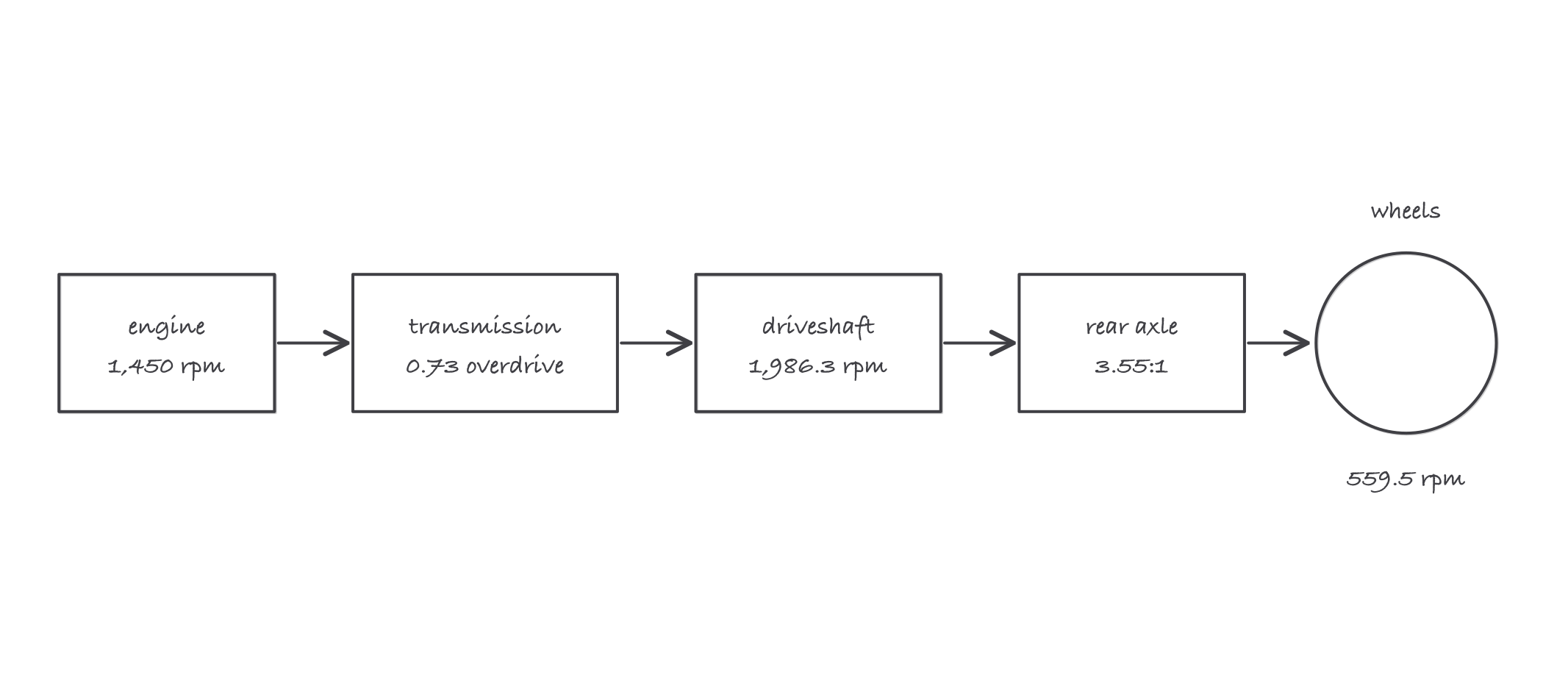
Ratios in series multiply: 1,450 rpm at the engine becomes 559.5 rpm at the wheels
Where it bites
- Vibration diagnosis starts with the question: engine-speed or road-speed? Park in neutral and rev the engine: still there means engine or clutch side; gone means driveline, wheels, or tires.
- U-joint angles are a geometry spec, not a feel. Ride-height changes, worn engine mounts, or a shimmed transmission alter working angles and create vibrations that new u-joints will not fix.
- A power divider is not a ride-through-anything switch. Locking it on dry pavement in a turn winds up the driveline; unlocking under torque can be violent. Teach drivers, or replace the same parts twice.
- Clutch complaints are often linkage and adjustment. Measure free travel before quoting a clutch: a “slipping” clutch with zero free pedal was applied by the linkage, not worn out.
- AMT faults imitate mechanical failure. A failed shift actuator or a stale clutch calibration strands trucks with a healthy gearbox. Scan before you pull the transmission.