Learn · Diesel Mechanics
Engine Diagnosis
Part of ASE T-Series Prep · step 5 of 20 · next: Air Brake Systems
In learning paths: ASE T-Series Prep
Assumes you know: Fuel Systems: Common Rail and Injectors, Aftertreatment: DPF, SCR, DEF
Engine diagnosis is a discipline, not a parts list. The engines you fixed as a younger tech announced their problems; the modern diesel hides them behind interacting systems, adaptive software, and fault codes that describe symptoms, not causes. The tech who follows a method beats the tech who follows hunches.
Why it matters on the job
Diagnostic time is where shops win or lose money, and misdiagnosis is where customers are lost. A replaced part that did not fix the truck costs the shop the part, the labor, and the trust. At master level you are the person the comeback lands on, so your method has to produce the right answer when the easy answers have already failed.
The method
1. Verify the complaint. Operate the truck the way the driver does, or you will diagnose a different problem than the one they have. Low power empty and low power grossed out at 80,000 lb are different complaints.
2. Gather what the engine already knows. Pull fault codes and freeze-frame data before changing anything. Codes are a starting point, never a verdict: a rail-pressure code does not say the pump failed, it says pressure missed its target, and a dozen causes can do that.
3. Look at live data against expectations. Commanded versus actual values are the gold in the data stream: commanded rail pressure versus actual, desired boost versus measured, DEF dosing commanded versus NOx readings downstream. A gap between commanded and actual points to the subsystem that is not answering.
4. Test, do not assume. Every hypothesis gets a measurement: a pressure gauge, a leak-down, a cylinder cutout, a return-flow check, a smoke machine on the charge side. The test you skip is always the one that would have caught it.
5. Isolate to a system, then to a component. Air, fuel, mechanical, aftertreatment, controls: prove which system owns the fault before opening it. Cylinder contribution or cutout tests split mechanical from fuel in minutes: kill one cylinder at a time and watch which one the engine does not miss.
6. Fix, then prove the fix. Repeat the measurement that failed. A road test that recreates the original complaint conditions is part of the repair.
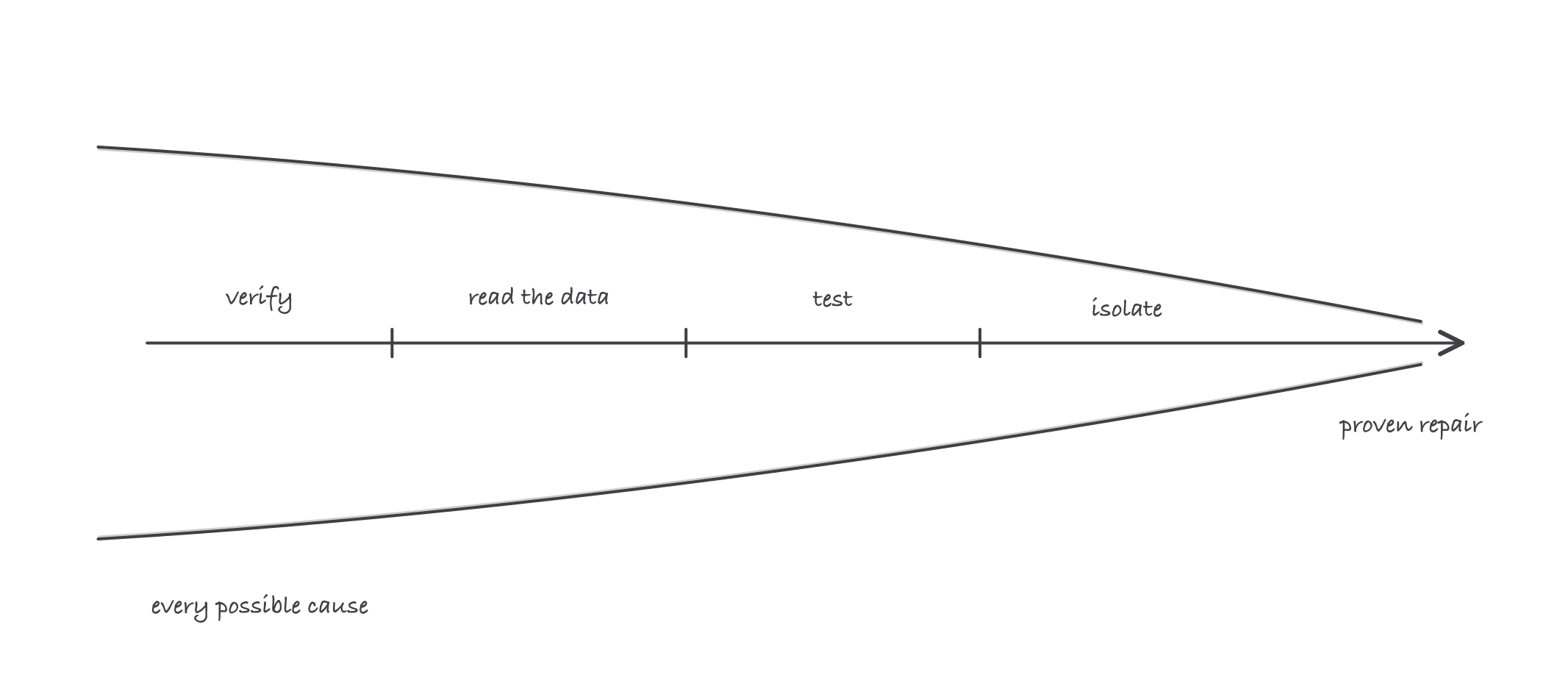
Each step spends a little time to shrink the space where the fault can hide
Worked example: a low-power complaint
A tractor pulls poorly under load, no smoke, no codes. The spec sheet for this engine calls for 28 psi of boost at full load; the gauge shows 18 psi.
Deficit: 28 − 18 = 10 psi. As a fraction of spec, 10 ÷ 28 = 0.357, so boost is 35.7 percent low. That is a real air-path problem, not sensor noise.
The computer meters fuel to the air it measures, which is why the truck is slow but clean: less air, less fuel, no smoke. The short list is now a charge-side leak, a lazy VGT, or a fouled charge air cooler. Pressure-test the charge side first because it is the cheapest test: pressurize the cooler and plumbing per the service procedure and listen. A split boot found in 20 minutes ends a complaint that parts-swapping injectors would never have touched.
The habit to copy: one measured number (18 versus 28) eliminated fuel, mechanical, and aftertreatment in a single step.
Where it bites
- Codes describe symptoms. Read what the code monitors, then ask what else could move that reading.
- The last repair is evidence. Ask what was changed recently. A surprising share of hard diagnostics are a previous repair done wrong: a nicked seal, a swapped connector, an unplugged sensor.
- Mechanical fundamentals never stopped mattering. Compression, valve adjustment, and base engine health sit under every electronic system. When data looks impossible, verify the engine can breathe and seal before doubting five sensors at once.
- Intermittents need recorded data. Chasing an intermittent with a live-only view wastes days. Set up a snapshot or datalog triggered by the fault and let the truck catch itself.
- Two problems can share one symptom. High-mileage trucks accumulate faults. When a repair helps but does not cure, you may have fixed one of two causes, not missed the diagnosis.