Business · Industrial Maintenance
Maintenance Career Paths: Plant, Field, Planning
Part of Maintenance Tech to CMRP · step 30 of 30
In learning paths: Maintenance Tech to CMRP
Maintenance is one of the few trades where the ladder goes sideways as often as up. A technician with five good years can deepen into a specialty in one plant, travel to other people’s plants, move to the desk that plans the work, or move to the role that decides which work is worth doing. Those paths pay differently and suit different lives, and the choice arrives sooner than most people expect.
Why it matters on the job
The spread in this field is unusually wide for a trade. Across the occupational group BLS reports (industrial machinery mechanics, machinery maintenance workers and millwrights together), the lowest 10 percent earned less than $44,430 and the highest 10 percent more than $91,620 as of May 2024, against a median of $63,510. The top decile earns roughly 91,620 / 44,430 = 2.1 times the bottom decile.
A gap that size inside one occupational group is not explained by seniority. It is explained by which industry you work in and which of these paths you took. Choosing deliberately is worth more than waiting to be promoted.
The two doors in
Both entry routes are legitimate and they are not the same door.
The apprenticeship route runs about four years for millwrights, paid, with classroom instruction alongside. It is the deeper and more structured start, and it comes with a credential the industry recognizes.
The on-the-job route is how many industrial machinery mechanics enter. BLS gives a high school diploma or equivalent as the typical entry-level education for the group, with mechanics and maintenance workers usually needing at least a year of on-the-job training. Some workers complete a two-year associate degree in industrial maintenance, which is a middle route between the two.
Where you started constrains less than people fear. What it changes is how much of the theory you have to go back and pick up deliberately, which is exactly what the mechanical and controls subjects in this trade are for. Industrial machinery mechanics sit under Standard Occupational Classification 49-9041.00 if you are searching for registered programs.
Where the work leads
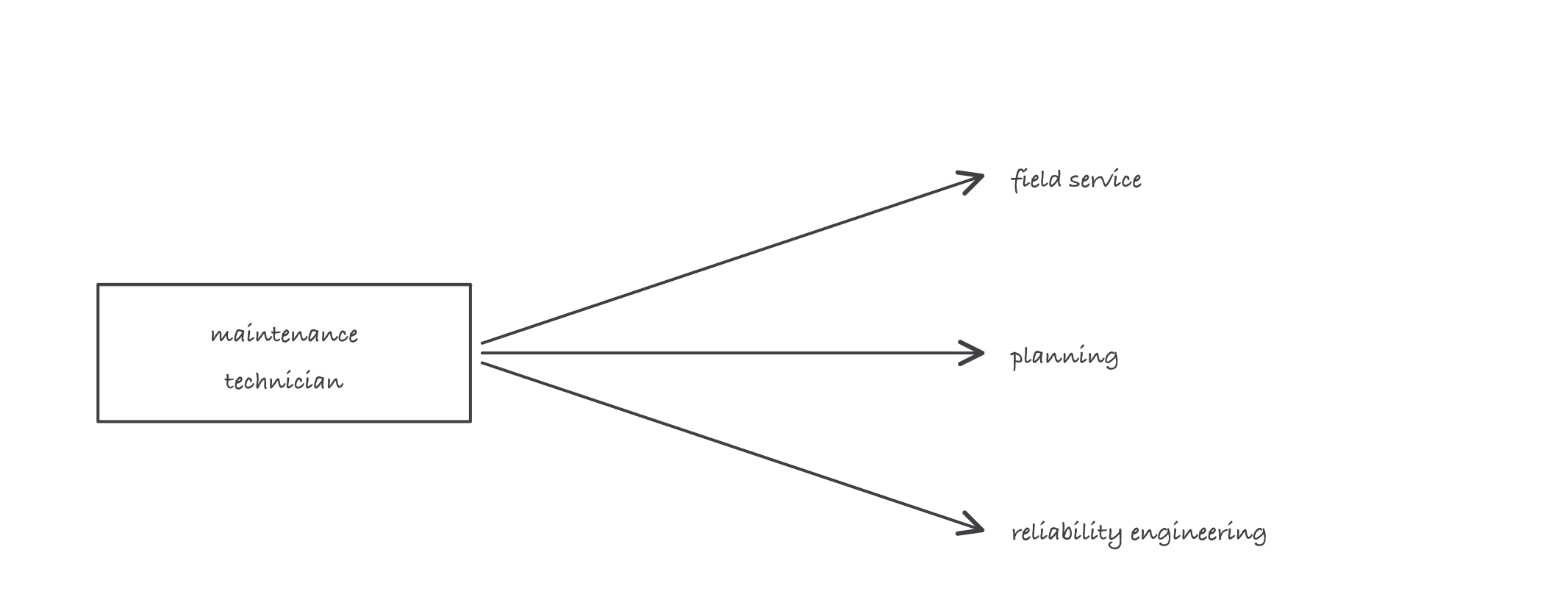
One starting point, three directions, and staying put is a fourth choice rather than the absence of one
Stay in the plant and go deep. The senior plant technician is the person who knows this equipment, this process and this building, and who gets called when the diagnosis is not obvious. Depth here is specialization: hydraulics, controls and PLCs, rotating equipment, or the condition monitoring technologies. The reward is stability, local knowledge that cannot be transferred, and being genuinely hard to replace. The risk is that the knowledge is site-specific, so it does not always travel with you.
Go to the field. Field service technicians and traveling millwrights work on other people’s equipment: OEM service, contractor work, and outage and turnaround work where a plant shuts down and a crew arrives to do a year of work in three weeks. The reward is variety, machine exposure that plant work cannot match, and premium rates for outage and travel work. The cost is that you are away, and outage work runs long days for weeks at a stretch.
Move to planning. The maintenance planner turns identified work into executable work: scoping the job, specifying parts and tools, estimating labor, and sequencing so a crew arrives to a job that is ready. This is a common move off the tools, and technicians routinely underestimate it. A planner who has never done the work writes plans that do not survive contact with the machine, which is why plants recruit planners from the floor.
Move to reliability. The reliability role asks a different question from all of the above. Instead of how do we fix this, it asks why does this keep happening and what would it be worth to stop. Root cause analysis, criticality ranking, PM program design, condition monitoring strategy and the metrics that judge it all live here. This is where the CMRP’s five pillars point, and it is the path that continues into engineering and management.
The credentials that map to each
Two SMRP certifications sit on these paths, and they are aimed at different jobs rather than arranged as steps.
- The CMRT is the technician credential, across four hands-on domains. It fits the plant and field paths.
- The CMRP is the professional credential, across the five pillars of the SMRP Body of Knowledge. It fits the planning and reliability paths.
Neither has an education or experience prerequisite, which means the timing is a judgment rather than a gate. Both have their own lessons in this trade.
Outlook
BLS projects 13 percent growth for this occupational group from 2024 to 2034, which it describes as much faster than the average for all occupations, with about 54,200 openings a year. Those openings come from growth and from replacement, and the replacement half is the larger story in a workforce with a lot of experience close to retirement.
For a technician deciding where to aim, the practical reading is that the plant floor will keep hiring and the roles that need judgment about which maintenance to do are the ones getting harder to fill.
Where it bites
- Leaving the tools is a real change of job. Planning and reliability work is done in a system, in meetings and in documents. Some of the best technicians in a plant are miserable within a year of the move, and the ones who thrive usually knew they wanted the problem rather than the promotion.
- Field money is gross, not net. Outage rates look transformative until you count the weeks away, the unpaid gaps between jobs, and the cost of keeping two places to live. Ask people doing it what a full year actually pays.
- Site-specific knowledge is fragile. Fifteen years of knowing one plant is enormously valuable to that plant and worth much less across the fence. Balance depth with transferable skills: alignment, hydraulics, controls, analysis.
- Titles are inconsistent between plants. Millwright, industrial machinery mechanic, maintenance technician and maintenance mechanic overlap differently in every building. Read the job description and ask what a normal week contains before you read the title.
- The wage spread is a message. A group where the top decile earns roughly twice the bottom is telling you that the industry you pick and the skills you add matter more than the years you serve.
Verified requirements
| Where | Expires | Renewal | Continuing education |
|---|---|---|---|
| United States (federal) | Yes | 3 years | 50 course hours per 3-year cycle, drawn from two or more of the recertification activity categories; recertification application due within 90 days of the expiration date or the exam must be retaken |
| United States (federal) | Yes | 3 years | 50 course hours per 3-year cycle, drawn from two or more of the recertification activity categories; recertification application due within 90 days of the expiration date or the exam must be retaken |
Information comes from issuing-authority sources. Confirm current rules, fees and eligibility with the authority before acting.