Qualifications · General Contracting
Do You Even Need a License for This Job
Assumes you know: How Contractor Licensing Actually Works
Most licensing states draw a dollar line under which a small job needs no contractor license. Above the line you are contracting and the whole licensing chapter applies to you. Below it you are exempt from that chapter and from nothing else. The line is real and the state publishes it. Almost everything contractors get wrong here is a mistake about what gets counted, not about the figure itself.
*Learn the Trades is a free study resource. We are not a licensing body, an authorized training provider, or an exam administrator. Reading this page does not award any card, license, or certification. Always verify requirements with the issuing authority linked in the sources.*Why it matters on the job
How Contractor Licensing Actually Works covers the machinery of getting licensed. The question here comes before all of that, and it is the one a handyman, a moonlighting journeyman and a brand-new one-truck operation all get asked in their first month: is this particular job something I can legally take right now. Getting it wrong is not a fine you pay and move past. In the states with real enforcement, the penalty is aimed at your right to be paid for work you have already done.
What a threshold measures
Two words decide the close calls: aggregate and price.
Aggregate means the whole job added together, not the biggest line in it. Price means the contract price, not your cost and not your profit.
California’s exemption is a good specimen because the statute says it in plain words. Business and Professions Code section 7048 exempts work where “the aggregate contract price for labor, materials, and all other items is less than one thousand dollars.” Three buckets, one sum. Labor is one bucket. Materials is the second. “All other items” is the third, and it is the bucket contractors forget: permit fees, dump fees, equipment rental, the delivery charge on the lumber.
That $1,000 figure is current from January 1, 2026. It was $500 before, raised by AB 1170. Any guide, forum answer or old set of notes quoting $500 for California is describing the law as it stood through 2025. Whenever you write down a threshold, write the year beside it.
Note the exact comparison too. The statute says less than one thousand dollars, so a job priced at exactly $1,000 is outside the exemption. There is no rounding in your favor here.
Where the exemption stops
The dollar figure is the part everyone quotes and it is not the whole section. Section 7048 also carries conditions on the nature of the work and language aimed squarely at people who slice a project into exempt-sized pieces. It runs a single short paragraph. Read it before you rely on it, because the number is the easy half.
And be precise about what an exemption exempts. Falling under the line releases you from the licensing chapter. It does not release you from the building code, from the permit your city requires, from your obligation to carry insurance if you have employees, or from liability for the work when the stair you built fails in two years. An exempt job is one you may take without a license. Every other rule that applied to it still applies.
California is a specimen, not a template
Each state sets its own figure, and some set none at all. Some run registration below the line and full licensing above it. Some license all contracting regardless of value. What travels between states is the structure (a published line, an aggregate measure, and a set of conditions attached to the exemption), and the number itself always comes from the board that publishes it.
One distinction is worth fixing in your head now, because the two devices sound alike and do opposite things. A threshold is a floor: below it, no license. That is different from a monetary limit capping how large a job a given classification may contract, which is a ceiling and a separate mechanism. Whether your state uses ceilings at all, and on which classifications, is a question for your board’s own law and rules.
Worked example: pricing a deck stair
A homeowner wants a rotted deck stair and its rail replaced. You are unlicensed and working in California in 2026. Price the job first, then test it.
- Labor: $700
- Materials, including framing lumber, decking, fasteners and hardware: $520
- Other items, the permit and the dump run: $180
Aggregate contract price: $700 + $520 + $180 = $1,400.
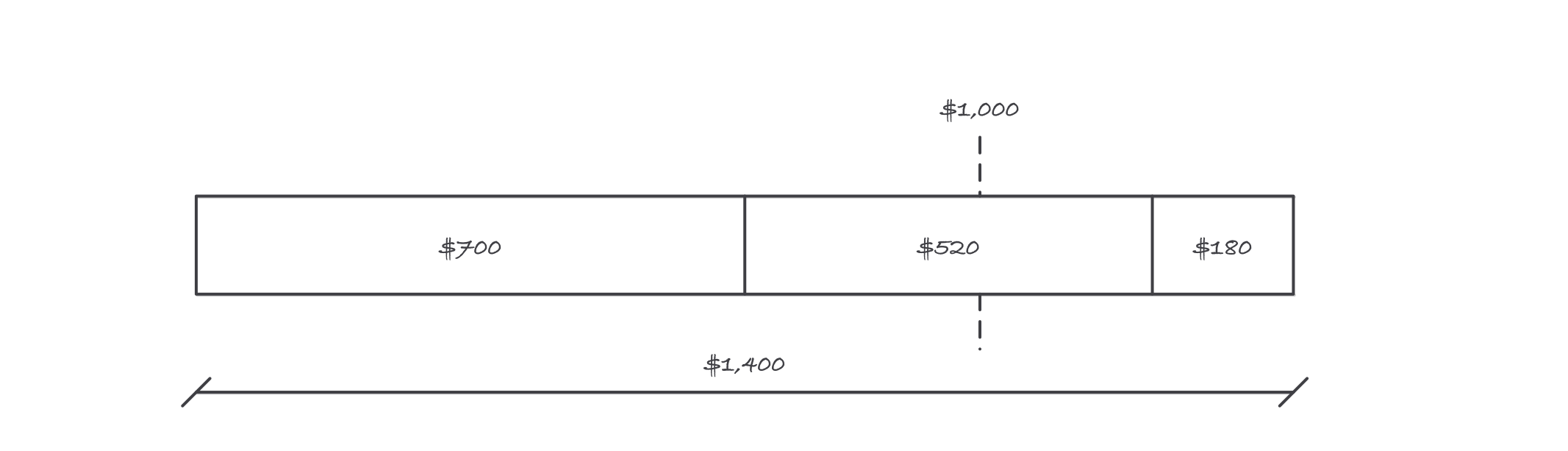
Labor, materials and everything else are one price, and the exemption measures against the whole of it
Test it against the section: is $1,400 less than $1,000? It is not. The exemption does not reach this job, and taking it unlicensed is unlicensed contracting.
Now watch how the wrong reading gets there. Count labor alone and you see $700, which is comfortably under the line, and the job looks exempt. Your labor was never the number the statute asked for. It asked for the aggregate contract price, and the $520 of lumber plus the $180 of fees is $700 of that answer on its own.
There is a second wrong reading whose arithmetic is perfectly correct. Write the work as two contracts of $700, one for the stair and one for the rail, and each sits under the line. Both halves are one deck, on one day, for one homeowner. The exemption is written against exactly that, and Licensing Law Penalties covers what happens when a board decides a split was a split.
What being over the line actually costs
The penalties for unlicensed contracting are their own subject. The part that belongs here is what states do to your money, because it is the part that surprises people.
California B&P 7031(a) bars an unlicensed contractor from bringing an action in any court to collect compensation for work that required a license. The work is done, the customer has it, and the courthouse is closed to you. Section 7031(b) goes further: the person who hired you may bring an action to recover all compensation they already paid. Money in your account is not the end of the story.
Florida takes the same shape by a different route. Florida Statutes section 489.128 makes contracts entered into by an unlicensed contractor unenforceable in law or in equity by that contractor, and shuts off the lien and bond claims that a licensed contractor would use to chase payment.
Both states landed on the same remedy: rather than only fining you, they remove your ability to get paid. That is what makes the threshold question worth two minutes with a calculator before you shake hands.
Where it bites
- Materials count toward the total. What you think of as a $700 day of work is a $1,400 contract once the lumber and the fees are inside it, and $1,400 is the figure the board reads.
- “I’ll write it as two jobs” is a decision the board has seen before. Splitting a project to fit under an exemption is a distinct problem from being over the line, and it is worse, because it shows intent.
- An old number is a wrong number. California moved from $500 to $1,000 effective January 1, 2026. Thresholds move when legislatures decide they should, and material written before a move keeps circulating long after it.
- Exempt from licensing is not exempt from permits. The building department and the licensing board are different agencies with different lines, and clearing one tells you nothing about the other.
- The exemption belongs to the job, not to you. Doing three exempt-sized jobs a week does not make you an exempt contractor. Each contract is tested on its own, and the pattern is what draws attention.
Exam relevance
Business and law exams, including the NASCLA-based ones, test this material as a measurement question rather than a memory question: given a job with labor, materials and fees, is it above or below the state’s line. The obvious wrong answers are a labor-only total and a profit figure. What an unlicensed contractor can and cannot recover belongs to the same area of the syllabus, because that is where the statutes have teeth. For your own state exam, get the current figure and the current wording from the board’s law and rules, and note whether the comparison is written as “less than” or “up to.” That one word decides every job priced exactly on the line.
Verified requirements
| Where | Expires | Renewal | Continuing education |
|---|---|---|---|
| California | Yes | 2 years (CSLB: 'Active licenses expire every two years.' Inactive licences expire every four years.) | Confirm with issuer |
| Florida | Confirm with issuer | Confirm with issuer | Confirm with issuer |
| Arizona | Confirm with issuer | Confirm with issuer | Confirm with issuer |
Information comes from issuing-authority sources. Confirm current rules, fees and eligibility with the authority before acting.