Qualifications · Sheet Metal
TABB Certification: Technician and Supervisor
Part of Sheet Metal to TAB Certified · step 18 of 23 · next: NEBB Certification: Certified Technician and Certified Professional
In learning paths: Sheet Metal to TAB Certified
Assumes you know: Balancing Procedures
TABB runs a two-tier personnel certification in testing, adjusting and balancing: the TABB Certified Technician does the work and prepares the reports, and the TABB Certified Supervisor reviews and signs them off. The certifications are issued through the International Certification Board, and the technician route is the one with a hands-on practical exam, which makes it unusual among the three TAB bodies.
*Learn the Trades is a free study resource. We are not a licensing body, an authorized training provider, or an exam administrator. Reading this page does not award any card, license, or certification. Always verify requirements with the issuing authority linked in the sources.*Why it matters on the job
If you work for a union sheet metal contractor, this is most likely the program your employer will point you at. TABB sits inside the sheet metal industry’s own certification structure, and specifications in that market name it.
The practical exam is also the honest reason to care. A written test proves you can recall a procedure. Eight hours of hands-on work in a certified lab proves you can take the readings, and that difference shows up in how the certification is regarded.
Who actually issues it
The issuer is the International Certification Board. This matters because the accreditation belongs to ICB: ICB states it is a personnel certification body accredited to ISO/IEC 17024 by ANAB. Writing “TABB is ANAB accredited” is a shortcut that gets the entity wrong, and in a submittal that is the kind of imprecision that invites a question you do not want.
TABB also sits inside a much larger ICB certification family. Alongside the TABB Technician and TABB Supervisor, ICB lists a TABB Commissioning Supervisor, a TABB Sound and Vibration Supervisor and a TABB Fume Hood Performance Testing Technician, plus certifications in fire and smoke damper work, duct air leakage testing, indoor air quality, smoke control, building envelope, mechanical acceptance testing and total building energy auditing. The acronym on the card does not name the scope. The discipline does.
The technician route
Two parts, in order.
A written exam, taken after you qualify. Qualification means meeting the program’s eligibility criteria, which the program itself defines and which you should confirm with ICB rather than take from anyone else.
An 8-hour hands-on practical exam in a certified TABB lab. A full working day of taking real readings on real equipment under examination conditions. This is what people mean when they call the TABB route the hands-on one.
Once certified, a technician performs the work and prepares the reports, working under a TABB certified supervisor and for a contractor that meets the program’s requirements. Both of those conditions are structural: the technician certification is designed to operate inside a supervised arrangement rather than independently.
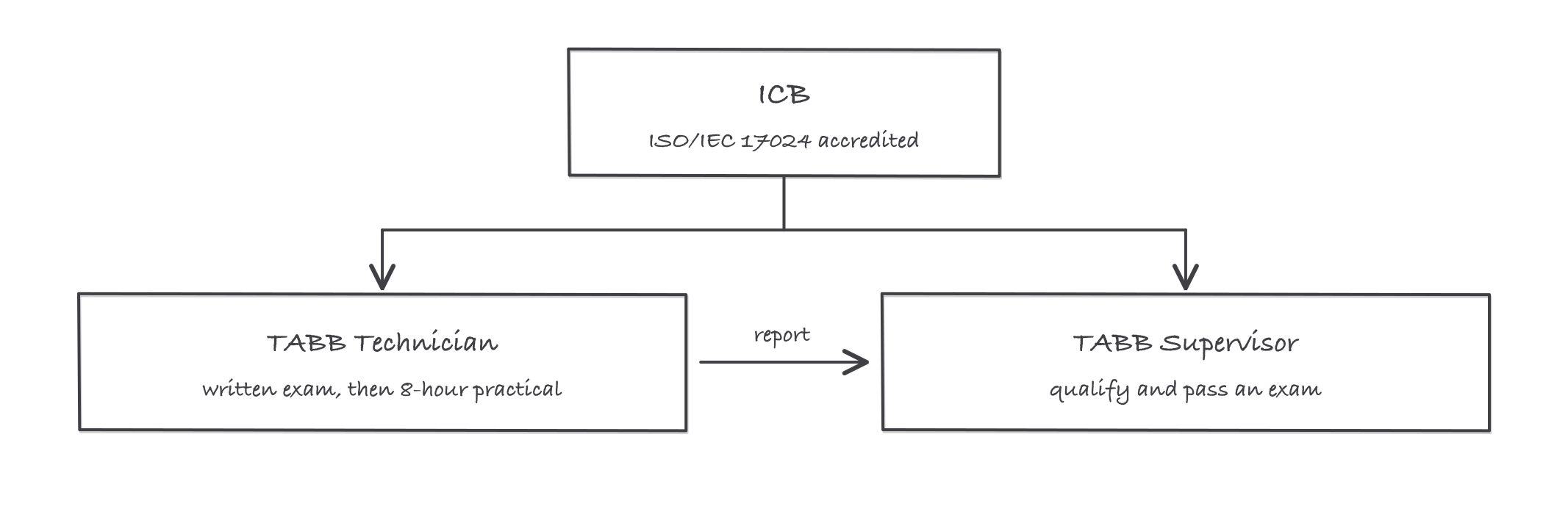
Two tiers and one report path: the technician prepares, the supervisor reviews
The supervisor route
TABB describes the supervisor route as qualifying and passing a rigorous exam. No hands-on practical component is stated for it, which is a genuine difference from the technician route and not an oversight in how it is described.
The eligibility criteria and the testing procedures for supervisors sit in the TABB Quality Assurance Program. What the supervisor does with the certification is defined there too: reports prepared by a TABB certified technician are reviewed by a TABB certified supervisor. That review is the supervisor’s function in the program.
Renewal
TABB’s Quality Assurance Program states that renewal requires continuing education and continuous compliance with the eligibility criteria. The certification expires and has to be maintained.
What is not published on TABB’s public pages is the renewal period or the quantity of continuing education required. Anyone quoting you a specific number of years or hours is going beyond what the program states publicly, so get it from ICB directly when you need it.
Where it bites
- The accreditation belongs to ICB, not to TABB and not to you. ICB is the accredited personnel certification body. Your certification is a personnel certification issued through it; it does not make you or your employer accredited.
- The card names a discipline. With this many certifications in the ICB family, “TABB certified” on a resume or a submittal is incomplete until the discipline is named.
- The technician certification assumes a structure around it. Technicians work under a supervisor and for a qualifying contractor, and reports are reviewed. That is how the program is built, so plan the work around it rather than around one person.
- The renewal numbers are not public, so do not carry them from another body. AABC publishes its continuing education requirements in detail and TABB does not. Applying one body’s numbers to another is guesswork dressed as fact.
Exam relevance
This lesson is about the exam gate itself. The technician exam is written plus practical, so preparation splits accordingly: the written half rewards knowing instruments, airflow measurement and the balancing procedure, and the practical half rewards having actually taken traverses and set devices. The balancing procedures and airflow measurement lessons are the direct preparation for both halves. Confirm current eligibility criteria and exam structure with ICB before you commit to a date.
Verified requirements
| Where | Expires | Renewal | Continuing education |
|---|---|---|---|
| United States (federal) | Yes | Confirm with issuer | Confirm with issuer |
| United States (federal) | Yes | Confirm with issuer | Confirm with issuer |
Information comes from issuing-authority sources. Confirm current rules, fees and eligibility with the authority before acting.