Qualifications · Sheet Metal
NEBB Certification: Certified Technician and Certified Professional
Part of Sheet Metal to TAB Certified · step 19 of 23 · next: AABC Certification: TBT and TBE
In learning paths: Sheet Metal to TAB Certified
Assumes you know: Balancing Procedures
NEBB certifies both firms and people, and its personnel certification runs two tiers across eight disciplines of which testing, adjusting and balancing is one. The Certified Technician works under the guidance of a Certified Professional. The Certified Professional is the person who may authenticate official reports, and only while working for a certified firm. That last condition is the part of the NEBB structure that surprises people.
*Learn the Trades is a free study resource. We are not a licensing body, an authorized training provider, or an exam administrator. Reading this page does not award any card, license, or certification. Always verify requirements with the issuing authority linked in the sources.*Why it matters on the job
NEBB is widely named in commercial mechanical specifications, and it is often named at the firm level. That single design decision shapes careers around it: your certification and your employer’s certification are both required for your signature to carry, so where you work is part of what your certification is worth.
It also means a NEBB-specified project has a fixed staffing shape. Somebody senior must be a Certified Professional in the right discipline, at a firm that holds certification in that discipline, or the reports cannot be authenticated regardless of how good the balancing was.
The two tiers
Certified Technician (CT) is the working tier. NEBB describes it as requiring specific eligibility criteria, training and examinations, and it is explicit that CTs work under the guidance of a Certified Professional. CT is offered in TAB alongside building systems commissioning, cleanroom performance testing, sound measurement and vibration measurement.
Certified Professional (CP) is the senior tier. NEBB describes it as extensive educational background combined with field experience, and notes that certain disciplines also demand demonstration of practical working knowledge and hands-on testing. The CP is the one who signs.
The signing rule
Two conditions have to hold at the same time for a report to be authenticated: the person is a NEBB Certified Professional, and that person is working for a NEBB certified firm.
Read the failure cases. A Certified Professional at an uncertified firm cannot authenticate. A certified firm with no Certified Professional in the relevant discipline cannot hold that discipline’s firm certification in the first place, since NEBB requires a firm to employ a CP in the discipline it wants certification in. The two sides hold each other up.
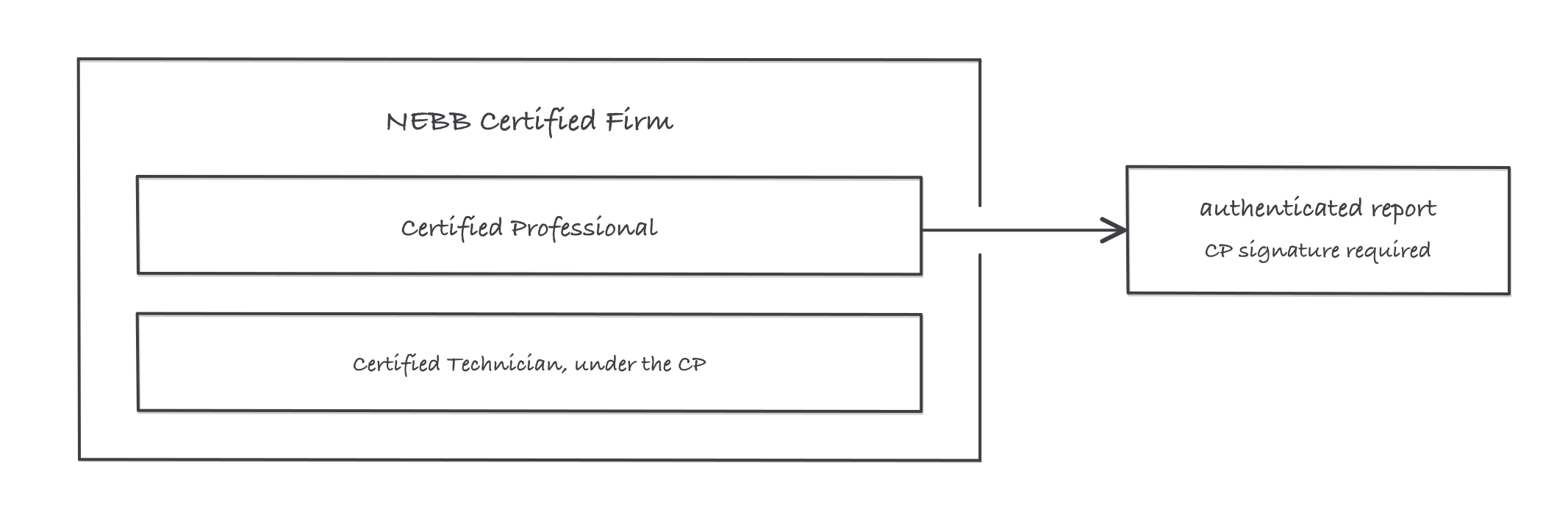
Both conditions at once: a Certified Professional, at a certified firm, is what makes the report authenticated
Eight disciplines, one acronym
NEBB certifies individuals across eight disciplines, so “NEBB certified” is not a scope statement until the discipline is named. TAB and building systems commissioning are two of them, and retro-commissioning is a third and separate one from commissioning.
The practical consequence at submittal review: check that the certification named matches the scope specified. A Certified Professional in sound measurement is a Certified Professional, and it is the wrong discipline for a TAB scope.
Recertification
NEBB states that all Certified Professionals are expected to undertake further education to gain recertification. The certification is maintained rather than held permanently.
What NEBB does not publish on those pages is the numbers: the years of experience required, the structure of the examinations and the quantity of continuing education all live in per-discipline candidacy documents linked from the individual certification page. Get those from NEBB directly. Anybody who quotes you specific years or hours for NEBB TAB certification is going beyond what NEBB states publicly, and comparing against AABC’s published figures is not a substitute, because they are different programs with different rules.
Where it bites
- The firm condition is a live constraint, not paperwork. Changing employer can change whether your signature carries, so ask about the firm’s certification status in the discipline before you take the job.
- The discipline is the fact; the acronym is not. Eight disciplines share one name. Name the discipline in every submittal and every resume line.
- Certified Technicians are not junior Certified Professionals. They are a distinct certification with its own criteria, designed to work under supervision. The path from one to the other is an application, not an automatic progression.
- NEBB, TABB and AABC do not recognize each other. No reciprocity exists between the three bodies, at either the individual or the firm level.
- The published detail is genuinely thinner than AABC’s. That is a fact about where the documents live, not evidence that the requirements are lighter. Treat missing numbers as missing, and go to the source.
Exam relevance
Questions in this area test the structure rather than trivia: which tier may authenticate a report, what additional condition attaches to that authority, what a firm must have to hold certification in a discipline, and how many disciplines exist. For the examinations themselves, prepare against the discipline you are certifying in, and confirm the current eligibility criteria and examination structure with NEBB before you apply.
Verified requirements
| Where | Expires | Renewal | Continuing education |
|---|---|---|---|
| United States (federal) | Yes | Confirm with issuer | Confirm with issuer |
| United States (federal) | Yes | Confirm with issuer | Confirm with issuer |
Information comes from issuing-authority sources. Confirm current rules, fees and eligibility with the authority before acting.