Qualifications · Sheet Metal
AABC Certification: TBT and TBE
Part of Sheet Metal to TAB Certified · step 20 of 23 · next: The Sheet Metal Apprenticeship (SMART/ITI)
In learning paths: Sheet Metal to TAB Certified
Assumes you know: Balancing Procedures
AABC certifies two individual tiers in testing and balancing: the Test and Balance Technician at 3 years of experience, and the Test and Balance Engineer at 8, the latter through an 8-hour written examination. AABC publishes its requirements in more numeric detail than the other two bodies do. It also attaches a condition the others do not: its individual certifications are open only to eligible employees of independent, approved AABC member companies.
*Learn the Trades is a free study resource. We are not a licensing body, an authorized training provider, or an exam administrator. Reading this page does not award any card, license, or certification. Always verify requirements with the issuing authority linked in the sources.*Why it matters on the job
The employment condition changes the question. For the other two bodies, “which certification should I pursue?” is a decision you can make about yourself. For AABC it is partly a decision about your employer, because eligibility runs through an approved member company. If you do not work for one, this route is not open to you today no matter how many years you have on instruments.
That is not a reason to dismiss AABC. It is a reason to find out early whether your employer is a member agency, because the answer determines which of the three ladders you are actually standing on.
The two tiers, in numbers
Test and Balance Technician (TBT). A minimum of 3 years of test and balance experience, plus employment by an AABC agency for the past 12 months, then the required examination. Certified Technicians must be competent in both air and water balancing, not one or the other, and must perform all work in accordance with the AABC National Standards.
Test and Balance Engineer (TBE). A minimum of 8 years of test and balance experience, with 4 years credited for an engineering degree, and an 8-hour written examination delivered through secure computer-based local testing centers. The syllabus is broad: air and hydronic balancing, fan and pump laws, psychrometrics and heat transfer, electrical systems, sound and vibration testing, instrumentation, and TAB project management.
The TBE is also a role and not only a rank. AABC describes the TBE as overseeing the company’s technical operations, reviewing and certifying test and balance reports, and supervising and training technicians.
Worked example: how the 8 years are made up
Two candidates arrive at the same TBE requirement by different routes, and the arithmetic is worth doing because people misread the degree credit as a discount on the exam rather than on the experience.
Candidate A holds an engineering degree. The degree credits 4 years toward the 8-year requirement, so the remaining test and balance experience needed is 8 − 4 = 4 years.
Candidate B does not. No credit applies, so all 8 years must be actual test and balance experience: 8 − 0 = 8 years.
Both then sit the same 8-hour written examination. The degree moves the experience requirement and it does not move the exam.
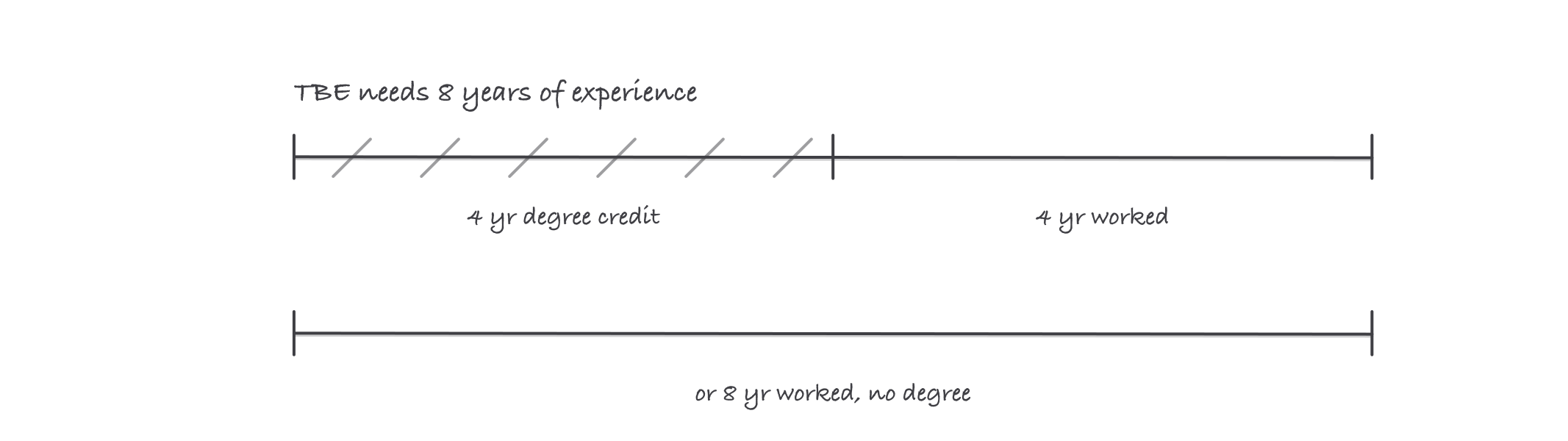
The degree credit reduces the experience requirement by 4 years and leaves the examination unchanged
Now the maintenance arithmetic, which people underestimate.
A TBE needs 60 points of technical continuing education every 3 years, which averages 60 / 3 = 20 points per year. A TBT needs 30 over the same period, or 30 / 3 = 10 points per year. Both certifications are renewable annually, so the renewal is a yearly event while the education requirement is measured over a rolling 3 year window. Falling a year behind on the education does not show up at that year’s renewal and it does show up at the end of the window, which is exactly why people get caught by it.
The firm side
A company becomes an AABC-Certified Member Agency once the Board of Directors approves it for membership and it has at least one individual who has passed the TBE exam, and every member agency must keep at least one certified TBE on staff.
Combine that with the employment condition on individual certification and the structure closes on itself: individuals qualify through member companies, and member companies qualify by having a TBE. In practice that means this route is entered by joining an existing member agency, and a firm building the capability from nothing has a sequencing problem to solve rather than a form to fill in.
Where it bites
- Certification is not portable in the usual sense. Eligibility runs through employment at an approved member company, so “which body should I certify with?” is partly a question about who employs you.
- The degree credit is 4 years, not an exemption. It reduces the experience requirement and it leaves the 8-hour examination exactly where it was.
- The TBT experience has two parts. Three years of test and balance experience, and 12 months of it at an AABC agency. Meeting the total while failing the recent-employment part does not qualify you.
- Air and water, both. The TBT competence requirement covers hydronic balancing as well as air. An air-only background is an incomplete one for this certification.
- Do not read AABC’s numbers onto the other bodies. AABC publishes years, exam hours and continuing education points; TABB and NEBB keep some of that off their public pages. Borrowing a number across bodies produces a confident wrong answer.
Exam relevance
The TBE examination is 8 hours, and the syllabus above tells you what to study. It is a broader body of knowledge than day-to-day air balancing, and the hydronic and sound and vibration portions are where field-trained candidates typically find the gaps. Confirm current requirements and examination arrangements with AABC before you plan around them.
Verified requirements
| Where | Expires | Renewal | Continuing education |
|---|---|---|---|
| United States (federal) | Yes | 1 year | 30 points of technical continuing education credit every 3 years |
| United States (federal) | Yes | 1 year | 60 points of technical continuing education credit every 3 years |
Information comes from issuing-authority sources. Confirm current rules, fees and eligibility with the authority before acting.