Business · Sheet Metal
Moving From Installer to TAB Technician
Part of Sheet Metal to TAB Certified · step 23 of 23
In learning paths: Sheet Metal to TAB Certified
Assumes you know: The Sheet Metal Apprenticeship (SMART/ITI)
Testing, adjusting and balancing is the sheet metal trade’s real specialization, and it is reached from the tools rather than instead of them. You install duct, you learn what a system is supposed to do, and then you move to the crew that measures and sets it. What you usually do not get to choose is which of the three certifying bodies you end up with, because that follows your employer.
*Learn the Trades is a free study resource. We are not a licensing body, an authorized training provider, or an exam administrator. Reading this page does not award any card, license, or certification. Always verify requirements with the issuing authority linked in the sources.*Why it matters on the job
Sheet metal is a small trade that is not growing quickly. BLS counts about 127,000 sheet metal workers in the US in 2024, with roughly 10,600 openings a year and 2 percent growth projected across 2024 to 2034. In a trade shaped like that, moving up the ladder beats waiting for the market to move.
TAB is the clearest rung above journeyman that does not require you to start a company. It changes what you do all day: less fabrication and hanging, more instruments, arithmetic and reports, and considerably more time explaining findings to people who are not tradespeople.
What the work actually is
Three verbs, and they are not synonyms. Testing is measuring what the system is doing. Adjusting is changing device settings. Balancing is proportioning flow across the system so each terminal gets its design share, and then documenting it.
The report is a real part of the job, not the paperwork after the job. In every one of the three programs the senior certified tier exists specifically to review and sign reports, which tells you how much weight the industry puts on that document.
The move is made from the tools
Start with the apprenticeship. The ITI program that SMART and SMACNA jointly sponsor is a four or five year registered apprenticeship, entered with a high school diploma or GED, with little to no tuition cost and books and tablets provided. That is where the trade knowledge comes from, and TAB is not a shortcut around it.
Then comes the part nobody schedules for you: getting onto TAB work. Balancing crews are small, and they are staffed from installers who already understand what the duct was supposed to do. Ask early, ask often, and say yes to the first traverse somebody offers to teach you.
Which body is mostly a question about your employer
Three unaffiliated bodies certify in this discipline and none of them recognizes another’s certification. The one you pursue is usually determined by who you work for.
Read the AABC condition again, because it is the one that turns this into a question about employment. You cannot pursue that certification as a free agent and carry it to any employer afterwards. The other two are structured differently, and the firm versus individual certification lesson lays out all three side by side.
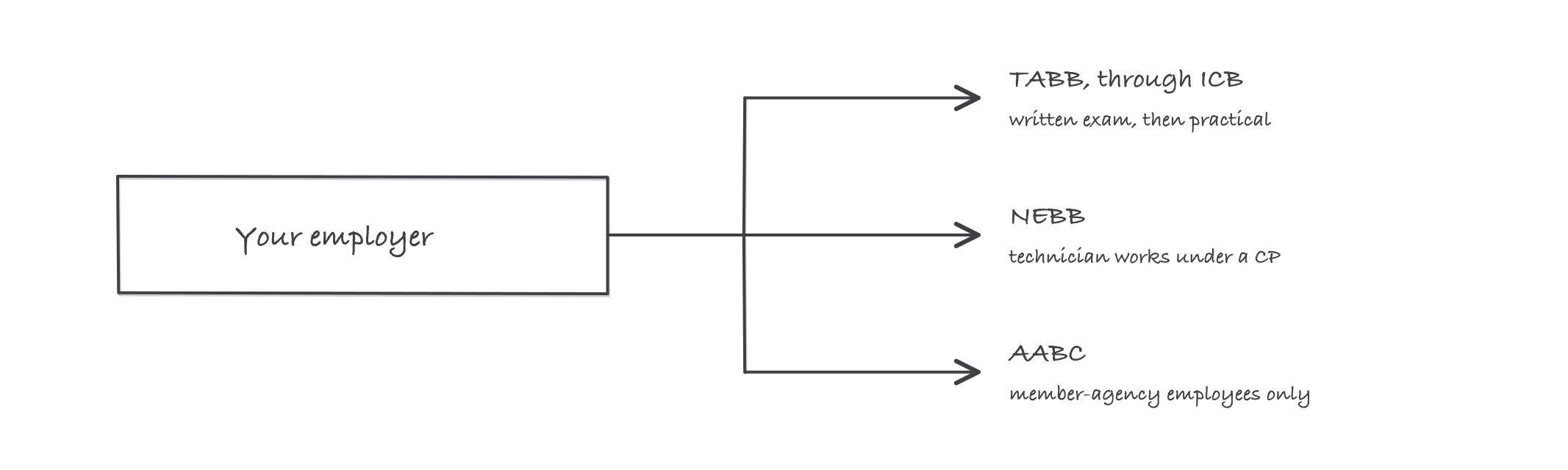
The realistic decision: your employer determines which of the three ladders is available to you
A realistic sequence
Put dates on it, using AABC’s published figures because they are the ones stated numerically.
- Years 1 to 5: apprenticeship. A four or five year registered program. Take the five year case.
- Year 5 onward: journeyman installer, while looking for TAB exposure. Whether any of this time counts as test and balance experience depends entirely on the work you actually performed, and that judgment belongs to the certifying body rather than to you.
- Earliest TBT eligibility on experience alone: 3 more years. 5 + 3 = year 8 of your career, and only if the last 12 months of it are with an AABC agency.
- Earliest TBE eligibility: 8 years of test and balance experience. 5 + 8 = year 13 without a degree. With an engineering degree crediting 4 years, the requirement drops to 4 years of test and balance experience, so 5 + 4 = year 9.
Two things to take from that arithmetic. The senior tier is a decade-scale commitment rather than a course, and the four year gap between year 13 and year 9 is the practical value of the degree credit in this program.
Where it bites
- Apprenticeship years are not automatically test and balance years. Hanging duct teaches you the systems; it is not the same as performing TAB. Keep records of what you actually did and by whom it was supervised.
- You may not get a free choice of body. With AABC the eligibility runs through your employer. With the others the practical pressure is the same, because employers sponsor and specify the program they work under.
- Nothing converts. Certification with one body does not transfer to another, so changing employers can mean starting a new ladder rather than climbing further up the one you are on.
- The junior tier is designed to be supervised. In each program the technician works under a senior certified person who reviews the reports. That is the structure and not a comment on your ability.
- The instruments are only half of it. Psychrometrics, fan and pump laws, hydronics and electrical systems all show up in the senior examinations. Field skill without the theory stalls at the technician tier.
Exam relevance
Which examination you sit depends on the body, and the shapes differ: TABB’s technician route pairs a written exam with an 8-hour hands-on practical, while AABC’s TBE is an 8-hour written examination across a broad syllabus. Study the discipline rather than the acronym, prepare on real systems as well as on paper, and confirm current eligibility criteria with the certifying body itself before you plan a date around any of it.