Qualifications · Low Voltage and Telecom
Security and Alarm Licensing: The State Pattern
Part of Fire Alarm Technician, NICET Track · step 11 of 11
In learning paths: Fire Alarm Technician, NICET Track
Assumes you know: Low-Voltage Licensing by State
Security and alarm work is often licensed separately from everything else in the low-voltage trade, sometimes by a different agency entirely. If you install intrusion, access control or fire alarm systems, the license that covers your cable pulls may say nothing about your alarm panels, and the state’s electrical board may not even be the regulator to ask.
*Learn the Trades is a free study resource. We are not a licensing body, an authorized training provider, or an exam administrator. Reading this page does not award any card, license, or certification. Always verify requirements with the issuing authority linked in the sources.*Why it matters on the job
Alarm work touches life safety and property protection, so legislatures regulate it harder and differently than data cabling. The consequences of guessing wrong are worse here too: in the states below, unlicensed alarm contracting is a statutory violation, and in Texas the regulator is a public safety agency running fingerprint background checks. Know the pattern before you quote alarm work anywhere.
Texas: alarm work belongs to DPS, not the electrical board
Texas regulates alarm installers through the Department of Public Safety’s Private Security program, under Occupations Code chapter 1702, not through the state’s electrical licensing scheme. Two features define the regime:
- Individuals must affiliate with a licensed company. An alarm installer license only operates under a DPS-licensed alarm systems company (a Class B security contractor). There is no freestanding individual authorization to sell alarm work.
- Fingerprint background checks. This is a security regime; vetting is part of the license.
Florida: two alarm licenses split on fire
Florida’s electrical contracting board licenses alarm system contractors under statute 489.505, in two classes:
- Alarm System Contractor I: all alarm systems, including fire alarm.
- Alarm System Contractor II: all alarm systems except fire alarm.
The statute also cuts the other way: a registered electrical contractor may not contract for alarm system work without the separate alarm license. Holding the broader electrical credential does not fold alarm work in.
California: the carve-out inside the low-voltage classification
California’s C-7 Low Voltage Systems contractor classification explicitly excludes fire alarm systems. A C-7 contractor can build out communications, intrusion and sound systems, and still cannot contract the fire alarm scope on the same floor plan under that classification.
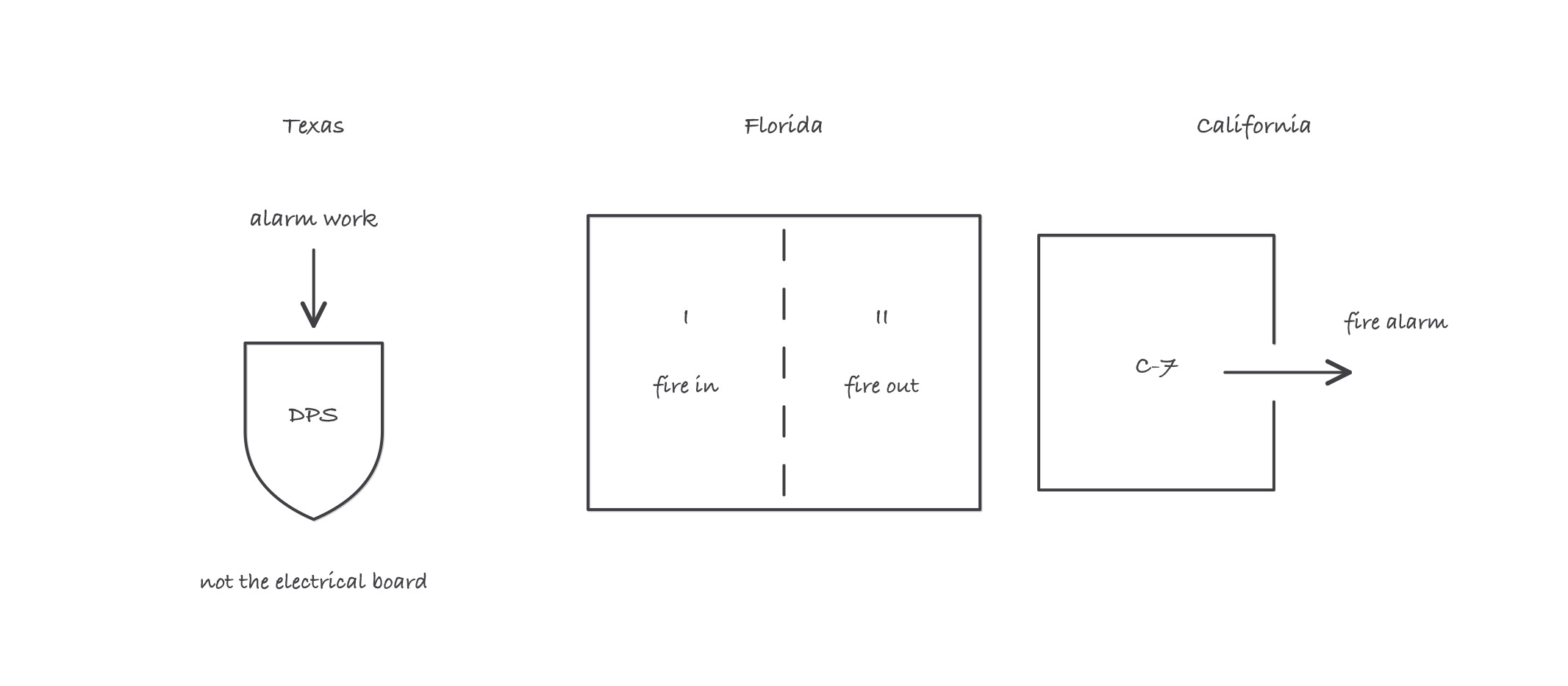
Three states, one lesson: the alarm scope keeps escaping the license you expected to cover it
The pattern to carry
Across states, three questions locate any alarm licensing regime:
- Which agency owns it? Electrical board, contractor board, or public safety agency; Texas proves it is not always the board you expect.
- Where is the fire line drawn? Fire alarm is repeatedly split from other alarm work: Florida’s two classes and California’s C-7 exclusion are the same idea in different statutes. Oregon draws a similar line inside its limited-energy licenses, covered in the licensing-by-state lesson.
- Who must hold the license, the person or the company? Texas requires both, tied together by affiliation.
Answer those three from the issuing agency’s own pages and you understand a state’s regime; guess any of them and you can be confidently, expensively wrong.
Where it bites
- “My low-voltage license covers alarms” fails in several big states. Scope text decides, not the license title.
- Fire alarm is the recurring carve-out. Whenever you see an alarm license, check which side of the fire line it sits on before you bid.
- Monitoring, selling and installing may be regulated separately. Security statutes often cover the whole chain of the business; verify which activities your license class actually permits.
Exam relevance
Where alarm licenses require exams, they test the state’s statute and rules alongside trade knowledge: scope, affiliation, conduct requirements. The statute citations in this lesson’s sources are the primary study documents for the Texas and Florida regimes.
Verified requirements
| Where | Expires | Renewal | Continuing education |
|---|---|---|---|
| Washington | Yes | Confirm with issuer | Confirm with issuer |
| Oregon | Yes | 3 years | Confirm with issuer |
| California | Yes | Confirm with issuer | Confirm with issuer |
| Texas | Yes | Confirm with issuer | Confirm with issuer |
| Florida | Yes | Confirm with issuer | Confirm with issuer |
Information comes from issuing-authority sources. Confirm current rules, fees and eligibility with the authority before acting.