Qualifications · Low Voltage and Telecom
Low-Voltage Licensing by State
Low-voltage licensing in the US is fragmented by design: there is no federal license, no national definition of “low voltage”, and no single pattern the states agree on. What exists instead is three broad regimes, and knowing which one your state runs tells you where to look and what to expect.
*Learn the Trades is a free study resource. We are not a licensing body, an authorized training provider, or an exam administrator. Reading this page does not award any card, license, or certification. Always verify requirements with the issuing authority linked in the sources.*Why it matters on the job
Work that is unregulated in one state is a licensed electrical specialty in the next and a fingerprint-checked security occupation in a third. Crossing a state line with the wrong assumption can put you on the wrong side of an electrical board or, in the security states, a public safety agency. Before you take work in a new state, you need to know which regime it runs.
Three regimes
Regime 1: a limited-energy electrician license. Washington and Oregon treat low-voltage work as a licensed electrical specialty with apprenticeship-style hour requirements. Washington’s Limited Energy System (06) specialty requires 4,000 hours of experience, with trainees also completing 48 hours of classroom instruction; its scope is defined by circuit type (signaling and power-limited circuits), covering telecom, fire protection signaling, intrusion, energy management and sound systems. Oregon splits the license in two: Class A Limited Energy (LEA) includes protective signaling such as fire alarm, nurse call and security, and runs through a 6,000-hour apprenticeship; Class B (LEB) excludes protective signaling and requires 4,000 hours, with renewal every three years.
Regime 2: a contractor classification. California does not license individual low-voltage installers; it licenses the contracting business. The CSLB C-7 Low Voltage Systems classification covers the work, and fire alarm systems are explicitly excluded from it.
Regime 3: a security-specific regime. Texas and Florida regulate the alarm and security slice of the trade through dedicated schemes: Texas through DPS Private Security, Florida through Alarm System Contractor licenses under its electrical contracting board. The security and alarm licensing lesson covers both in detail.
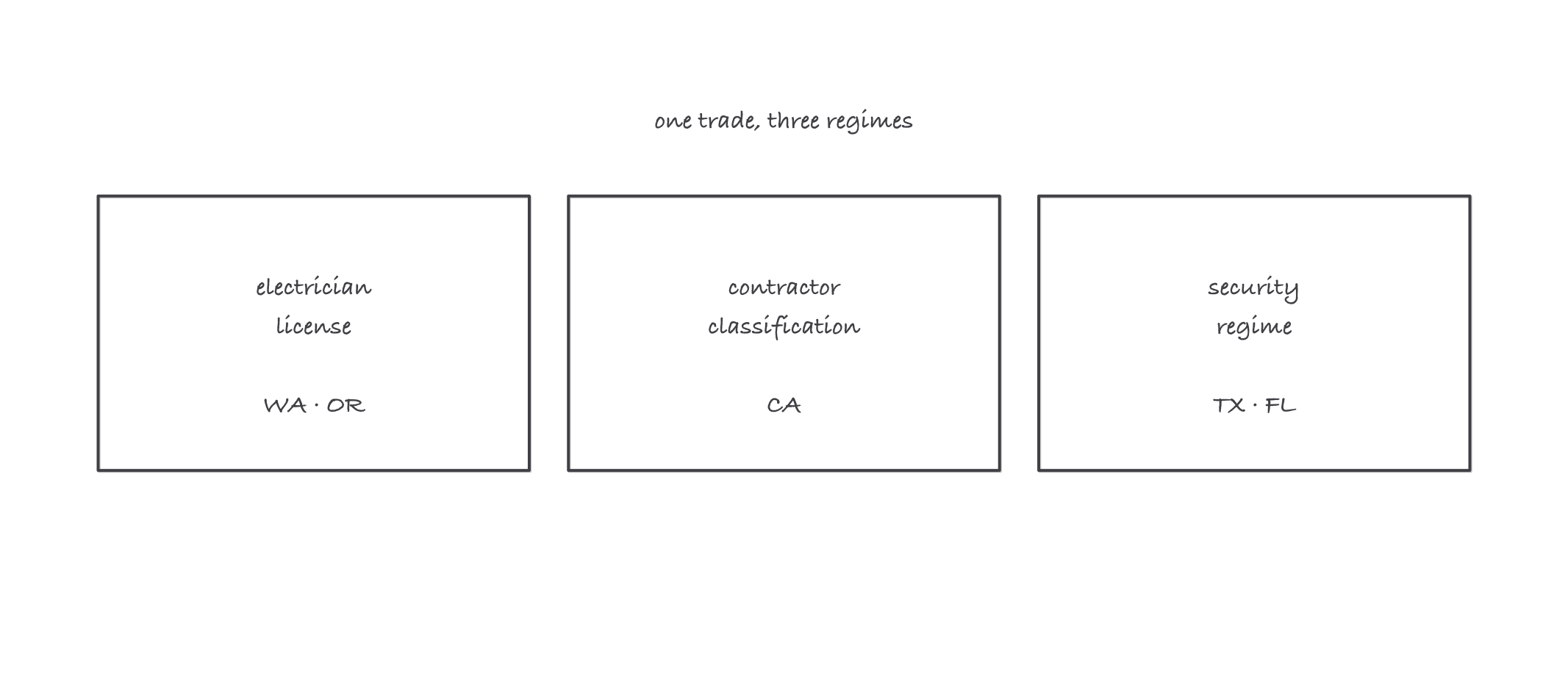
The same cable pull sits under three different legal regimes depending on the state
The definition trap
Volts and volt-amperes are different quantities: volts measure electrical potential, volt-amperes measure power. Swap them and you misstate the law in both Oregon and California at once. This is not pedantry; a 24 V circuit can exceed 100 VA easily, and a 90 V circuit can sit under it.
Where it bites
- Fire alarm is often carved out. California’s C-7 excludes it, Oregon’s LEB excludes protective signaling, and Florida splits its alarm licenses over exactly this line. Holding “the low-voltage license” does not mean you can touch fire alarm; check the scope text.
- The regulator may not be the electrical board. In Texas, alarm work runs through DPS Private Security, a public safety agency, not the electrical licensing body.
- This lesson is a map, not a rulebook. Five states are profiled because their rules are verified; the other 45 each have their own answer, including no license at all. The pattern to carry: find the scope definition, find the hour or experience requirement, find out who issues it. Your state board’s own pages are the only authority that counts.
Exam relevance
Where a state runs a limited-energy license, it runs a licensing exam to match, built on that state’s adopted electrical code and license scope. The state pages linked in the sources are where exam candidate information lives.
Verified requirements
| Where | Expires | Renewal | Continuing education |
|---|---|---|---|
| Washington | Yes | Confirm with issuer | Confirm with issuer |
| Oregon | Yes | 3 years | Confirm with issuer |
| California | Yes | Confirm with issuer | Confirm with issuer |
| Texas | Yes | Confirm with issuer | Confirm with issuer |
| Florida | Yes | Confirm with issuer | Confirm with issuer |
Information comes from issuing-authority sources. Confirm current rules, fees and eligibility with the authority before acting.