Qualifications · Low Voltage and Telecom
NICET Fire Alarm Certification (Levels I-IV)
Part of Fire Alarm Technician, NICET Track · step 8 of 11 · next: NICET Fire Alarm Levels I-II: Exams and Work History
In learning paths: Fire Alarm Technician, NICET Track
Assumes you know: NFPA 72 Basics
NICET Fire Alarm Systems certification is the credential ladder for the fire alarm side of low-voltage work: four levels, run by NICET, the National Institute for Certification in Engineering Technologies. When a job spec, a state licensing rule or a contract document wants proof that a person knows fire alarm systems and NFPA 72, this is the credential it names.
*Learn the Trades is a free study resource. We are not a licensing body, an authorized training provider, or an exam administrator. Reading this page does not award any card, license, or certification. Always verify requirements with the issuing authority linked in the sources.*Why it matters on the job
Fire alarm is the most heavily specified corner of low-voltage work, and NICET levels are the industry’s shorthand for competence in it. Specifications routinely call for work to be performed or supervised by personnel holding a stated NICET level, and several states fold NICET levels into their fire alarm licensing rules. On the pay side, each level is a defensible reason to renegotiate: the credential is portable between employers and states in a way that a company title is not.
The four-level ladder
The program runs from Level I through Level IV. Each step assumes more scope and more responsibility: the early levels sit closest to the tools, the later levels sit with system layout, project responsibility and program-level work. The two lessons that follow this one cover Levels I-II and Levels III-IV in detail.
What matters at the overview stage is the shape of the ladder: no level is exam-only. Every level requires passing the exam for that level and documenting a verified work history. Levels III and IV add personal recommendations, and Level IV adds a Major Project submission, a documented piece of senior-level work.
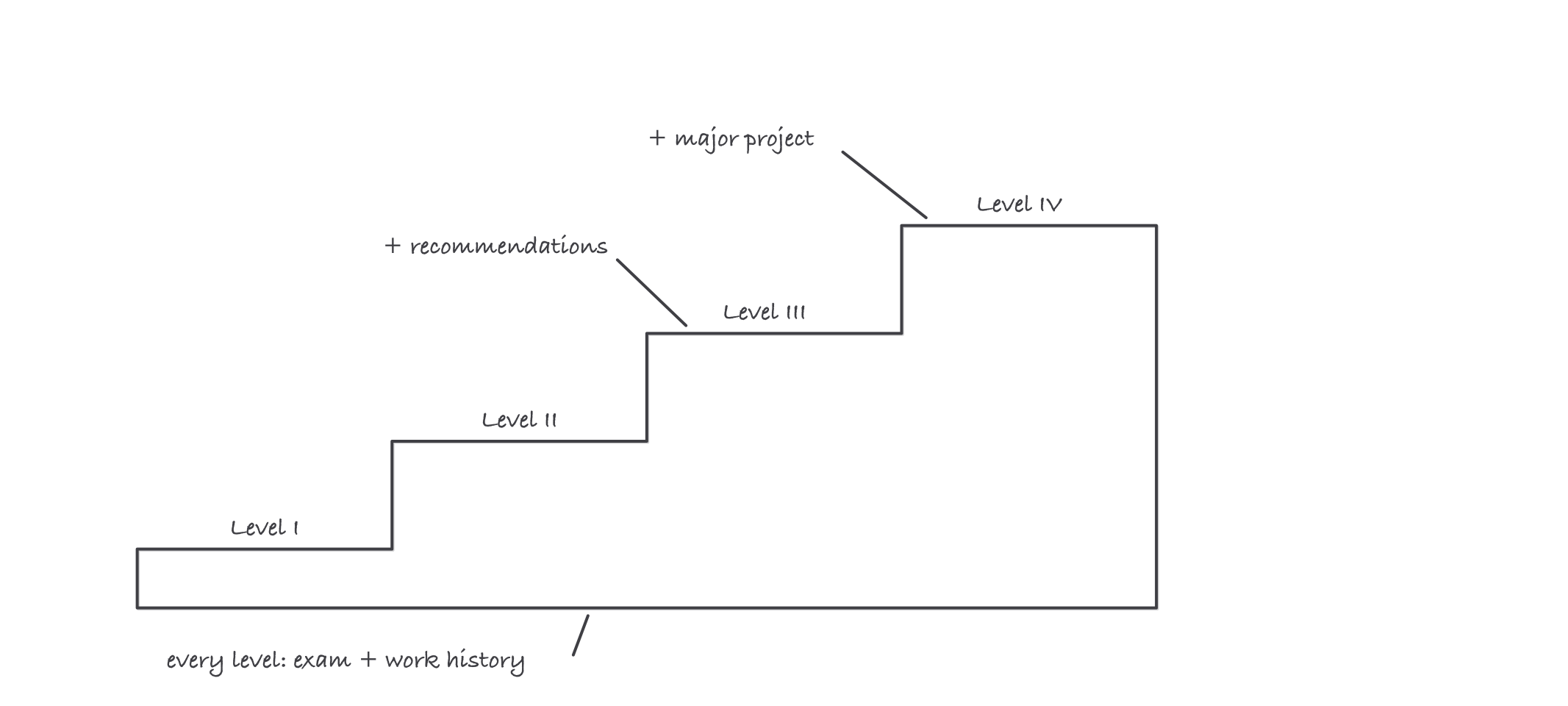
Every step is exam plus work history; the top two steps add more evidence, not more multiple choice
The exams at a glance
| Level | Questions | Time | Fee |
|---|---|---|---|
| I | 85 | 110 min | $235 |
| II | 110 | 155 min | $325 |
| III | 115 | 170 min | $380 |
| IV | 120 | 290 min, incl. 30-min break | $435 |
Fees shown took effect August 1, 2026; NICET adjusts them periodically, so check the program page before you schedule.
Recertification
Certification at every level renews on a three-year cycle. Renewal is by documented continuing professional development, not by retesting: you log qualifying activity across the cycle and submit it. Let it lapse and you are back to proving yourself from scratch, so treat the CPD log as part of the job.
Where it bites
- “Pass the test, get certified” undersells it. The work history requirement is real at every level, and reconstructing years of project dates and supervisor signatures at application time is painful. Keep records as you go.
- Certification is not a license. Several states reference NICET levels inside their own fire alarm licensing schemes; the license still comes from the state. Check your state board before assuming a level satisfies a legal requirement.
- The levels are sequential in practice. The work history and content build on each other; plan the ladder as a career arc, not a cramming exercise.
Exam relevance
The exams are built around NFPA 72 and fire alarm practice: system types, circuits, initiating devices, notification appliances, and inspection and testing. If you have worked through the life-safety lessons in this trade, you have seen the content the early levels test. Code navigation speed matters as much as knowledge; the NFPA 72 navigation lesson exists for exactly this reason.