Business · Low Voltage and Telecom
Becoming a Low-Voltage Contractor
Assumes you know: Low-Voltage Licensing by State
Becoming a low-voltage contractor means moving from holding a personal qualification to holding the business license: the thing that lets a company contract for low-voltage work, pull the jobs, and carry the legal responsibility. In most states the contractor license is a separate object from any individual license or certification you already hold, with its own application, its own exam and its own obligations.
Why it matters on the job
The contractor license is where the margin lives. As an employee or a licensed individual, you sell hours; as a contractor, you sell installed systems, and you keep the difference between the bid and the cost. The trade-off is that every compliance obligation in this trade (licensing scope, permits, code, insurance) now lands on you personally.
The pattern
The exact mechanics vary state by state, but the recurring shape looks like this:
- An individual qualifies the company. States typically require a named person, often called a qualifying party or qualifier, whose experience and exam results the company license hangs on. In California’s C-7 classification, that is the qualifier structure of a CSLB contractor license. In Texas, alarm work requires the company itself to be licensed through DPS Private Security, and licensed individuals must work under a licensed company.
- The business is vetted, not only the person. Expect entity registration, insurance and bonding at state-set levels, and in the security states, background checks; Texas fingerprints applicants.
- Scope follows the license class. A California C-7 contractor cannot contract fire alarm work under that classification; a Florida Alarm System Contractor II cannot contract fire alarm where a Contractor I can. Pick the class that matches the work you intend to sell.
- Renewal and compliance are continuous. Licenses renew on a cycle, records must be kept, and the contractor answers for employees’ work.
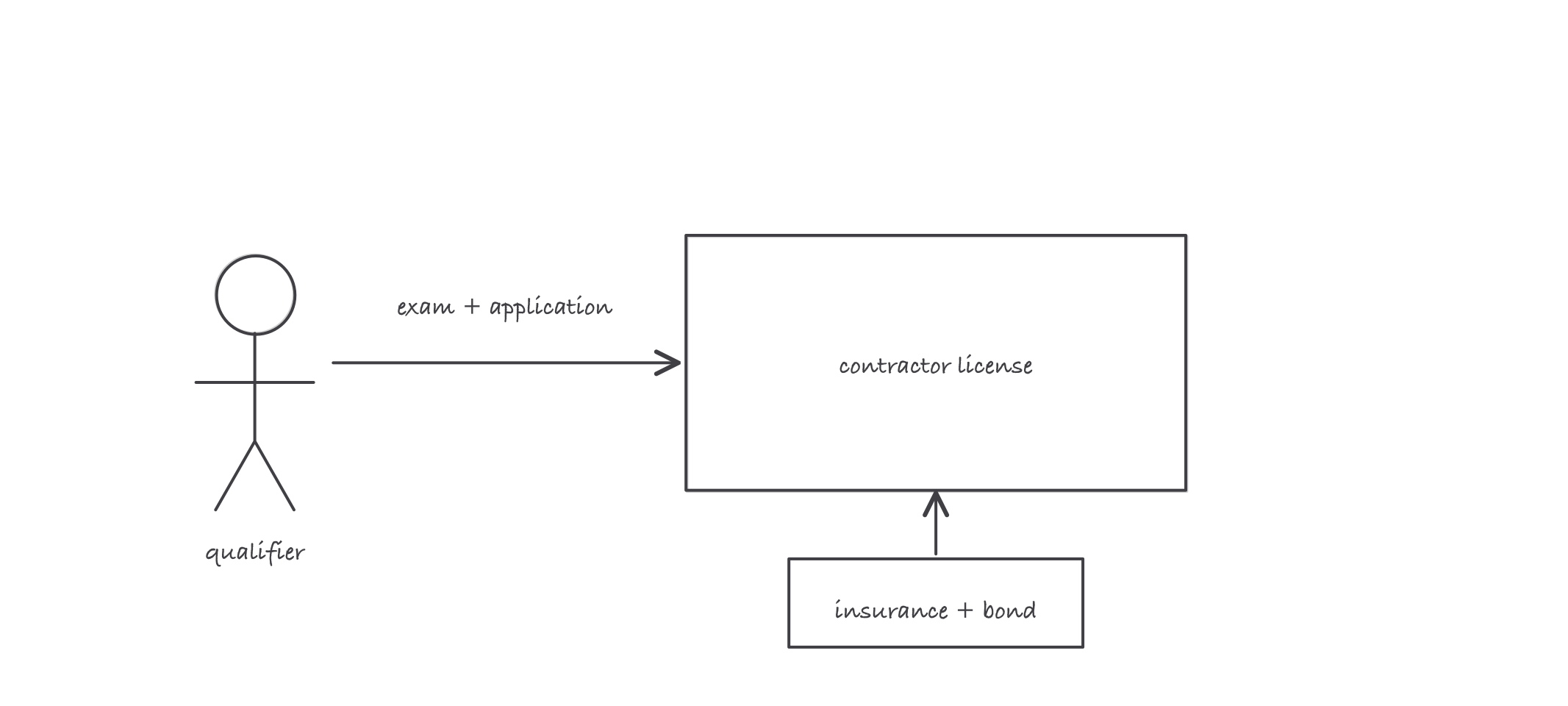
The company license hangs on a qualified individual plus a vetted business, not on either alone
Reading the market
The Bureau of Labor Statistics groups much of this trade under telecommunications technicians, with a May 2024 median wage of $64,310. Projected employment declines 3 percent over 2024-34, yet the occupation still produces roughly 23,200 openings a year, essentially all from replacing workers who retire or move on. For a contractor, the read is: this is a replacement-driven labor market with steady installed-base service demand, not a boom market. Specializing where the demand is structural (security, life safety interface work, network upgrades) beats chasing volume.
Where it bites
- Your individual credential does not become a company license. A personal limited-energy license or an industry certification qualifies you; the company still needs its own license where the state requires one.
- Contracting without the right class is the classic violation. The scope lines (fire alarm carve-outs above all) exist in statute, and boards enforce them against contractors far more often than against employees.
- The qualifier carries the risk. If you qualify a company, its violations attach to your record. Qualify only businesses you actually control or trust.
Exam relevance
Contractor exams typically add business and law content, contracts, lien law, payroll, safety obligations, on top of trade content. The state board that issues the license publishes the candidate bulletin that defines exactly what its exam covers.
Verified requirements
| Where | Expires | Renewal | Continuing education |
|---|---|---|---|
| Washington | Yes | Confirm with issuer | Confirm with issuer |
| Oregon | Yes | 3 years | Confirm with issuer |
| California | Yes | Confirm with issuer | Confirm with issuer |
| Texas | Yes | Confirm with issuer | Confirm with issuer |
| Florida | Yes | Confirm with issuer | Confirm with issuer |
Information comes from issuing-authority sources. Confirm current rules, fees and eligibility with the authority before acting.