Business · Construction Safety
Building a Safety Career From the Trades
Part of From the Tools to Safety Professional · step 24 of 24
In learning paths: From the Tools to Safety Professional
Assumes you know: OSHA 30: What It Covers
Safety is construction’s most underrated second career: it keeps you on sites, it pays professionally, and it values exactly the field experience a decade on the tools builds. The path from trade work into safety is well marked once you can see the rungs.
*Learn the Trades is a free study resource. We are not a licensing body, an authorized training provider, or an exam administrator. Reading this page does not award any card, license, or certification. Always verify requirements with the issuing authority linked in the sources.*The arc
- On the tools, safety-aware. The OSHA 10, then the 30 when supervision arrives. Cost: days. This is where most people discover whether hazards interest them beyond compliance.
- The bridge role. Foreman or crew lead who owns the site’s daily safety: toolbox talks, inspections, incident response. Same paycheck source, new muscle. Many companies formalise it as a part-time site safety role.
- Site safety professional, the CHST. The certification that makes it a job title. Full-time site safety on commercial projects, often a pay rise from the tools and always an easier decade on the body.
- Safety management, ASP, then CSP. Program ownership across projects or a company: systems, budgets, culture, the regulator relationship. The CSP is the field’s master license equivalent.
Why tradespeople make the best safety professionals
Credibility. A safety manager who has actually built scaffold, pulled wire, or run a trench crew gets listened to on sites in a way a clipboard-first hire never will. The industry knows it: field-to-safety converts are actively sought, and their deficit, exam technique, report writing, regulatory navigation, is exactly what the Learn section and the credential guides here teach.
Honest trade-offs
- Early safety roles can pay less than peak tool wages, especially against overtime-heavy trade income; the curve crosses back with the CHST and beyond.
- The job is influence without much direct authority: you stop hazards through supervisors, not your own hands. People who need to fix things personally find that transition the hardest part.
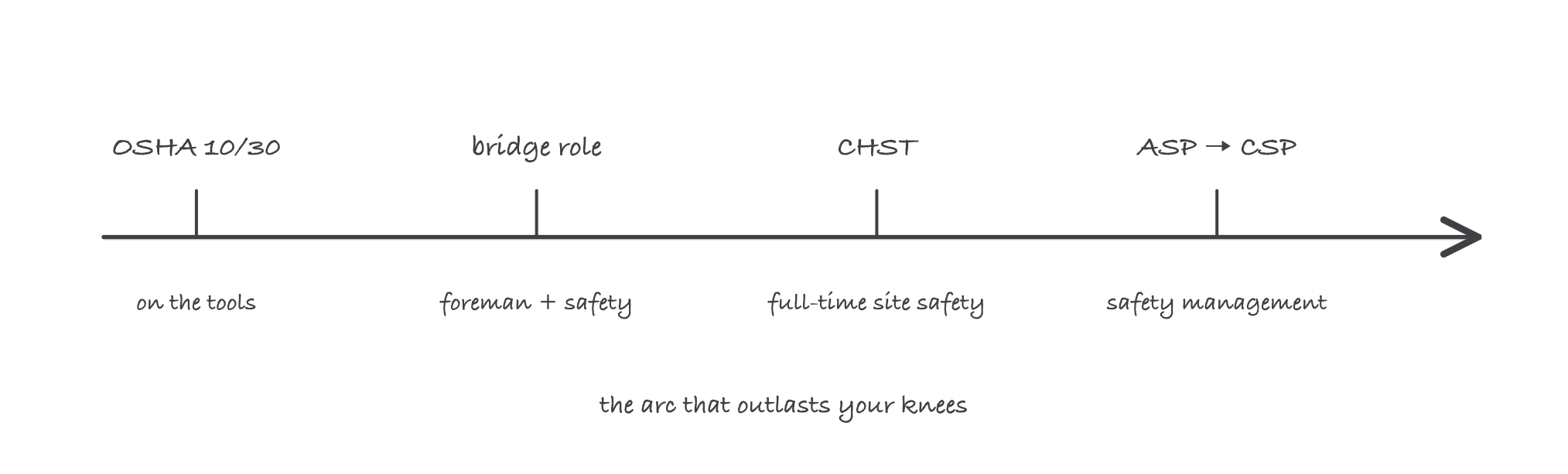
Mid-career is the entry window: credibility banked, runway left
Where it bites
- Waiting too long: the best entry window is mid-career, with credibility banked and enough runway to build the credential ladder before the body demands it.
- Treating the cards as the destination, the OSHA 30 opens the bridge role; the certifications (CHST, CSP) are what make it a career.
Sources
- OSHA Outreach Training Program; Board of Certified Safety Professionals (career-structure facts)
- Bureau of Labor Statistics, occupational health and safety specialists (+12% growth 2024–34)
Verified requirements
| Where | Expires | Renewal | Continuing education |
|---|---|---|---|
| United States (federal) | Confirm with issuer | Confirm with issuer | Confirm with issuer |
| United States (federal) | Confirm with issuer | Confirm with issuer | Confirm with issuer |
| United States (federal) | Confirm with issuer | 5 years | Confirm with issuer |
| United States (federal) | Yes | 5 years | Confirm with issuer |
| United States (federal) | Yes | 5 years | Confirm with issuer |
| United States (federal) | Yes | 5 years | Confirm with issuer |
Information comes from issuing-authority sources. Confirm current rules, fees and eligibility with the authority before acting.