Qualifications · Mold Remediation
Where Mold Work Is Licensed
Assumes you know: What EPA Guidance Is, and Is Not
Mold licensing is jurisdictional. There is no federal mold-remediation license, and the states that regulate the work define their own license categories, exemptions, experience routes, examinations, and separation rules.
*Learn the Trades is a free study resource. We are not a licensing body, an authorized training provider, or an exam administrator. Reading this page does not award any card, license, or certification. Always verify requirements with the issuing authority linked in the sources.*Why it matters on the job
A certification can show that you studied a body of practice. A state license answers a different question: whether the jurisdiction allows you to offer or perform a regulated service there.
The address of the project therefore matters as much as the technician’s resume. Before pricing assessment or remediation, identify the jurisdiction, the activity, the project size, and any applicable exemption.
The structural rule: separate diagnosis from cure
Texas and Florida both separate mold assessment from mold remediation on the same project. The assessor investigates and defines the problem. The remediator performs the corrective work. Keeping those roles apart removes the financial incentive for the company selling the cleanup to define how much cleanup is needed.
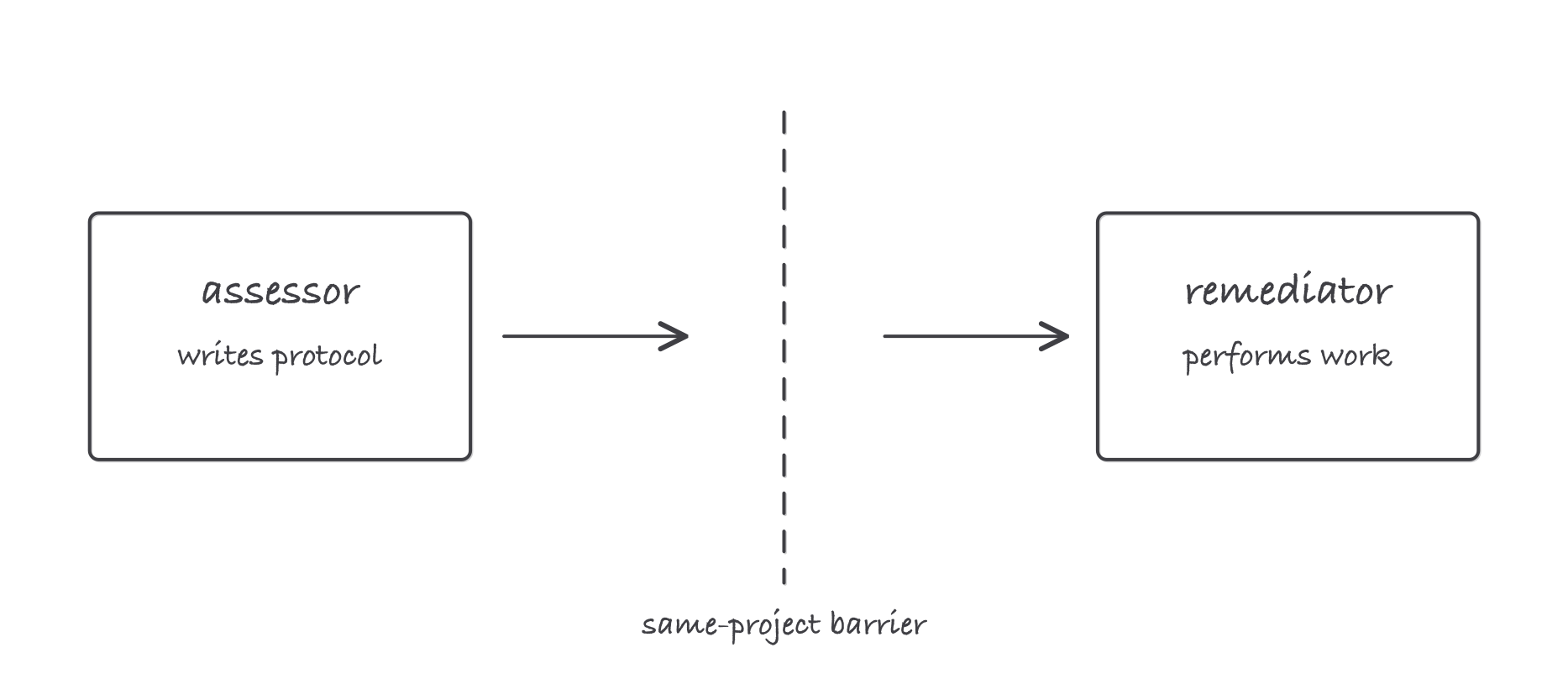
The assessor defines the work; the remediator performs it; the same-project barrier keeps the roles independent
Texas: a category system
Texas regulates a set of individual and company roles through TDLR. The published categories include remediation worker registration, assessment technician, remediation contractor, assessment consultant, assessment company, remediation company, and mold analysis laboratory.
The state also publishes exemptions. TDLR says that visible mold affecting less than 25 contiguous square feet can often be cleaned by an owner or maintenance staff without a license. That is not a universal small-job rule. It is a Texas exemption with conditions, and a licensed remediation contractor hired for a small job still has to follow the rules applying to that licensee.
Texas requires assessment-technician, assessment-consultant, and remediation-contractor applicants to apply before taking the required examination. TDLR reviews the application first, then its exam vendor sends eligibility to schedule.
Florida: two individual licenses
Florida’s DBPR licenses mold assessors and mold remediators as individuals rather than licensing the business itself. Its published initial routes use either a 2-year degree or equivalent with at least 30 semester hours in microbiology, engineering, architecture, industrial hygiene, occupational safety, or a related science plus at least 1 year of field experience, or a high school diploma or equivalent plus 4 years of documented field experience. Applicants also document training, pass an approved examination, and complete the required application and background process.
Those are Florida requirements, not a national template. Texas uses different categories and different qualification routes. A credential held in one place does not answer for another place until the receiving authority says it does.
A concrete exemplar: classify before you quote
A company is asked to inspect a Florida building, write the scope, and then perform the cleanup through the same company 3 months later.
The job contains two regulated activities, assessment and remediation, on one structure inside Florida’s 12-month separation window. The right response is to separate the roles before quoting the work. Calling the first visit a “consultation” does not change the activity if the company is performing an assessment.
Where it bites
- Project location controls. A license question without a jurisdiction is unfinished.
- Assessment and remediation are distinct activities. Changing the invoice description does not change what the work is.
- An exemption is not a trade-wide rule. Texas’s 25-square-foot provision cannot be carried into another state.
- Company and individual licensing differ. Texas has company categories; Florida’s mold program licenses individuals.
- Rules change. Verify the current authority page before relying on a fee, exam, renewal rule, or experience route.
Exam relevance
Questions test classification: assessor versus remediator, individual versus company, license versus registration, and state rule versus federal guidance. Start every scenario by naming the jurisdiction and the activity.
Verified requirements
| Where | Expires | Renewal | Continuing education |
|---|---|---|---|
| Texas | Yes | Confirm with issuer | 8 continuing education hours from a department-approved training provider, taken within the 2 years before the licence expires; the completion certificate goes to TDLR with the renewal |
| Florida | Yes | 2 years (licences expire 31 July of even-numbered years) | 14 hours of general continuing education per biennial licence period, made up of at least 6 hours on water and moisture intrusion, 4 hours on mold and mold safety including respiratory protection, 2 hours on report writing and 2 hours on standards of practice |
Information comes from issuing-authority sources. Confirm current rules, fees and eligibility with the authority before acting.