Qualifications · Mold Remediation
Becoming a Remediation Contractor
Assumes you know: IICRC Certifications
Becoming a mold-remediation contractor means proving the route your jurisdiction recognizes, then building a company that can satisfy the project requirements after the license is issued. Experience, training, examination, insurance, and business structure are separate gates.
*Learn the Trades is a free study resource. We are not a licensing body, an authorized training provider, or an exam administrator. Reading this page does not award any card, license, or certification. Always verify requirements with the issuing authority linked in the sources.*Why it matters on the job
Technical skill gets a wall clean. Contracting adds responsibility for eligibility, insurance, employees, scope control, documentation, and the legal separation between assessment and remediation.
The mistake is treating the license as the whole business plan. A license can be one gate into the work while company registration, insurance, project notifications, and qualified supervision remain separate gates.
Start with the jurisdiction’s route
Texas and Florida show why there is no single national checklist. Both regulate mold remediation, but they organize entry differently.
The four Texas qualification routes pair different education or professional credentials with different experience. The shortest description that stays accurate is this: TDLR accepts a relevant bachelor’s or graduate degree with 1 year of hands-on experience, 60 relevant college credit hours with 3 years, a high school diploma or GED with 5 years, or one of the named professional certifications with 1 year.
Florida’s published route uses either a 2-year degree or equivalent with at least 30 semester hours in microbiology, engineering, architecture, industrial hygiene, occupational safety, or a related science and at least 1 year of field experience, or a high school diploma or equivalent with 4 years of documented field experience. DBPR also requires documented training, an approved examination, the application and fees, a background check, and the required liability coverage.
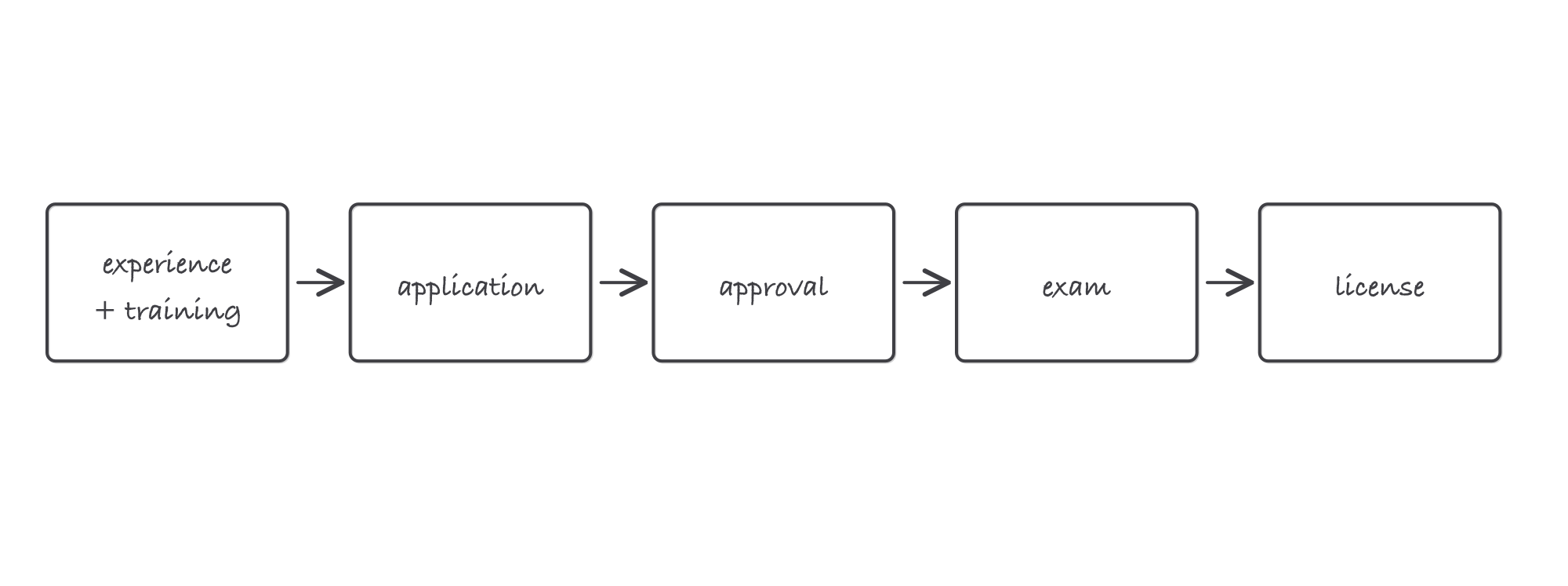
The license is reached through several gates; passing one never skips the others
Build the evidence file before applying
An application is an evidence exercise. “Five years in restoration” is a resume line. The authority wants the documents its application names.
Build the file around the route you are actually claiming:
- education records or the high school equivalency document;
- dates and descriptions supporting the required field experience;
- the required training certificate;
- insurance documents that match the applicant and employer structure;
- any background or identity material the authority requests.
Do not collect evidence for all routes if one route clearly fits. Pick the route, map every requirement to a document, and resolve gaps before paying or scheduling around an approval date.
A concrete exemplar: the Texas high-school route
A Texas applicant has a high school diploma and 5 documented years in allied building work. The sequence is:
- Confirm the experience fits TDLR’s stated allied-field or general-contractor language.
- Complete the department-accredited initial contractor course and retain the certificate.
- Assemble the application, experience evidence, employer and insurance information, and the $450 fee.
- Submit the application and wait for TDLR approval.
- Schedule the examination only after the testing vendor sends eligibility.
The five years do not replace the course, application, fee, insurance evidence, or examination. They satisfy one eligibility route.
Contractor is not assessor
A remediation contractor plans and performs remediation inside the governing protocol and rules. Assessment is a separate professional role in licensing states such as Texas and Florida. Owning the remediation company does not let you redefine the assessment whenever the work becomes inconvenient.
That separation belongs in the business model. Build referral relationships and project handoffs that preserve independence rather than discovering the conflict after a customer has already hired you for both sides.
Where it bites
- Experience has to match the authority’s words. Years near mold work are not automatically qualifying years.
- Insurance follows the actual business structure. A policy has to cover the person or employer the rule addresses.
- Application order matters. In Texas, approval comes before exam eligibility.
- A personal license may not be the only business requirement. Check company, office, supervision, notification, and employee rules separately.
- Do not export one state’s route. Texas and Florida are examples of different systems, not a national ladder.
Exam relevance
Licensing questions test process and scope: which authority issues the license, which route the applicant is using, what evidence belongs to that route, and whether the applicant is confusing remediation contracting with assessment.
Verified requirements
| Where | Expires | Renewal | Continuing education |
|---|---|---|---|
| Texas | Yes | Confirm with issuer | 8 continuing education hours from a department-approved training provider, taken within the 2 years before the licence expires; the completion certificate goes to TDLR with the renewal |
| Florida | Yes | 2 years (licences expire 31 July of even-numbered years) | 14 hours of general continuing education per biennial licence period, made up of at least 6 hours on water and moisture intrusion, 4 hours on mold and mold safety including respiratory protection, 2 hours on report writing and 2 hours on standards of practice |
Information comes from issuing-authority sources. Confirm current rules, fees and eligibility with the authority before acting.