Qualifications · Mold Remediation
IICRC Certifications
Assumes you know: Where Mold Work Is Licensed
IICRC’s Applied Microbial Remediation Technician certification covers mold and sewage remediation techniques. It is a professional certification about demonstrated knowledge, while a state mold license is a jurisdiction’s permission to perform a regulated activity.
*Learn the Trades is a free study resource. We are not a licensing body, an authorized training provider, or an exam administrator. Reading this page does not award any card, license, or certification. Always verify requirements with the issuing authority linked in the sources.*Why it matters on the job
The two questions arrive together in hiring and sales: “Does the technician know the work?” and “May the technician legally perform it here?” AMRT speaks to the first question. A licensing authority answers the second.
Keeping those questions separate protects you from two errors. You do not dismiss training because a state license exists, and you do not treat training as permission to ignore a state license.
What AMRT covers
IICRC says AMRT emphasizes mold and sewage remediation techniques for people working in property management, property restoration, indoor-environment investigations, and related professions. Its public description also connects the work to protecting workers and occupants.
S520 is the related professional mold-remediation standard. Its public scope includes the building, materials, health and safety, documentation, structural and HVAC remediation, contents, and post-remediation verification.
Certification and license travel differently
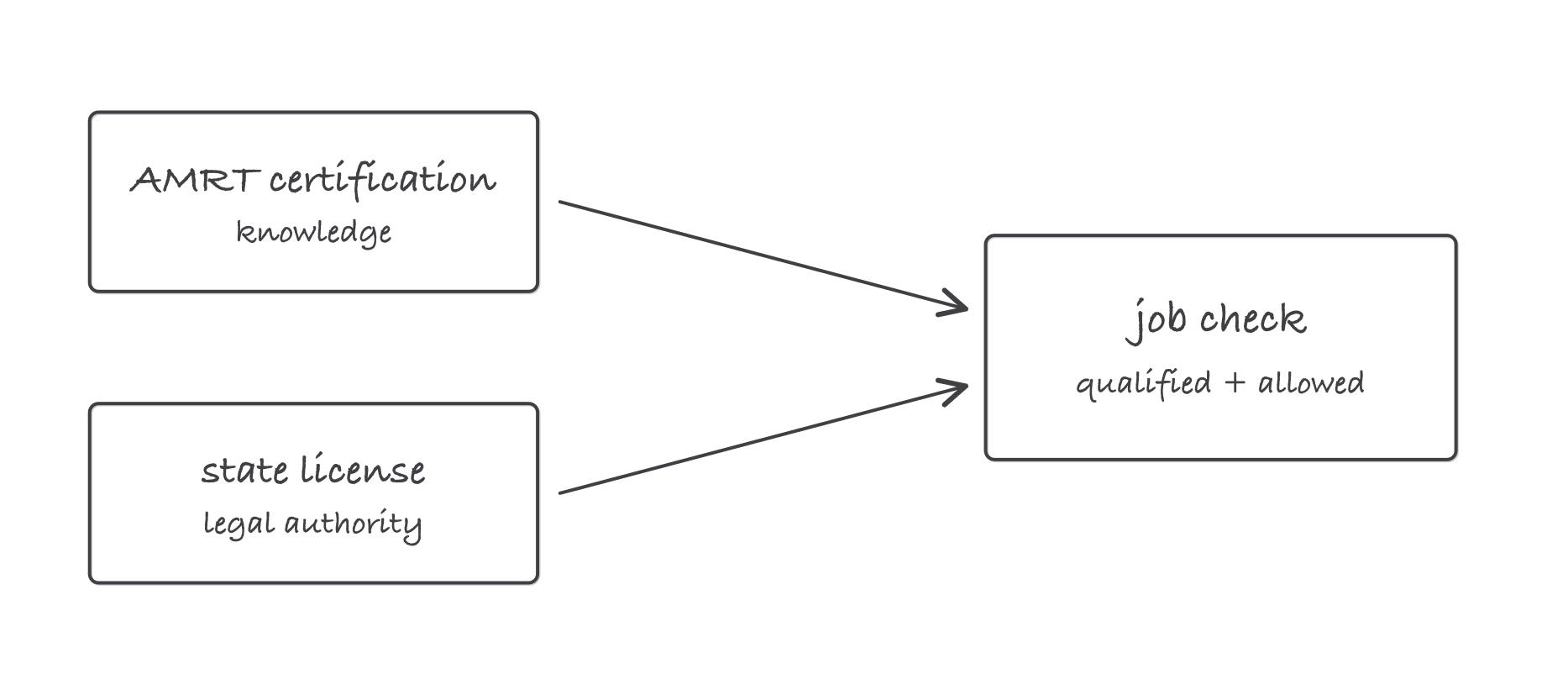
A job can demand two checks: professional knowledge and jurisdictional authority
An IICRC certification follows the certification holder under IICRC’s rules. A state license belongs to the jurisdiction that issued it and the scope that jurisdiction defined. Crossing a state line can therefore leave the certification unchanged while changing the licensing answer completely.
The same distinction applies inside one company. A company may employ certified technicians but still need the correct licensed individual, licensed company, insurance, protocol, or notification for a regulated project. The project file has to show the requirements that actually apply there.
A concrete exemplar: the qualified technician in a new state
An AMRT-certified technician is sent to estimate remediation work in a state that licenses mold remediators.
The AMRT remains relevant evidence of training. It does not settle whether the technician may offer, supervise, or perform that state’s regulated service. Before the estimate becomes a contract, the company checks the state authority’s license categories, scope, company rules, and exemptions.
If the state does not license mold work, the certification still does not become a government license. It remains a professional certification that can be required by an employer, client, contract, or insurer.
Choosing the right source
Use IICRC for the current AMRT certification details and the current S520 edition. Use the state authority for legal scope and licensing. Use the project documents for the acceptance criteria and responsibilities on one job.
When one source is silent, do not let another source answer a different question. A state FAQ does not define the AMRT exam, and an AMRT page does not define a state exemption.
Where it bites
- Certification and licensure are not synonyms. Name which one the job actually requires.
- A course is not the certification. Use IICRC’s current process rather than assuming attendance alone determines the credential.
- A certification is not a project protocol. It does not define the scope or acceptance criteria for one property.
- Public source detail has a ceiling. If IICRC’s public page does not state an exam number or renewal rule, verify it with IICRC rather than repeating a training provider’s summary.
Exam relevance
Expect the distinction between professional certification, consensus standard, state license, and project protocol. For AMRT itself, study the current IICRC materials rather than relying on a static third-party outline.