Qualifications · Construction Safety
The Safety Trained Supervisor Certification
Assumes you know: OSHA 30: What It Covers
Completing a two-year trade or union apprenticeship satisfies the experience requirement for the Safety Trained Supervisor certification on its own. BCSP lists four ways to meet that requirement and a finished apprenticeship is one of them, standing level with two years of supervisory experience or an associate degree in safety. For a journeyman who has been running the toolbox talks for years without a title, that route is already finished before the application starts.
*Learn the Trades is a free study resource. We are not a licensing body, an authorized training provider, or an exam administrator. Reading this page does not award any card, license, or certification. Always verify requirements with the issuing authority linked in the sources.*Who BCSP built it for
BCSP describes the STS candidate as someone whose safety responsibilities are “adjunct, collateral, or ancillary” to their job duties, with a main job in a craft or trade, a technical specialty, supervision, management or leadership. The listed duties are the ones a working foreman already carries: hazard monitoring, regulatory compliance, employee training, safety documentation, coordinating corrections for identified hazards, and talking to safety specialists or management.
That description matters because it is the gap the STS fills. The CHST is aimed at people doing construction safety as their job. The STS is aimed at people doing safety as part of a different job, which is what the trades actually look like.
All BCSP certifications are accredited by the ANSI National Accreditation Board (ANAB) to the ISO/IEC 17024 standard for personnel certification, and that accreditation is an audit of the certifying body rather than of any individual holder. It covers fairness in testing, impartiality in the process, independence in governance, validated examination content, and security and confidentiality. That is the structural difference between a certification and a course completion: somebody outside the organization checks how the exam was built.
What BCSP requires
Two things, then the exam:
At least 30 hours of safety, health, and environmental training.
One of four experience routes:
- two years of supervisory experience, or
- four years of work experience in any industry (BCSP sets a minimum of part-time work at 18 hours per week for the experience to qualify), or
- an associate degree or higher in occupational safety, risk management, or construction management, or
- completion of a two-year trade or union training program or apprenticeship
Then passing the STS examination, and after that maintaining the certification through an annual renewal fee and recertification requirements. Applicants also have to disclose criminal convictions and any action against a professional license or credential; BCSP reviews that confidentially and can deny an application on it.
Read the second route carefully, because it is more open than it looks. Four years in any industry qualifies, and the bar for what counts as work is 18 hours a week, which against a 40-hour week is 18 ÷ 40 = 45%. Half-time work in any trade, for four years, meets it.
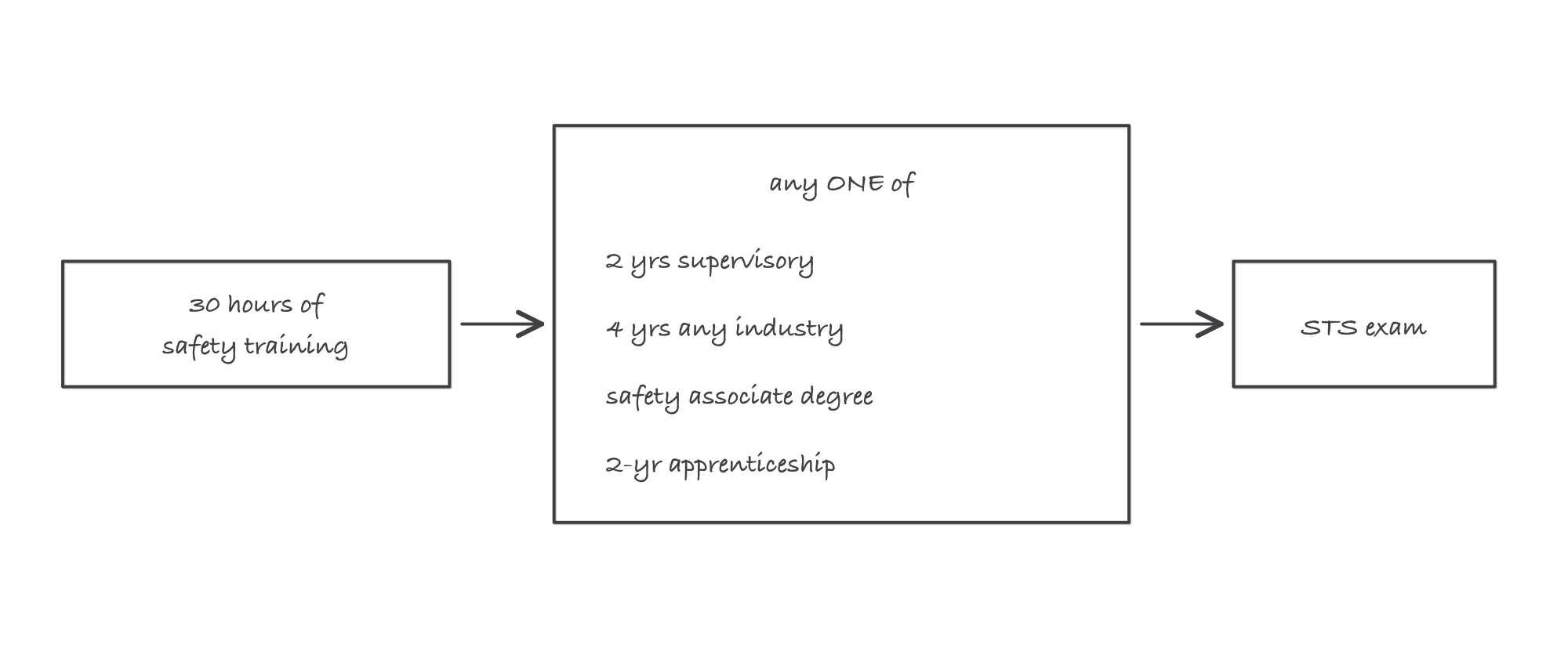
Both gates, in order: the training hours, then exactly one of the four experience routes
What the exam covers
BCSP publishes an STS examination blueprint (currently STS5, version 2025.07.15) with six weighted domains:
| Domain | Weight |
|---|---|
| Life Critical Activities | 22% |
| Hazard Awareness | 20% |
| Hazard Controls | 20% |
| Safety Program Implementation and Management | 15% |
| Basic Industrial Hygiene | 12% |
| Emergency Preparedness and Management | 11% |
Life Critical Activities carries the heaviest weight, and its seven listed items are the hazards this trade teaches, almost line for line: electrical hazards, confined space hazards, fall hazards, isolation of hazardous energy, ladder safety, fire protection systems, and the risks in hoisting and rigging. Hazard Awareness and Hazard Controls together are another 40%, and their items are inspections and corrections, stop work authority, safety audits, the hierarchy of controls, risk assessment and machine safeguarding.
What BCSP does not publish on the STS page is a question count or a passing score. Pull the current blueprint PDF from bcsp.org and study the weights, because the blueprint is versioned and BCSP revises it. Where a number of questions or a cut score turns up on a training site, it did not come from BCSP.
Worked example: when the first recertification is actually due
BCSP recertification cycles run five years, starting July 1 and ending June 30 of the fifth year, and for a new certificant the first cycle completes on the June 30 following five years. That is not the same as a five-year anniversary, and the difference is worth working out before you plan around it.
Take someone who certifies in October 2026:
- Five years from October 2026 is October 2031.
- The June 30 that follows October 2031 is June 30, 2032.
- The recertification worksheet is due no later than the July 31 after the cycle ends, so July 31, 2032.
- Elapsed time from certification: October 2026 to June 2032 is 5 years and 8 months.
Now run the same arithmetic on a certification dated mid-June 2026. Five years lands in mid-June 2031, the June 30 that follows is June 30 of that same year, and the first cycle is barely 5 years long. Certify a few weeks later, in early July 2026, and five years lands in July 2031, the next June 30 is June 30, 2032, and the first cycle runs 5 years and 11 months.
Two certifications a few weeks apart, first cycles almost a year different in length. Points are earned across the cycle either way, so the practical reading is to log activities as you complete them rather than counting down from an anniversary that is not the deadline.
Where it bites
- Two different 30s. An OSHA 30-hour Outreach card is 30 hours of training and BCSP asks for at least 30 hours of safety, health and environmental training, and BCSP’s STS page does not state that one satisfies the other. Ask BCSP how your training should be documented before you assume the card covers the requirement.
- The STS and the STSC are separate credentials. BCSP lists Safety Trained Supervisor and Safety Trained Supervisor Construction as two entries with their own pages and their own requirements. Compare both on bcsp.org before applying rather than assuming the construction variant is the same credential with a suffix.
- A certification is not a designation. Passing the STS does not make you the competent person for any OSHA standard. That designation is made by your employer, for a specific activity, and it needs both the ability to identify the hazard and the authority to stop the work (Competent Person and Qualified Person covers the definition). The certification is evidence of knowledge; the authority comes from the employer.
- The clock starts at approval, not at the exam. You have one year from approval of your application to take and pass, and BCSP requires at least six weeks between attempts. Book a first attempt in month 11 and there is no room left for a second one inside the year.
- The annual fee is not optional. BCSP assesses a fee every year to retain use of the credential, separate from the five-year recertification points. Lapse on either and the letters go away.
Preparing
The exam is written against a supervisor’s view of a site rather than a specialist’s, so study the material as decisions rather than facts. The blueprint verbs are the tell: identify, apply, describe, determine. It asks whether you can recognize a confined space hazard and act on it, not whether you can recite 1926.1202.
The logistics are straightforward. BCSP publishes current fees on its Credentials At-A-Glance PDF, and the STS examination stood at $185 for a single examination when this was written, bought either bundled with the application or after approval. Exams run on computer at Pearson test centers and the official result comes up as soon as you submit.
The study itself maps onto this trade’s material directly. The Focus Four pages, the site hazard pages (scaffolding, excavation, confined spaces, silica) and the protection systems pages cover Life Critical Activities and Basic Industrial Hygiene between them. Hazard Controls is the hierarchy of controls applied over and over. Safety Program Implementation is the employer-duties and recordkeeping material, read from the position of the person who has to make the program work at 6:30 on a Tuesday morning with two crews waiting.
Verified requirements
| Where | Expires | Renewal | Continuing education |
|---|---|---|---|
| United States (federal) | Yes | 5 years | Confirm with issuer |
Information comes from issuing-authority sources. Confirm current rules, fees and eligibility with the authority before acting.