Qualifications · Construction Safety
The ASP and the Route to the CSP
Assumes you know: The CHST Certification
The CSP has three requirements that have to be satisfied at the same time, and one of them is a credential you must already hold. BCSP asks for a bachelor’s degree, four years of safety, health and environment experience, and a BCSP Qualified Credential. That third item is required in every route, not in most of them. The ASP is the qualifying credential built for the person whose route in is a degree plus a year of professional safety work.
*Learn the Trades is a free study resource. We are not a licensing body, an authorized training provider, or an exam administrator. Reading this page does not award any card, license, or certification. Always verify requirements with the issuing authority linked in the sources.*Why the order is fixed
You cannot sit the CSP and pick up the qualifying credential afterward. It is an eligibility condition, checked before BCSP approves the application, which means the ASP is not an optional warm-up. It is the step that makes the next step possible, and anyone planning a route to the CSP is really planning two exams with a gap between them.
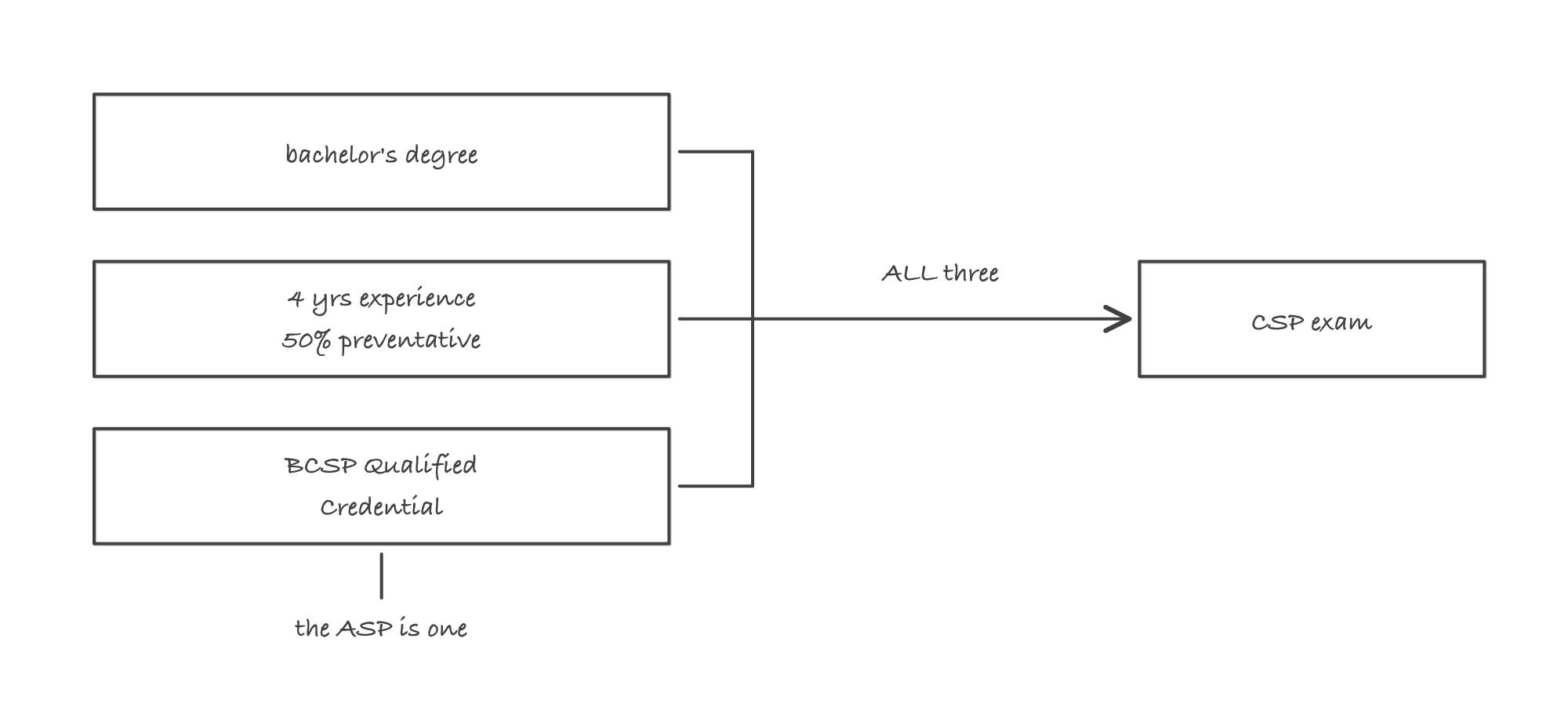
Three requirements at once, and the third is a credential you have to be holding before you apply
What the ASP requires
Education, at minimum one of:
- a bachelor’s degree in any field, or
- an associate degree in safety, health, or the environment, which must include at least four courses carrying at least 12 semester hours (18 quarter hours) of study in the safety, health or environmental domains covered by the ASP examination blueprint
Experience: one year of safety, health and environment experience, at least 50% of which is or was preventative, professional level work with breadth and depth of safety duties.
Then passing the ASP examination, and maintaining the certification through an annual renewal fee and recertification. A degree earned outside the United States is evaluated for US equivalency as part of the application, and BCSP publishes what it needs from you to do that, so check how your school and program are treated before you count on them.
The education test is the lower bar of the two. A bachelor’s degree in any field satisfies it, so the degree is a threshold rather than a subject requirement. The experience line is where applications actually turn.
Worked example: what the 50% test asks for
The requirement is not a year spent near safety. It is a year in which at least half the work was preventative, professional level safety work with breadth and depth.
Run it against a 40-hour week, where half is 20 hours. Take a superintendent whose safety duties are the weekly site safety walk (4 hours), two toolbox talks (1 hour), writing up inspections and corrections (3 hours) and the project safety meeting (2 hours):
4 + 1 + 3 + 2 = 10 hours a week, and 10 ÷ 40 = 25%.
That is half of what the test asks. Closing it takes 20 - 10 = 10 more hours a week of preventative professional level work, which is not something you find by working harder on the same job. It is a different job description, and it usually arrives with a different title.
The same 50% test then reappears on the CSP across four years instead of one, so the number to work out before choosing a route is not how many years you have been on construction sites. It is what fraction of your hours were preventative professional level safety work, and whether an employer will describe them that way in writing.
What the exam covers
BCSP publishes an ASP examination blueprint (currently ASP11, version 2024.04.24) with nine weighted domains:
| Domain | Weight |
|---|---|
| Safety Programs and Concepts | 25% |
| Fire Prevention and Protection | 12% |
| Industrial Hygiene and Occupational Health | 12% |
| Training, Education, and Communication | 11% |
| Mathematical Calculations | 10% |
| Emergency Preparedness and Response | 10% |
| Ergonomics | 8% |
| Environmental Management | 7% |
| Legal | 5% |
BCSP numbers Mathematical Calculations as Domain 1, so it is the first thing the blueprint puts in front of you, and its sixteen listed tasks are specific: rigging and load calculations, slope angle and depth ratio for trenching, noise and time-weighted averages, fall protection parameters (free fall distance, maximum arresting force, total fall distance and clearance), incidence rates, the NIOSH lifting equation, descriptive statistics and unit conversions. Most of that arithmetic already appears in the fall protection, excavation and silica material: free fall against clearance, slope ratio against spoil setback, and an eight-hour average built from two four-hour halves.
Domain 1 is still only 10% of the weighting. Safety Programs and Concepts is 25%, and its items are management systems, hazard and risk analysis methods, risk matrices, GHS, hazardous energy control, incident investigation and the leading-versus-lagging indicator distinction.
BCSP does not publish a question count or a passing score on the ASP page. It publishes the blueprint, and the blueprint is versioned, so pull the current PDF from bcsp.org rather than working from a copy.
The Qualified Credential list is longer than the ASP
BCSP names thirteen credentials that satisfy the CSP’s Qualified Credential requirement. Alongside the ASP it includes BCSP’s own Graduate Safety Practitioner and Transitional Safety Practitioner, the Certified Industrial Hygienist, the Canadian Registered Safety Professional, chartered membership and chartered fellowship of IOSH, the NEBOSH National and International Diplomas, and several national credentials issued outside the United States.
Someone arriving in US construction with a NEBOSH Diploma or a CRSP may already hold the qualifying credential and need only the degree and the experience behind it. BCSP also states that all education requirements still have to be met when pursuing the CSP, so a qualifying credential never stands in for the degree.
Where it bites
- The qualifying credential is required in every route. It is not a common option or a recommended stepping stone; there is no CSP route without one. Anything that describes it as usual rather than required will cost you an application cycle.
- The associate degree route is narrow. It has to be in safety, health, or the environment, and it has to carry at least four courses totaling 12 semester hours (18 quarter hours) in blueprint domains. A general associate degree in another field does not open that door, and a bachelor’s degree in any field does.
- Mathematical Calculations is one domain in nine. Drilling arithmetic while leaving program material alone trades a 25% domain for a 10% one. Work the calculations until they are automatic, then spend the remaining time on management systems and hazard analysis methods.
- Nobody outside BCSP knows the cut score. BCSP publishes domain weights, and it does not publish a question count or a passing score. Treat any specific figure you meet elsewhere as an estimate somebody made, and note that the blueprint carries a version date because its contents move.
- Experience is not stated to stack. BCSP lists one year for the ASP and four for the CSP separately and does not say on these pages how the two are counted against each other. Ask BCSP directly rather than assuming your ASP year is banked toward the CSP total.
- Neither one is a license. The ASP and the CSP are certifications issued by a private board, and no state licenses construction safety officers. They evidence competence against a published standard and are maintained by recertification; they grant no legal authority to do work others may not.
Preparing
Prepare for the ASP the way you would prepare for a design exam rather than a site exam. The CHST and STS ask what the hazard is and what to do about it. The ASP asks which analysis method fits the problem, what the system should look like, and what the numbers come out at.
On cost and scheduling, BCSP keeps current fees on its Credentials At-A-Glance PDF, and the ASP examination stood at $350 for a single examination when this was written. Approval starts a one-year window to take and pass, attempts have to be at least six weeks apart, and the exam runs on computer at a Pearson test center with the result on screen at submission.
A workable sequence is to close the calculation gap first, because it is the one part you can grade yourself on without a proctor, then work outward into Safety Programs and Concepts, which carries a quarter of the weighting on its own. Fire prevention, industrial hygiene and ergonomics add another 12 + 12 + 8 = 32%, and for anyone coming off construction sites those three are usually the thinnest ground. Budget the time by the weights, not by how interesting the domain is.
Verified requirements
| Where | Expires | Renewal | Continuing education |
|---|---|---|---|
| United States (federal) | Yes | 5 years | Confirm with issuer |
Information comes from issuing-authority sources. Confirm current rules, fees and eligibility with the authority before acting.